Chef Juliette
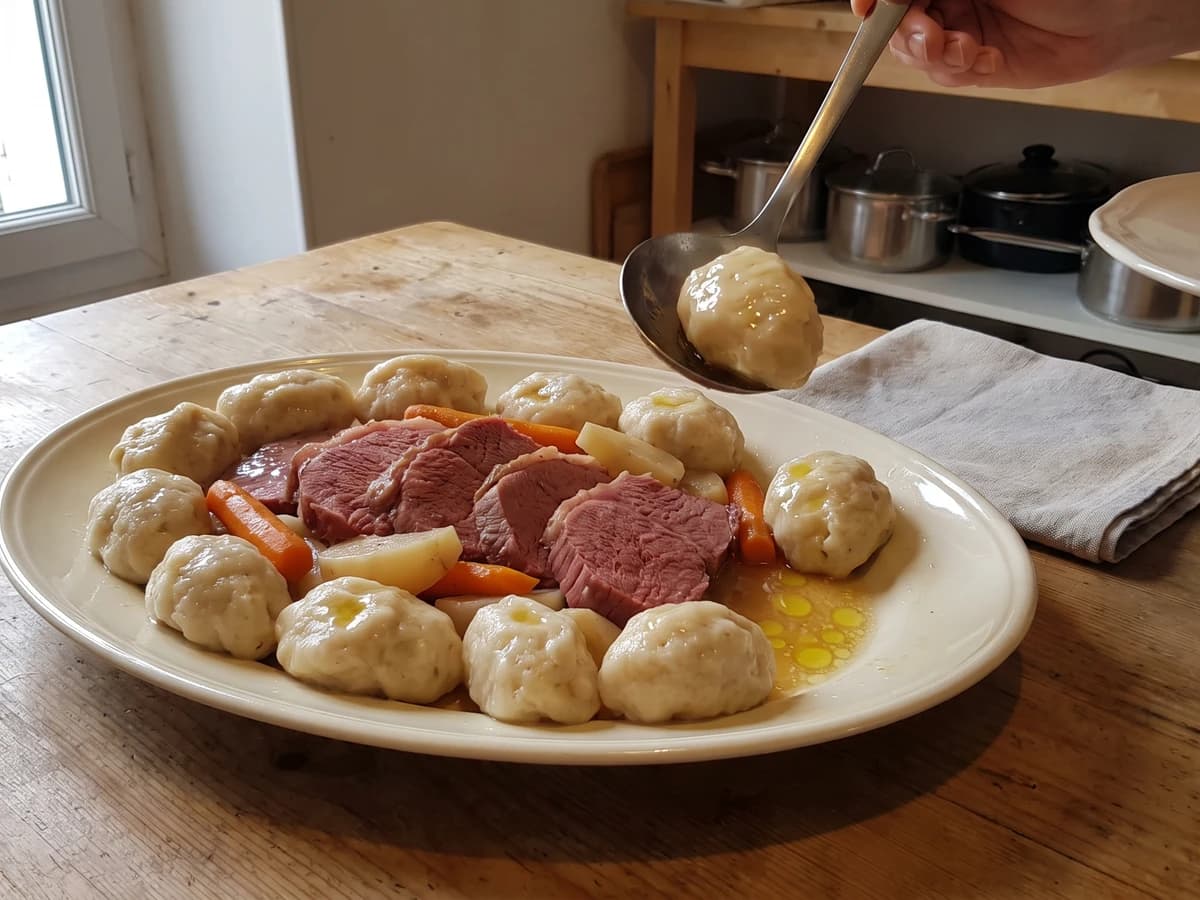
Suet Dumpling
Boulettes au suif, poached beside salt beef, turn equal weights of flour and finely chopped suet into tender, rich dumplings. Keep the beef liquor at a bare tremble and the old garnish works beautifully at home.
A cooking platform built around craft, culture, and the stories behind what we eat.

Created by Chef Juliette
Based on No. 2245, Pommes de Terre Suzette, from Le Guide Culinaire (1907) by Auguste Escoffier
Pommes de Terre Suzette turn four potatoes into little lidded eggs, their shells refilled with buttery yolk-rich pulp and a fine salpicon of chicken, tongue, truffle, and mushroom, then baked until softly set.
Pommes de Terre Suzette (lidded, stuffed potato eggs) teach structure. The shell is not packaging; it is the dish. Leave walls thick enough to stand but thin enough that each forkful carries plenty of buttery filling, and keep every little cap paired with the potato it fits.
The old grand kitchen might have had a saucier at the next station, stock never off the fire, and a salamander broiler over the range, but this entry calls on none of them. What it did assume was a garde-manger stocked with cooked chicken, tongue, truffle, and mushrooms, plus a commis to turn a tray of potatoes into perfect eggs. At home, four evenly sized Yukon Gold potatoes fill the role of the source's fine Dutch potatoes, a paring knife does the turning, and an ordinary oven supplies both bakings. The pulp is scaled to one pound so the original proportion of two ounces of butter and two yolks remains intact. One cook, one stove, one evening.
Cooking a chicken breast and a whole tongue expressly for a few spoonfuls is brigade scaffolding, so good plain leftovers and a slice of cooked tongue from the butcher are honest equivalents. The even salpicon, turned shells, hot enrichment, fitted lids, ten-minute return to the oven, and melted-butter glaze must stay. Those steps are the dish.
Hollow the potatoes while they're hot, leaving an even ¼-inch wall. Cold pulp turns stubborn, and an over-thinned shell collapses; that is the step that decides the Suzette before the filling ever meets it.
Pommes de Terre Suzette belong to the Parisian grand-kitchen repertoire rather than to a regional farmhouse table, where precisely turned vegetables and small salpicons served as demonstrations of disciplined knife work. The filling shows the economy beneath the grandeur: modest quantities of cooked chicken, tongue, mushroom, and truffle from the working pantry are gathered into a luxurious second life. Despite the shared name, the dish has no technical kinship with crêpes Suzette: there is no orange, liqueur, or flambé, only a potato preparation built around shape, stuffing, and service.
Quantity
4 (about 2 lb / 900 g total; enough to yield about 1 lb / 454 g baked pulp)
Quantity
¼ cup (60 ml / 57 g)
softened
Quantity
2
Quantity
3 tablespoons (45 ml / 45 g)
at room temperature
Quantity
¼ cup (60 ml / 40 g)
cut into ⅛-inch dice
Quantity
3 tablespoons (45 ml / 30 g)
cut into ⅛-inch dice
Quantity
¼ cup (60 ml / 35 g)
well drained and cut into ⅛-inch dice
Quantity
1 tablespoon (15 ml / 10 g)
cut into ⅛-inch dice
Quantity
¾ teaspoon (3.75 ml / 4.5 g)
Quantity
⅛ teaspoon (0.6 ml / 0.3 g)
Quantity
1 tablespoon (15 ml / 14 g)
melted
| Ingredient | Quantity |
|---|---|
| large oval yellow-fleshed potatoes, such as Yukon Gold | 4 (about 2 lb / 900 g total; enough to yield about 1 lb / 454 g baked pulp) |
| unsalted butter for the fillingsoftened | ¼ cup (60 ml / 57 g) |
| large egg yolks | 2 |
| heavy creamat room temperature | 3 tablespoons (45 ml / 45 g) |
| cooked white meat of chickencut into ⅛-inch dice | ¼ cup (60 ml / 40 g) |
| cooked tonguecut into ⅛-inch dice | 3 tablespoons (45 ml / 30 g) |
| cooked button mushroomswell drained and cut into ⅛-inch dice | ¼ cup (60 ml / 35 g) |
| black truffle, fresh or preservedcut into ⅛-inch dice | 1 tablespoon (15 ml / 10 g) |
| fine salt | ¾ teaspoon (3.75 ml / 4.5 g) |
| ground white pepper | ⅛ teaspoon (0.6 ml / 0.3 g) |
| unsalted butter for glazingmelted | 1 tablespoon (15 ml / 14 g) |
Heat the oven to 400°F (200°C) with a rack in the middle. Peel the potatoes, then use a small paring knife to turn each into a smooth egg shape, tapering one end and rounding the other. Slice only enough from the broad end to make a level base, then stand each potato up to check it. Keep the trimmings for soup or a purée; throwing them away improves nothing.
Set the turned potatoes on an ungreased rimmed baking sheet and bake for 45 to 55 minutes. They are ready when a thin skewer enters the centre with almost no resistance, while the outside remains firm enough to handle. If the centre still grips the skewer, give them another 5 to 8 minutes. An underbaked potato tears as you scoop and leaves hard grains in the filling; more oven time corrects it completely.
While the potatoes bake, combine the chicken, tongue, mushrooms, and truffle. This is the salpicon, a mixture cut into fine, even dice so every spoonful carries all four ingredients. Keep the pieces near ⅛ inch rather than chopping them to paste, and make certain the mushrooms and preserved truffle are well drained. Wet ingredients loosen the potato filling and blur its flavour.
Working while the potatoes are hot, steady each one in a folded towel and cut off its pointed upper quarter as though opening a boiled egg. Keep every cap beside its matching shell. Scoop the pulp into a warm bowl, leaving an even ¼-inch (6 mm) wall and an intact base. Weigh out 1 lb (454 g) of pulp, reserving any excess. If a shell splits, don't discard it. Ça se rattrape: support it in a snug ramekin for the final baking and serve it there with confidence.
Pass the hot pulp through a potato ricer or work it thoroughly with a sturdy fork. Fold in the softened butter, then the yolks, salt, and white pepper. Add 2 tablespoons of the cream, fold in the salpicon, and judge the texture before adding the final spoonful. The filling should be soft and generous but still hold a mound. If it seems stiff, add the remaining cream a teaspoon at a time; if it turns slack, let it stand for 2 minutes, then fold in a little reserved potato pulp. Ça se rattrape. Never use a food processor here, which works the starch into glue.
Spoon the warm filling into the shells without compressing it, mounding it just enough to meet the caps. Replace each cap in its original position and return the potatoes to the baking sheet. Bake at 400°F (200°C) for 10 minutes, until the filling is hot through and softly set around the edges but not browned. The ordinary oven is doing exactly what the original intended: warming and setting, not gratinating.
Move the potatoes to a warm serving dish and brush or spoon the melted butter over every surface, including the caps. The glaze should leave them butter-gold and softly gleaming, not greasy. Carry them to the table at once, while the shells stand proudly and the filling remains light. À table!
1 serving (about 240g)
Culinary guides, cultural storytelling, and the editorial depth that makes cooking meaningful.
Discover Culinary ExplorerChef Juliette
Boulettes au suif, poached beside salt beef, turn equal weights of flour and finely chopped suet into tender, rich dumplings. Keep the beef liquor at a bare tremble and the old garnish works beautifully at home.

Chef Juliette
Bread, flour, frangipane, and rice become four cool, supple panades for binding forcemeats, each changing body and flavor while preserving tenderness. The finest Mousselines need none, and knowing that distinction is the lesson.

Chef Juliette
Panade au pain is bread, milk, salt, heat, and attention: stir until the paste releases cleanly, butter it against a skin, and you have the quiet binder behind tender French farces.

Chef Juliette
Panade de farine teaches the drying stroke behind pâte à choux: flour meets boiling buttered water, then stays over the fire until the paste gathers, smooths, and quits the pan cleanly.