Chef Juliette
Suet Dumpling
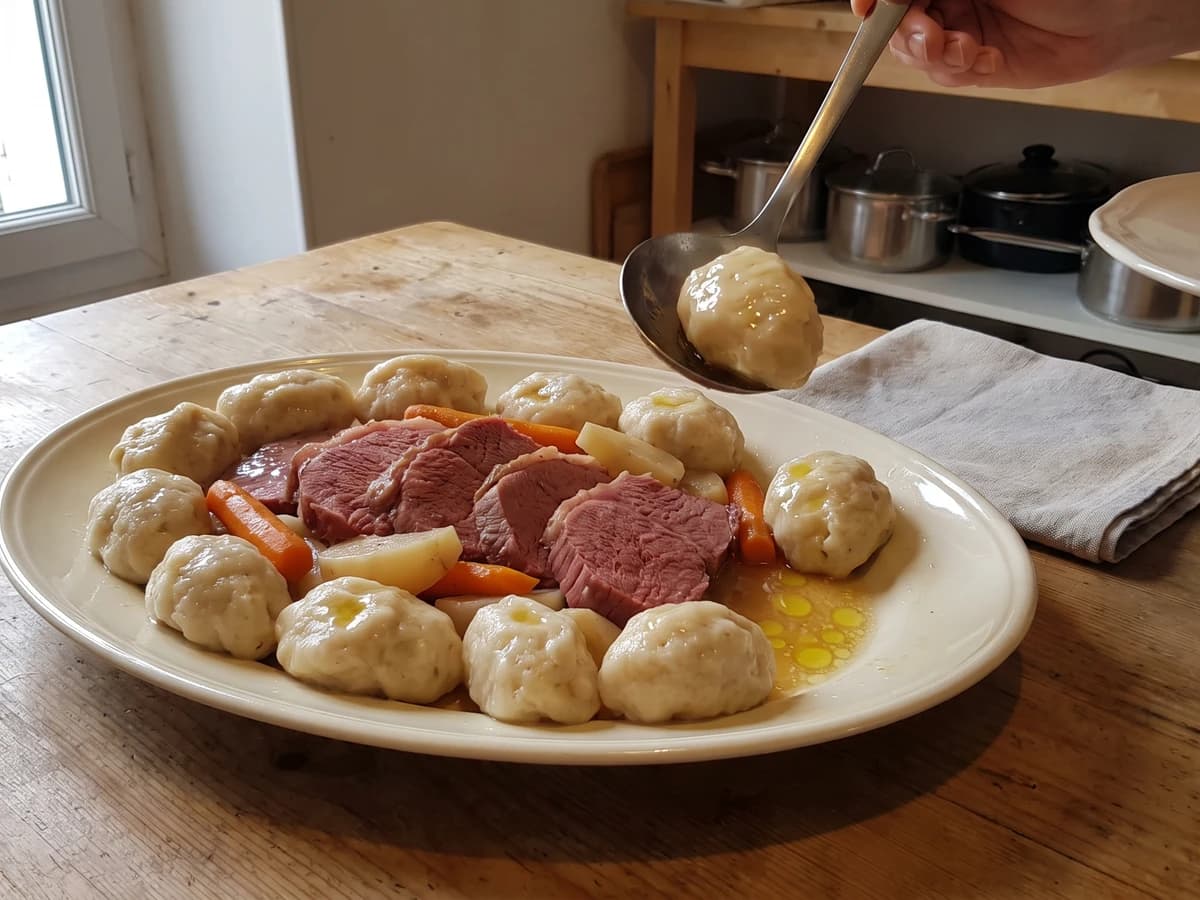
Boulettes au suif, poached beside salt beef, turn equal weights of flour and finely chopped suet into tender, rich dumplings. Keep the beef liquor at a bare tremble and the old garnish works beautifully at home.
A cooking platform built around craft, culture, and the stories behind what we eat.

Created by Chef Juliette
Based on No. 2240, Pommes de Terre Robert, from Le Guide Culinaire (1907) by Auguste Escoffier
Pommes de Terre Robert makes one decisive lesson of baked potato: keep the Macaire mixture dry, enrich it with eggs and chives, then brown the galette patiently until the crust releases.
Pommes de Terre Robert (a Macaire potato galette bound with whole eggs and chives) teaches the discipline behind every skillet galette: the potato must be dry before enrichment, and the first crust must set before you ask it to move. Start with baked starchy potatoes, not boiled ones. Water makes paste where you want a tender, buttery crumb.
The source assumes a Pomme Macaire composition already waiting at the potato station, then gives the Robert addition by the pound. A home kitchen has no tray of Macaire at the ready, and this dish never needed a saucier, a perpetual stockpot, or a salamander. So the brigade scaffolding goes: 415 grams of baked flesh and 39 grams of butter make the one-pound Macaire base, then the source's three whole eggs and large pinch of chives go in. The large pinch becomes one measured tablespoon for repeatability, and a plate turn replaces the line cook's midair flip. The proportions and the frying-pan galette remain untouched because they are the dish. One cook, one stove, one evening.
The finished Robert should arrive as one generous round, deeply butter-gold outside, pale and soft within, with green chive flecks through every wedge. Give the first side time. If you pry before the crust releases, the galette tears; if you wait until the pan lets it travel as one piece, the turn becomes almost calm.
Pommes de Terre Robert belongs to the national classical repertoire of composed potato garnishes, not to a particular regional larder. Its parent is Pomme Macaire, baked potato flesh worked with butter and browned as a galette; the Robert variation folds in three whole eggs per pound and chopped chives, then returns the composition to the same frying pan. Despite the shared surname, it has nothing to do with Sauce Robert: here the eggs make it hold, and the chives make it Robert.
Quantity
3 large, about 1½ pounds (680 g), yielding 2⅔ lightly packed cups (630 ml / 415 g) baked flesh
baked, split, and scooped
Quantity
2¾ tablespoons (41 ml / 39 g)
softened
Quantity
3
Quantity
1 packed tablespoon (15 ml / 3 g)
finely chopped
Quantity
¾ teaspoon (3.75 ml / 4.5 g)
Quantity
¼ teaspoon (1.25 ml / 0.6 g)
Quantity
3 tablespoons (45 ml / 42 g)
divided
| Ingredient | Quantity |
|---|---|
| starchy baking potatoesbaked, split, and scooped | 3 large, about 1½ pounds (680 g), yielding 2⅔ lightly packed cups (630 ml / 415 g) baked flesh |
| unsalted buttersoftened | 2¾ tablespoons (41 ml / 39 g) |
| large whole eggs | 3 |
| fresh chivesfinely chopped | 1 packed tablespoon (15 ml / 3 g) |
| fine sea salt | ¾ teaspoon (3.75 ml / 4.5 g) |
| freshly ground white pepper | ¼ teaspoon (1.25 ml / 0.6 g) |
| clarified butterdivided | 3 tablespoons (45 ml / 42 g) |
Heat the oven to 220°C / 425°F. Scrub and dry the potatoes, prick each a few times, and bake them directly on the oven rack for 50 to 65 minutes, until a thin knife enters without resistance and the skins feel dry and firm. Do not wrap them in foil. A bare skin lets moisture escape, which gives the Robert its tender interior instead of a gluey one.
Split the potatoes as soon as you can handle them and scoop out the flesh. Pass it through a potato ricer, or press it gently through a medium-mesh food mill, onto a wide tray. Weigh out 415 g, keeping any extra dry flesh nearby for rescue. While the measured potato is still warm, fold in the 39 g softened butter, salt, and white pepper without beating. This is the Pomme Macaire composition, one pound before its light seasoning. Spread it out and let it cool for 10 to 15 minutes, until no warmer than your hand; hot potato would begin cooking the eggs before the pan does.
Beat the whole eggs only until no ropes of white remain. Fold them into the cooled Pomme Macaire composition in three additions, then fold in the chopped chives. Work gently and stop as soon as the mixture is even. It should be soft and spoonable but still hold a low mound. If it flows like cream, the potatoes carried too much moisture. Chill the mixture for 15 minutes; if it remains loose, fold in the reserved dry potato one tablespoon at a time until it holds. Ça se rattrape.
Warm a heavy 23 cm / 9-inch frying pan over medium heat for 2 minutes. Add half the clarified butter and turn the pan to coat it. Spoon in the potato mixture and spread it into an even galette about 1.5 cm / ⅝ inch thick, smoothing the top without compressing it. Lower the heat to medium-low and cook for 10 to 12 minutes. Leave it alone until the rim looks set and deep gold. If it clings when you test the edge, do not force it; lower the heat slightly and give it another 2 minutes. A properly formed crust releases from a properly buttered pan.
Set a flat plate wider than the pan over the galette. Holding pan and plate firmly with dry towels, invert them together. Return the empty pan to medium-low heat, add the remaining clarified butter, and slide the galette back with its pale side down. If an edge cracks during the turn, press it together at once with the spatula; the egg will bind it as the second side sets. Cook for 8 to 10 minutes, rotating the pan occasionally, until both faces are deeply golden and the center feels softly springy. If the crust is ready before the center sets, lower the heat, cover for 2 minutes, then uncover for a final minute to restore its surface.
Slide the Robert onto a warm platter and let it rest for 5 minutes. That short pause lets the egg finish setting, so the galette cuts cleanly without losing its tender center. Divide it into four generous wedges and serve at once beside roast chicken, a pork chop, or a sharply dressed green salad. À table!
1 serving (about 155g)
Culinary guides, cultural storytelling, and the editorial depth that makes cooking meaningful.
Discover Culinary ExplorerChef Juliette
Boulettes au suif, poached beside salt beef, turn equal weights of flour and finely chopped suet into tender, rich dumplings. Keep the beef liquor at a bare tremble and the old garnish works beautifully at home.

Chef Juliette
Bread, flour, frangipane, and rice become four cool, supple panades for binding forcemeats, each changing body and flavor while preserving tenderness. The finest Mousselines need none, and knowing that distinction is the lesson.

Chef Juliette
Panade au pain is bread, milk, salt, heat, and attention: stir until the paste releases cleanly, butter it against a skin, and you have the quiet binder behind tender French farces.

Chef Juliette
Panade de farine teaches the drying stroke behind pâte à choux: flour meets boiling buttered water, then stays over the fire until the paste gathers, smooths, and quits the pan cleanly.