Culinary Explorer

A cooking platform built around craft, culture, and the stories behind what we eat.
Discover Culinary Explorer
Pommes de Terre Marquise

Pommes de Terre Marquise

Created by Chef Juliette

Based on No. 2231, Pommes de Terre Marquise, from Le Guide Culinaire (1907) by Auguste Escoffier

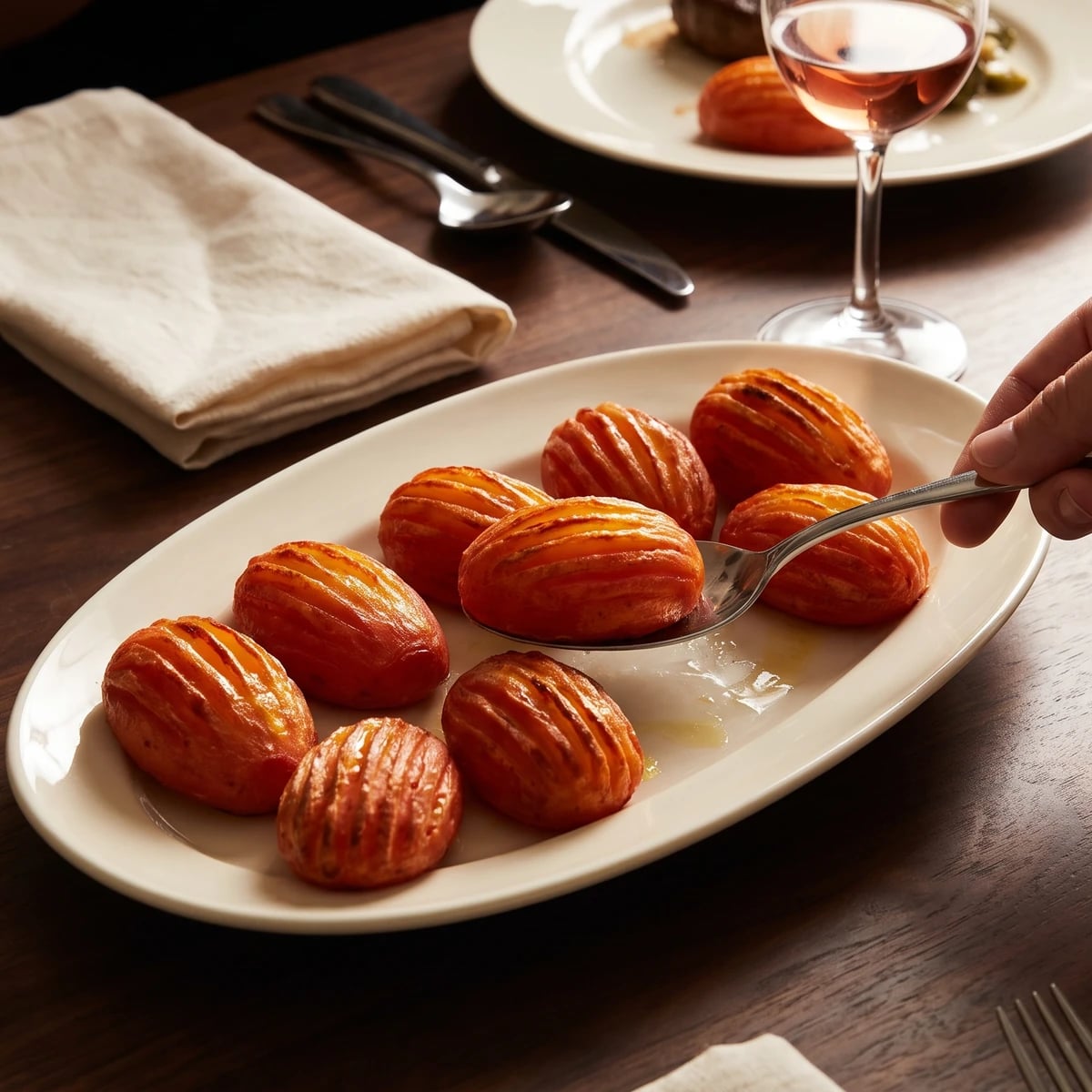
Ridged half-eggs of Pommes Duchesse, stained a clear tomato red, lightly gilded and baked until their furrows bronze: a precise little side dish whose success rests entirely on reduction.

Side Dishes
French
Dinner Party
Special Occasion
20 min
Active Time
20 min cook40 min total
Yield4 servings (8 pieces)

Pommes de Terre Marquise (tomato-tinted duchesse potatoes) teaches the discipline of reduction. The one true thing to know before you touch the pan is this: the tomato purée must surrender nearly all its water before it meets the potato. Leave it loose and the handsome half-eggs slump; reduce it to a dense, brilliant paste and their grooves stand proud while the egg gilding bronzes.

The classical kitchen assumed Pommes Duchesse ready in quantity, a saucier, the sauce cook, reducing tomato by eye, and sheet pans moving through service; a salamander might finish the colour, but this entry sends the shapes to a somewhat hot oven. At home, use one pound of prepared Pommes Duchesse, a small saucepan, one grooved piping tip, and the hot upper third of an ordinary oven, with the broiler only if the ridges need a final touch. The brigade's holding and tray-scale work was scaffolding, so it goes; the exact tomato ratio, firm piping, light gild, and last-minute bake are the dish, so they stay. One cook, one stove, one evening.

You are after eight plump, ridged shapes, red-gold at the tips and tender beneath, generous rather than dainty. Reduce first, measure second: those three tablespoons of finished purée per pound of Pommes Duchesse decide everything.

Pommes de Terre Marquise belongs to the codified Parisian grand-kitchen repertoire, where Pommes Duchesse served as a base and changes of colour, shape, and finish created distinct garnishes. Unlike a regional potato dish, Marquise claims no provincial larder: its identity is technical, three tablespoonfuls of very reduced tomato purée to each pound of Duchesse preparation, piped as grooved half-eggs and gilded. The garnish traveled naturally to bourgeois dinner tables because its decoration asks only for a piping bag and hot oven, while its substance remains familiar potato, butter, egg, and tomato.

The technique, the tradition, and the story behind every dish.

Discover Culinary Explorer

Ingredients

smooth canned tomato purée

Quantity

1/2 cup (120 ml / 125 g), yielding 3 tablespoons (45 ml / 45 g)

reduced until dense and bright red

prepared Pommes Duchesse

Quantity

about 2 cups (475 ml / 454 g; exactly 1 lb)

freshly made and warm

large egg

Quantity

1

beaten until uniform, for gilding

unsalted butter

Quantity

1 teaspoon (5 ml / 5 g)

softened

Equipment Needed

  • Small wide saucepan, about 8 inches (20 cm)
  • Rimmed baking sheet with parchment
  • Large piping bag with a 5/8-inch (16 mm) grooved open-star tip
  • Soft pastry brush
  • Thin flexible spatula

Instructions

  1. 1

    Ready the oven

    Heat the oven to 425°F (220°C), or 400°F (205°C) convection, with a rack in the upper third. Line a rimmed baking sheet with parchment and brush it with the thinnest film of softened butter. The original used buttered service trays; parchment is the home equivalent, giving reliable release without changing the buttered base.

  2. 2

    Reduce the tomato hard

    Put the tomato purée in a small, wide saucepan over medium-low heat. Cook for 8 to 12 minutes, stirring and scraping constantly as it thickens, until the colour is a clear deep red and a spatula drawn across the pan leaves a path open for two seconds. The purée must heap from the spoon without releasing a watery rim. Measure exactly 3 tablespoons (45 ml / 45 g) of the finished reduction. If it spreads or seeps, it isn't ruined, only unfinished: return it to the pan and reduce again. Ça se rattrape. If the bottom catches, transfer the clean upper portion to a fresh pan without scraping up the scorched layer.

    The source ratio applies to the finished reduction, not the purée before cooking: 3 tablespoonfuls of very reduced tomato purée for each 1 lb of Pommes Duchesse.
  3. 3

    Make the Marquise paste

    Let the measured tomato reduction cool from hot to warm, then add it to the warm Pommes Duchesse. Fold firmly with a stiff spatula just until the paste is evenly coloured, scraping through the centre and around the bowl without beating the potato into glue. It should stand in a mound and hold a sharply ridged spoon mark. If it feels soft, chill it for 10 minutes and test again; if it still relaxes, spread it in a buttered shallow baking dish, gild and bake it as a small Marquise gratin. You lose the half-egg silhouette, not the flavour.

  4. 4

    Pipe the half-eggs

    Fit a sturdy piping bag with a large grooved open-star tip, about 5/8 inch (16 mm) across, and fill it while the paste remains pliable. Holding the tip low over the buttered sheet, pipe 8 plump shapes about 3 inches (7.5 cm) long and 1 1/2 inches (4 cm) wide. Build a rounded shoulder, draw the bag steadily forward, then ease the pressure to taper the end, making each piece resemble half an egg with clean lengthwise grooves. If the ridges begin to soften, chill the filled bag for 10 minutes; if the paste cracks, warm the bag briefly between your hands.

  5. 5

    Gild them lightly

    Gild the shapes, meaning brush them lightly with beaten egg so heat gives them a golden sheen. Use a soft pastry brush and work from the crest down the grooves without pressing or flooding them. If egg gathers in the furrows, wick it away with the nearly dry brush; puddled egg hides the piping and cooks into patches.

  6. 6

    Bake and serve

    Set the tray in the hot upper third of the oven 7 to 8 minutes before serving. Bake until the ridges are set, their high points bronzed, and the centres heated through. If they remain pale after 8 minutes, give them 15 to 30 seconds under a hot broiler, watching without looking away; this is the home salamander, and it works quickly. Rest for 1 minute, lift with a thin spatula, and serve at once. À table!

Chef Tips

  • The entry begins with prepared Pommes Duchesse, and this recipe keeps that component whole rather than rebuilding its separate formula. Have it freshly made, warm, and firm before beginning; the stated times cover the Marquise finishing work.
  • Use smooth canned tomato purée when fresh tomatoes are pale or watery. Do not replace it tablespoon for tablespoon with commercial tomato paste, which is more concentrated and often darker; reducing the purée gives the clear red colour and controlled moisture the dish requires.
  • A 5/8-inch (16 mm) grooved open-star tip makes broad furrows that bronze without turning each piece into a coil. A smaller tip produces rope rather than the half-egg shape the source describes.
  • Serve the Marquise beside roast veal, chicken, or beef, placing any jus alongside rather than over the potatoes so their ridges stay distinct. Cooking well is not cooking fancy.

Advance Preparation

  • The tomato purée can be reduced up to 3 days ahead, covered, and refrigerated. Warm it gently only until pliable before mixing it into the warm Pommes Duchesse.
  • The shapes can be piped up to 4 hours ahead and refrigerated loosely covered. Let them stand for 15 to 20 minutes while the oven heats, then gild immediately before their 7 to 8 minute bake.
  • Do not gild in advance. The egg settles into the grooves as it stands, dulling the pattern and giving an uneven finish.

Frequently Asked Questions

Nutrition Information

1 serving (about 120g)

Calories
190 calories
Total Fat
9 g
Saturated Fat
4 g
Trans Fat
0 g
Unsaturated Fat
4 g
Cholesterol
140 mg
Sodium
320 mg
Total Carbohydrates
23 g
Dietary Fiber
2 g
Sugars
2 g
Protein
5 g

Note: Chef personas and recipes are created with AI assistance. Cook with care: follow safe food-handling practices, check doneness with a thermometer when needed, and adapt for allergies and your kitchen.

Where cooking meets culture.

Culinary guides, cultural storytelling, and the editorial depth that makes cooking meaningful.

Discover Culinary Explorer

More from Vegetables and Farinaceous Products - Onions (Oignons)

Browse the full collection