Chef Juliette
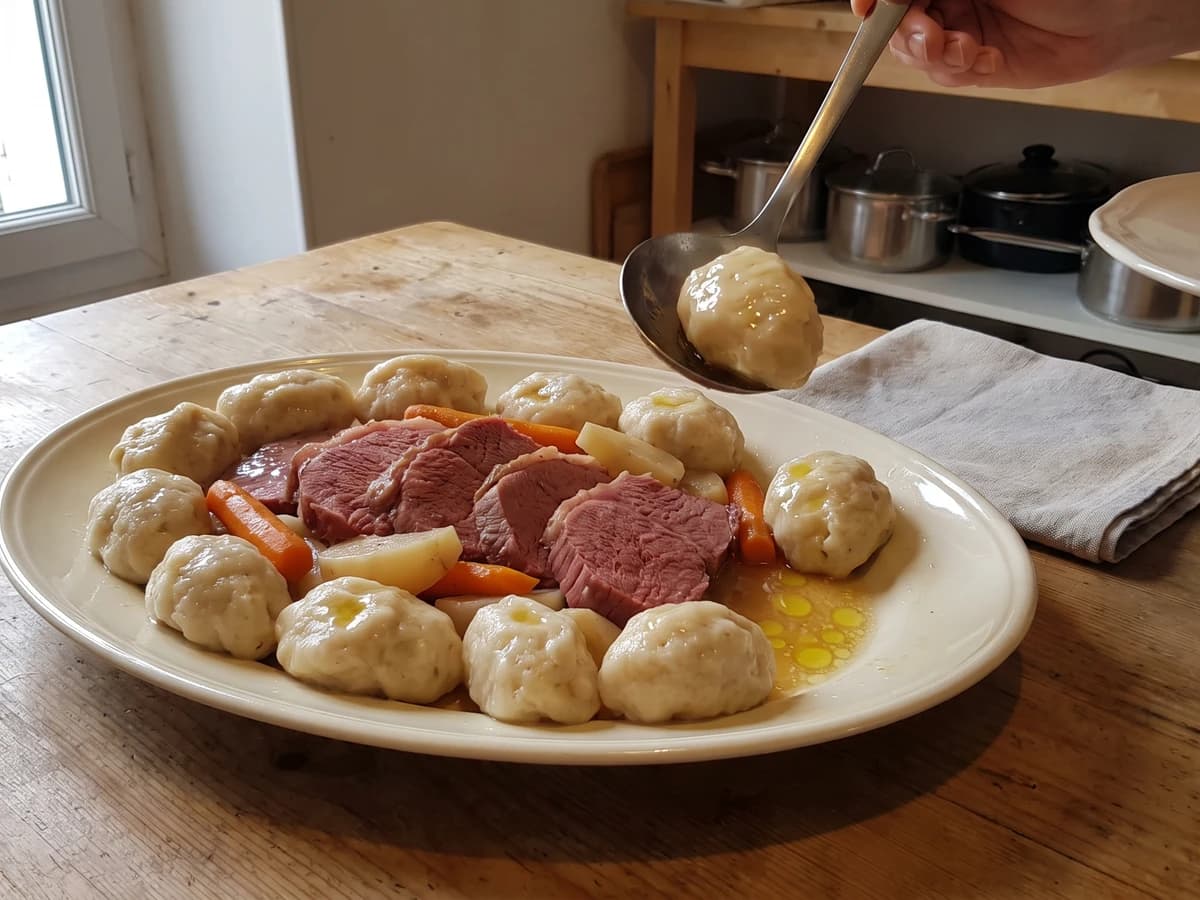
Suet Dumpling
Boulettes au suif, poached beside salt beef, turn equal weights of flour and finely chopped suet into tender, rich dumplings. Keep the beef liquor at a bare tremble and the old garnish works beautifully at home.
A cooking platform built around craft, culture, and the stories behind what we eat.

Created by Chef Juliette
Based on No. 2217, Chipped Potatoes, from Le Guide Culinaire (1907) by Auguste Escoffier
Pommes chips prove that crispness begins before the oil: thin potato roundels, soaked exactly ten minutes, dried without mercy, then fried pale gold for roast game, hot or cold.
Pommes chips (chipped potatoes) teach one clear principle: crispness begins in cold water, not hot oil. The ten-minute soak removes the loose surface starch that makes fine potato roundels cling together, while thorough drying allows them to fry crisp instead of softening beneath trapped moisture.
The original assumed a special potato plane, a fryer kept ready for service, stacks of linen, and brigade quantities. It needed neither a saucier nor stock kept on the fire, and certainly no salamander. A guarded mandoline, a heavy pot, two clean towels, and a thermometer are the honest home equivalents. The ready fryer and endless linen were brigade scaffolding and can go; the ten-minute soak, complete drying, and small-batch frying are the dish and must stay. This version uses 900 grams of potatoes for four people: one cook, one stove, one evening.
Finished well, the roundels are fine, curled at their edges, and pale gold, with a clean snap that holds whether they reach the table hot or cool beside game roasted à l'anglaise (in the English manner). The step that matters most is drying: before a single slice meets the oil, its surface must feel like dry paper beneath your fingertips.
Pommes chips belong to the cosmopolitan classical kitchens of Paris rather than to one regional French larder, where cooks adopted the English word for paper-thin potato roundels served with game roasted à l'anglaise. They are not the thick batons that British tables also call chips; in this preparation, the fine round shape, brief soaking, and brittle crispness define the dish.
Quantity
4, about 6 cups sliced (1.4 L / 900 g)
peeled
Quantity
8 cups (1.9 L / 1.9 kg)
Quantity
8 cups (1.9 L / about 1.75 kg)
for deep-frying
Quantity
1 teaspoon (5 ml / 6 g), plus more to taste
| Ingredient | Quantity |
|---|---|
| medium floury potatoespeeled | 4, about 6 cups sliced (1.4 L / 900 g) |
| cold water | 8 cups (1.9 L / 1.9 kg) |
| refined peanut oil or neutral high-heat frying oilfor deep-frying | 8 cups (1.9 L / about 1.75 kg) |
| fine sea salt | 1 teaspoon (5 ml / 6 g), plus more to taste |
Fit a mandoline with its hand guard and slice the peeled potatoes crosswise into roundels 1 to 1.5 mm thick. Keep the thickness exact, because a thick slice stays leathery while a thin neighbor burns. Stop before the potato becomes too small to hold safely; the final stub belongs in tomorrow's soup, not beneath your fingertips.
Drop the roundels directly into the cold water, separating them with your fingers so water reaches both sides. Leave them for exactly ten minutes. This brief soak loosens the surface starch responsible for sticking without waterlogging the potatoes; the cloudiness in the bowl is proof that the water has done its work.
Pour the frying oil into a heavy 5-quart pot, keeping the pot no more than halfway full, and heat it to 350°F (175°C). Drain the potatoes thoroughly, spread them between two clean lint-free towels, and press and turn them until no droplets remain and each surface feels dry. Damp slices make the oil spit and leave the chips soft, so don't negotiate with this step. Keep the oil attended throughout frying.
Lay 8 to 10 dry roundels loosely on a spider or wide mesh skimmer and lower them gently into the oil. Stir at once to keep them separate, then fry at 340 to 350°F (170 to 175°C) until the bubbling quiets and the slices turn crisp and straw-gold, about 2 to 3 minutes. If two slices cling, tease them apart during the first twenty seconds while they are still flexible. If a batch emerges limp, the pot was crowded or too cool. Ça se rattrape: drain it, return the oil to 350°F (175°C), and fry the chips again for 20 to 40 seconds. If they brown before becoming crisp, lower the heat slightly for the next batch.
Lift each batch onto a wire rack set over a tray, arranging the chips loosely rather than piling them, and season at once with a small pinch of salt. Let the oil return to 350°F (175°C) before adding the next batch. Serve the pommes chips immediately while hot, or cool them completely uncovered for the cold service prescribed with roast game à l'anglaise. Never cover warm chips, because trapped moisture steals their crispness. À table!
1 serving (about 150g)
Culinary guides, cultural storytelling, and the editorial depth that makes cooking meaningful.
Discover Culinary ExplorerChef Juliette
Boulettes au suif, poached beside salt beef, turn equal weights of flour and finely chopped suet into tender, rich dumplings. Keep the beef liquor at a bare tremble and the old garnish works beautifully at home.

Chef Juliette
Bread, flour, frangipane, and rice become four cool, supple panades for binding forcemeats, each changing body and flavor while preserving tenderness. The finest Mousselines need none, and knowing that distinction is the lesson.

Chef Juliette
Panade au pain is bread, milk, salt, heat, and attention: stir until the paste releases cleanly, butter it against a skin, and you have the quiet binder behind tender French farces.

Chef Juliette
Panade de farine teaches the drying stroke behind pâte à choux: flour meets boiling buttered water, then stays over the fire until the paste gathers, smooths, and quits the pan cleanly.