Chef Juliette
Suet Dumpling
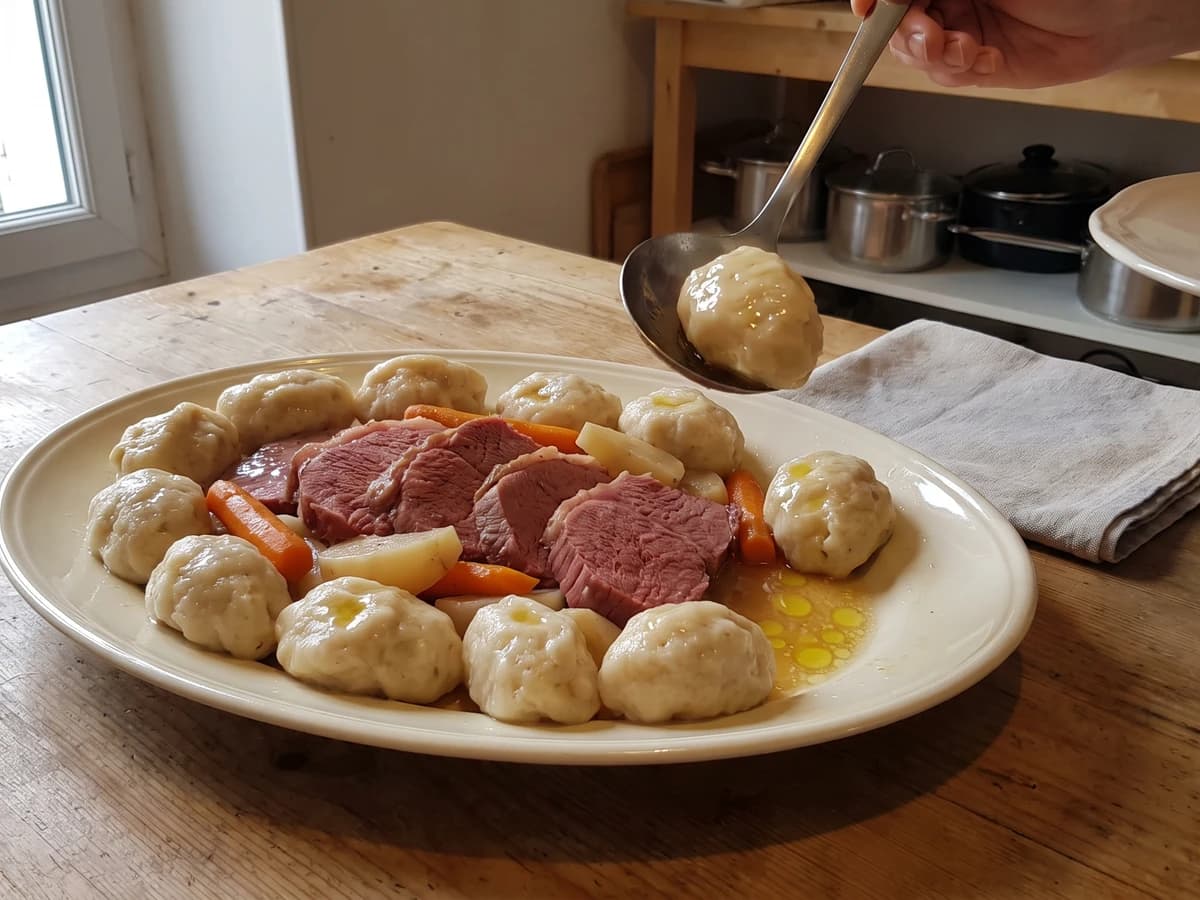
Boulettes au suif, poached beside salt beef, turn equal weights of flour and finely chopped suet into tender, rich dumplings. Keep the beef liquor at a bare tremble and the old garnish works beautifully at home.
A cooking platform built around craft, culture, and the stories behind what we eat.
Created by Chef Juliette
Based on No. 2204, Pommes Anna for Garnishing, from Le Guide Culinaire (1907) by Auguste Escoffier
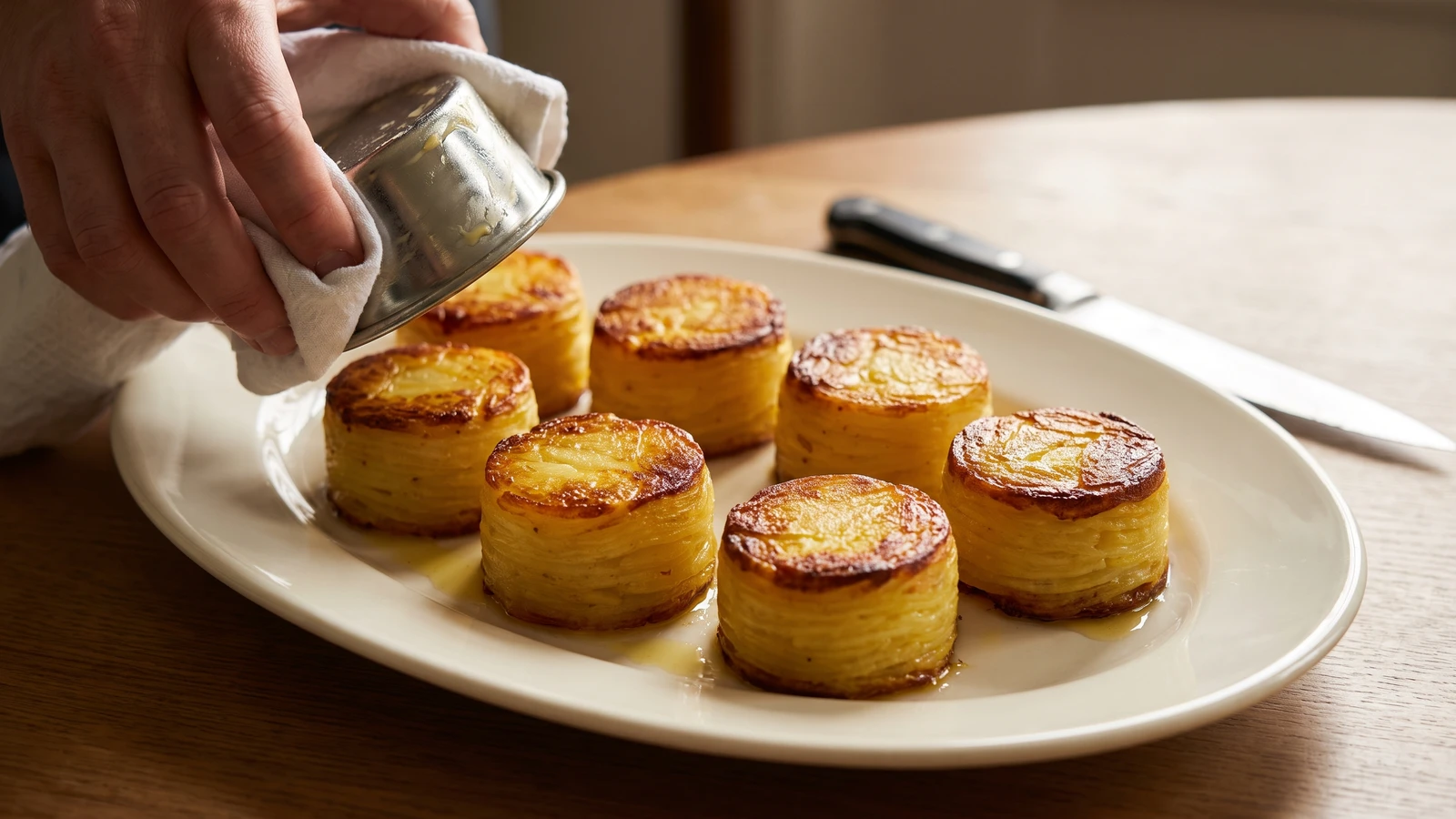
Pommes Anna, built as individual buttered potato towers, teach the discipline of even slicing: thin rounds, firm pressure, fierce heat, then a clean turn onto the plate at the last possible moment.
Pommes Anna pour garniture (individual layered potato cakes) teaches one clean principle: identical slices cook as one. Cut them unevenly and thick rounds remain firm while thin ones collapse; cut them thin and true, pack them closely, and eight little towers turn out with bronzed faces and tender, distinct layers.
The source assumes tinned copper Dariole-moulds or Baba-moulds, a standing tray of very hot fat, and several hands ready to turn every garnish out at the pass. It needs neither a saucier, a stock never off the fire, nor a salamander. Its brigade scaffolding is the bank of copper moulds and reusable hot fat. At home, eight small stainless-steel or aluminum moulds nested in one snug roasting tin do the same work, while refined oil serves as the external heat bath and real butter remains against the potatoes, where its flavour belongs. The equipment and quantity have changed, not the sequence. One cook, one stove, one evening.
If a mould resists at service, don't tear at it; warm it, loosen the rim, and turn again. Ça se rattrape. Before you touch the pan, set the mandoline to 1.5 mm, because even slicing is the step that decides everything afterward.
Pommes Anna belongs to Parisian grande cuisine, where an ordinary potato became a disciplined cake of overlapping rounds and butter. This miniature garnish carried the idea from the large service piece to individual plates in Dariole-moulds or Baba-moulds, each portion turned out hot at the last moment. The Anna behind the name remains debated, but the dish itself is often misread: no cream or cheese belongs here, only fine potato rounds, seasoning, butter, and fierce heat.
Quantity
4 medium (about 1½ lb / 700 g)
peeled
Quantity
3 tablespoons (45 ml / 42 g)
very soft
Quantity
1 teaspoon (5 ml / 6 g)
Quantity
¼ teaspoon (1.25 ml / 0.6 g)
Quantity
about 4 cups (960 ml / 880 g), or enough to reach halfway up the moulds
| Ingredient | Quantity |
|---|---|
| Yukon Gold or other firm golden potatoespeeled | 4 medium (about 1½ lb / 700 g) |
| unsalted buttervery soft | 3 tablespoons (45 ml / 42 g) |
| fine sea salt | 1 teaspoon (5 ml / 6 g) |
| ground white pepper | ¼ teaspoon (1.25 ml / 0.6 g) |
| refined neutral oil for the external hot-fat bath | about 4 cups (960 ml / 880 g), or enough to reach halfway up the moulds |
Heat the oven to 475°F (245°C), conventional, with a rack in the lower-middle position. Choose the smallest deep metal roasting tin that holds eight 2½ to 3 fl oz (75 to 90 ml) Dariole-moulds or Baba-moulds upright, leaving narrow channels for the fat. Coat the bases and sides of every mould generously with the softened butter. Missed patches become sticking points, so turn each mould under the light and check it before filling.
Slice the potatoes crosswise into roundels exactly 1⁄16 inch (1.5 mm) thick, working one potato at a time so the cut surfaces don't darken. Do not rinse them; the surface starch is what binds the finished stacks. Cut the slices into circles matching the moulds. If the moulds flare, use two or three cutter sizes and graduate the rounds from the narrower base to the wider rim. Reserve eight unbroken, handsome rounds for the bases, which become the visible crowns after turning.
Mix the salt and white pepper in a small bowl. Lay one reserved round flat in each buttered base, then stack the remaining potato circles one upon another, seasoning with a tiny pinch after every three or four layers. Press down firmly as you work so no large air gaps remain, and finish about ⅛ inch (3 mm) below each rim. The close stack, not extra fat between the slices, makes the compact, tender interior prescribed by this method.
Heat the refined oil in a deep saucepan to 375°F (190°C), when it is fluid and shimmering but not smoking. Arrange the filled moulds in the roasting tin, then place the tin on the fully extended oven rack so you won't carry an open bath of hot fat across the kitchen. Pour the oil slowly between the moulds until it reaches halfway up their sides, keeping it out of the potatoes, then slide the rack in gently. This external bath is the brigade's standing tray of fat reduced to a home quantity; it provides swift, even heat through the metal without changing the flavour.
Bake for 25 minutes in the very hot oven. Test the centre of one stack with a thin skewer; it should pass from top to bottom without raw resistance, while the buttered edges should be deep gold. If the centre still feels firm, continue for 5 minutes. If the edges are already dark, lower the oven to 425°F (220°C) for that final interval. Ça se rattrape: tenderness matters more than obedience to a temperamental oven.
Set a wire rack over a rimmed tray beside the oven. Using locking tongs, lift each mould straight from the bath, let the exterior drain over the tin, then stand it upright on the rack for 2 minutes. Keep the potatoes in their moulds until the rest of the meal is ready. Do not carry, strain, or pour the bath while it is hot.
Just before serving, wipe each mould's exterior dry. Place a warmed plate or platter over it, invert decisively, and lift the mould straight upward. If a stack clings, don't pry at its sides. Return it upright, loosen only the rim with a thin knife, warm it in the oven for 2 minutes, and turn again. If a few rounds slip, restack them in the mould, press firmly, and bake for another 5 minutes. Serve at once while the crowns are bronzed and the butter still gleams. À table!
1 serving (about 150g)
Culinary guides, cultural storytelling, and the editorial depth that makes cooking meaningful.
Discover Culinary ExplorerChef Juliette
Boulettes au suif, poached beside salt beef, turn equal weights of flour and finely chopped suet into tender, rich dumplings. Keep the beef liquor at a bare tremble and the old garnish works beautifully at home.

Chef Juliette
Bread, flour, frangipane, and rice become four cool, supple panades for binding forcemeats, each changing body and flavor while preserving tenderness. The finest Mousselines need none, and knowing that distinction is the lesson.

Chef Juliette
Panade au pain is bread, milk, salt, heat, and attention: stir until the paste releases cleanly, butter it against a skin, and you have the quiet binder behind tender French farces.

Chef Juliette
Panade de farine teaches the drying stroke behind pâte à choux: flour meets boiling buttered water, then stays over the fire until the paste gathers, smooths, and quits the pan cleanly.