Chef Juliette
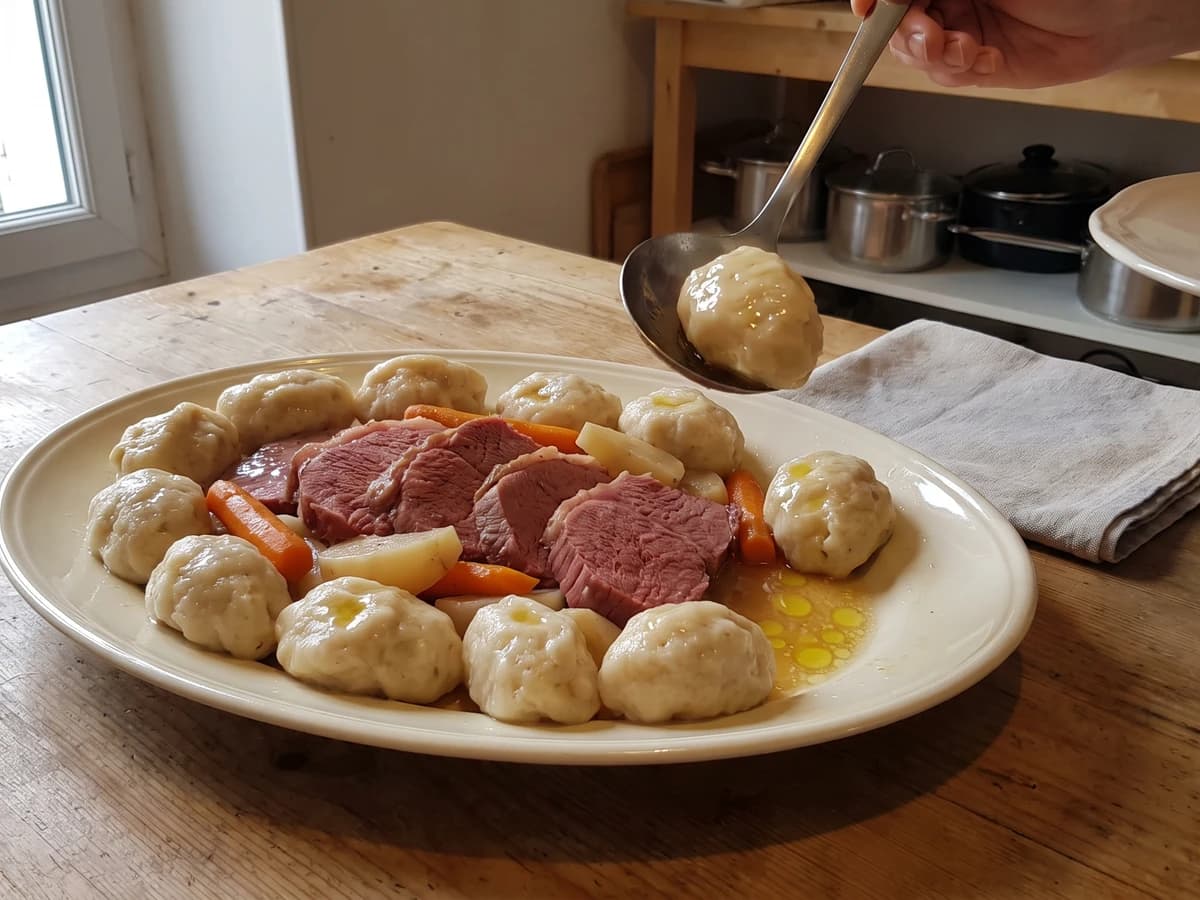
Suet Dumpling
Boulettes au suif, poached beside salt beef, turn equal weights of flour and finely chopped suet into tender, rich dumplings. Keep the beef liquor at a bare tremble and the old garnish works beautifully at home.
A cooking platform built around craft, culture, and the stories behind what we eat.

Created by Chef Juliette
Based on No. 2200, Purée de Pimentos, from Le Guide Culinaire (1907) by Auguste Escoffier
Purée de Pimentos turns red peppers and precisely measured rice into a loose, butter-glossed accompaniment for poached fowl, proving that a purée succeeds by how it moves, not how high it stands.
Purée de Pimentos (silken red-pepper and rice purée) teaches a precise lesson: a purée meant for poached fowl must flow. The rice gives body, but the finished purée should settle into a glossy pool rather than stand in a mound. Keep it thin. That is the one true thing to know before the pan comes out.
The old entry assumed a saucier, a broad tamis, and a quantity measured by the quart; a stockpot never off the fire might have supplied braising moisture without even being named. This version uses water because the entry calls for no referenced stock, a 2-quart saucepan in place of the brigade pot, and a sturdy fine-mesh sieve in place of the tamis. A salamander has no work here, because nothing is browned. The batch is reduced to 225 grams of trimmed pepper and 150 grams of rice, preserving the original ratio exactly. The scale changed, not the method.
The broad tamis and brigade volume are scaffolding and can go. Braising the pepper with two-thirds its weight in rice, rubbing the whole through a sieve, and monter au beurre (finishing by whisking in butter) at two ounces per quart are the dish and must stay. The decisive moment is the final thinning: if the rice turns it pasty, ça se rattrape with hot water, spoonful by spoonful, until the purée flows again.
Purée de pimentos belongs not to Provence but to the classical Parisian sauce-and-garnish repertoire, where fine vegetable purées were composed around the poached poultry and pale meats they accompanied. Its surprising proportion of rice, two-thirds the trimmed weight of the peppers, was not economy filler; it gave the pepper enough body to be sieved silky while remaining mild beside delicate meat. The dish traveled from the saucier's bench to the bourgeois table because a sieve and saucepan could reproduce the essential work, and its proper thinness distinguishes it from a standalone mashed side dish.
Quantity
1 large and 1 small (about 2 cups / 225 g trimmed)
stemmed, seeded, and thinly sliced
Quantity
¾ cup (180 ml / 150 g)
Quantity
2 cups (475 ml / 475 g), plus up to ½ cup (120 ml / 120 g) as needed
additional water kept hot
Quantity
¾ teaspoon (3.75 ml / 4 g), plus more to taste
Quantity
2 tablespoons (30 ml / 28 g)
cut into pieces
| Ingredient | Quantity |
|---|---|
| red bell peppersstemmed, seeded, and thinly sliced | 1 large and 1 small (about 2 cups / 225 g trimmed) |
| plain white rice, preferably short-grain | ¾ cup (180 ml / 150 g) |
| wateradditional water kept hot | 2 cups (475 ml / 475 g), plus up to ½ cup (120 ml / 120 g) as needed |
| fine sea salt | ¾ teaspoon (3.75 ml / 4 g), plus more to taste |
| cold unsalted buttercut into pieces | 2 tablespoons (30 ml / 28 g) |
Weigh the peppers after removing their stems, seeds, and white ribs; you need 225 grams. Weigh out exactly two-thirds that amount in rice, 150 grams. If your trimmed peppers weigh differently, calculate the rice from that trimmed weight rather than forcing the peppers to fit the recipe. Do not rinse the rice, because its surface starch helps give the purée its proper body.
Put the sliced peppers, rice, 1¾ cups (415 ml / 415 g) of the water, and the salt into a heavy 2-quart saucepan. Bring them just to a boil over medium heat, then immediately lower the heat, cover, and hold the mixture at a quiet tremble for 35 to 45 minutes. Stir from the bottom every 8 to 10 minutes. If the pan threatens to catch before the rice has softened, add the reserved water a tablespoon at a time and lower the heat; do not wait for a scorch, because burnt rice cannot be hidden by a sieve.
Judge the mixture by texture, not by the clock. The pepper skins should collapse under the spoon, and the rice grains should be swollen, splitting, and soft enough to smear between two fingers without a hard centre. If either remains firm, add a little hot water, cover, and continue for 5 to 10 minutes. If the mixture is soupy once everything is fully soft, simmer it uncovered for a few minutes; it should resemble loose porridge, not broth and not dough.
Set a sturdy fine-mesh sieve over a wide bowl and work the hot pepper-and-rice mixture through it in small batches with a firm silicone spatula or wooden spoon. Press, scrape, and turn until only dry pepper skins and stubborn fibres remain, then scrape the smooth purée from the underside of the sieve. A blender is not the equivalent here: it retains the skins and can work the rice into glue. If the sieve clogs, loosen the next batch with a spoonful of hot water. Ça se rattrape.
Measure the sieved purée and return it to a clean saucepan over low heat. The expected yield is about 2 cups (475 ml). If it pours like water, reduce it gently before adding the butter. Then monter au beurre, whisking in 1 tablespoon (15 ml / 14 g) cold butter for every cup (240 ml) of purée; for the expected yield, use all 2 tablespoons (30 ml / 28 g). Add the butter piece by piece and do not boil afterward. If a greasy film appears, take the pan off the heat and whisk in a teaspoon of hot water until the purée becomes glossy again.
Taste for salt, then judge the movement. The purée should leave the spoon in a broad ribbon and level itself almost at once. If it sits in a mound, whisk in hot water one tablespoon at a time; the rice will continue tightening as it waits. Spoon a shallow pool onto a warmed platter and arrange poached fowl or another white meat against it, or pass the purée from a warmed sauce bowl. It supports the meat rather than standing alone. À table!
1 serving (about 130g)
Culinary guides, cultural storytelling, and the editorial depth that makes cooking meaningful.
Discover Culinary ExplorerChef Juliette
Boulettes au suif, poached beside salt beef, turn equal weights of flour and finely chopped suet into tender, rich dumplings. Keep the beef liquor at a bare tremble and the old garnish works beautifully at home.

Chef Juliette
Bread, flour, frangipane, and rice become four cool, supple panades for binding forcemeats, each changing body and flavor while preserving tenderness. The finest Mousselines need none, and knowing that distinction is the lesson.

Chef Juliette
Panade au pain is bread, milk, salt, heat, and attention: stir until the paste releases cleanly, butter it against a skin, and you have the quiet binder behind tender French farces.

Chef Juliette
Panade de farine teaches the drying stroke behind pâte à choux: flour meets boiling buttered water, then stays over the fire until the paste gathers, smooths, and quits the pan cleanly.