
Chef Juliette
Stuffed Onions
Oignons farcis teach the discipline of the shell: mild onions hollowed without weakness, filled with their own flesh and Duxelle, braised in butter and stock, then glazed until the tops bronze.
A cooking platform built around craft, culture, and the stories behind what we eat.
Created by Chef Juliette
Based on No. 2190, Petits Pois au Beurre, from Le Guide Culinaire (1907) by Auguste Escoffier
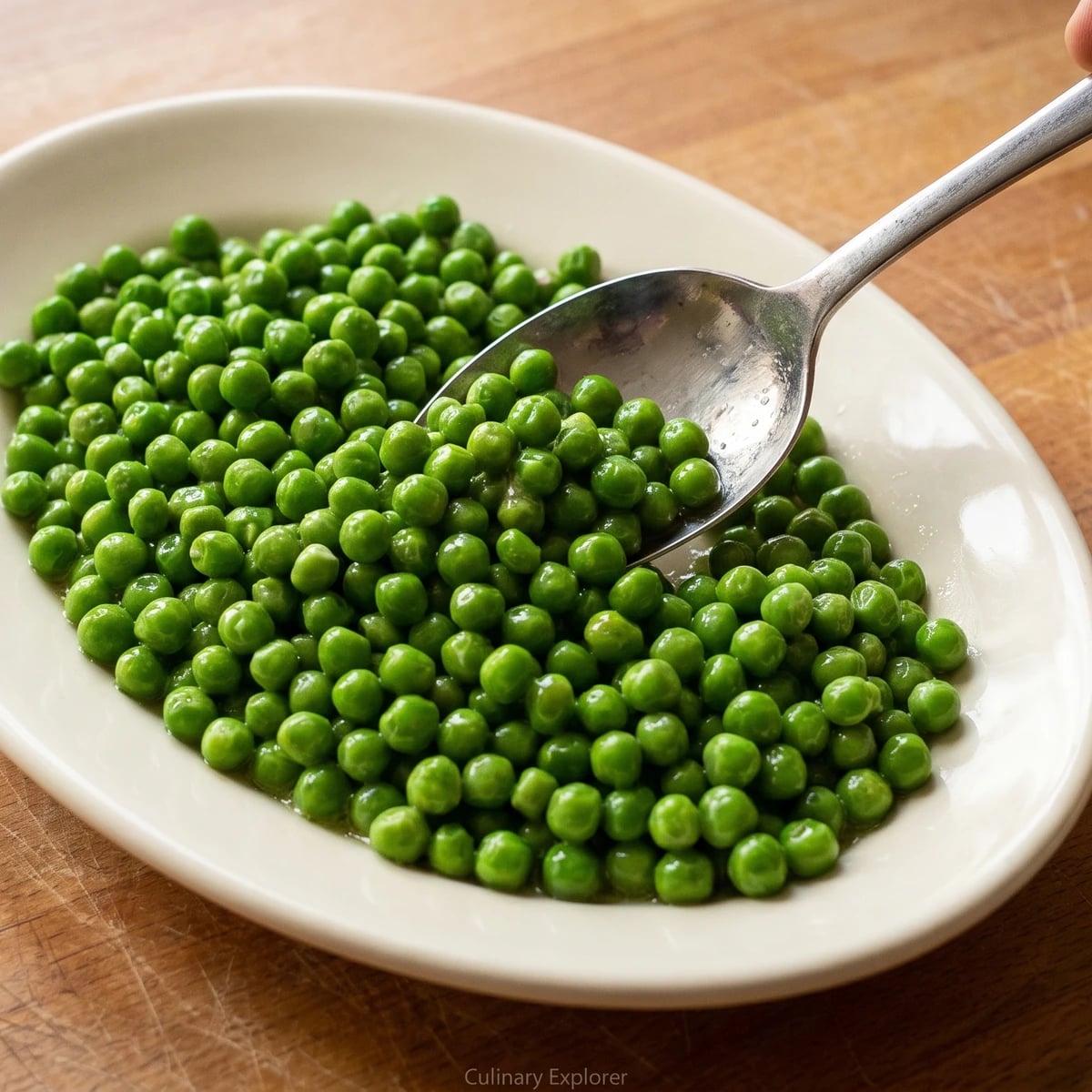
Petits pois au beurre prove that finishing is a technique: dry the cooked peas fiercely, add a whisper of sugar, then let cold butter bind them away from the heat.
Petits Pois au Beurre (buttered peas) teaches one true thing before you touch a pan: butter binds when the fire stops. Cook the peas tender, drive off their surface water over fierce heat, then lier au beurre (bind with butter) away from the burner. The peas become bright and lacquered, not greasy, because the butter clings instead of frying.
The old entry assumes cooked peas arriving at once, a fierce range, and a cook ready to finish them in seconds. It needs neither a saucier nor a stockpot kept going. At home, one saucepan and one colander replace the vegetable station; that separate station is brigade scaffolding and goes, while the fierce drying and off-heat finish stay because they are the dish. The stated ratio remains exact: three ounces of butter to one imperial pint of peas, now one generous side for four. One cook, one stove, one evening.
Fresh spring peas are lovely, but frozen petits pois picked young are the honest answer when the season has passed. Have the cold butter cut before the peas are drained, because this finish waits for nobody. The step that decides everything is simple: once the butter enters, the pan never returns to the heat.
Petits pois au beurre belongs less to one province than to the codified kitchens and bourgeois tables of Paris, where market-garden peas were prized as a garniture in their own right. The classical repertory refined a household method into three exact movements: cook, dry, then bind with butter. Its name is often misunderstood, since au beurre here is not melted butter poured over the top, but an off-fire finish that leaves every pea glossed and the pan free of grease.
Quantity
8 cups (2 quarts / 1.9 L / 1.9 kg)
Quantity
1 tablespoon (15 ml / 18 g)
for the cooking water
Quantity
2⅖ cups (1 imperial pint / 570 ml / 335 g)
leave frozen peas unthawed
Quantity
1 generous pinch (about 1/16 teaspoon / 0.3 ml / 0.3 g)
Quantity
6 tablespoons (3 oz / 90 ml / 85 g)
cold and cut into 6 pieces
| Ingredient | Quantity |
|---|---|
| water | 8 cups (2 quarts / 1.9 L / 1.9 kg) |
| fine sea saltfor the cooking water | 1 tablespoon (15 ml / 18 g) |
| shelled fresh peas or frozen petits poisleave frozen peas unthawed | 2⅖ cups (1 imperial pint / 570 ml / 335 g) |
| powdered sugar | 1 generous pinch (about 1/16 teaspoon / 0.3 ml / 0.3 g) |
| unsalted buttercold and cut into 6 pieces | 6 tablespoons (3 oz / 90 ml / 85 g) |
Bring the water to a full boil in a medium saucepan and add the salt. Add fresh peas and cook for 3 to 6 minutes, depending on their maturity, or add frozen petits pois directly from the freezer and cook for 2 to 3 minutes. Taste one: it should be tender through the centre but still hold its round shape. Drain immediately. Do not rinse or cool them, because their stored heat must melt the finishing butter.
Shake the colander thoroughly, then return the peas to the emptied saucepan and set it over the fiercest heat available. Toss continuously for 30 to 60 seconds, until no water remains on the pan floor and the peas roll cleanly beneath one another. Fierce means brief, not scorched. If their skins begin to wrinkle or catch, lift the pan off the heat at once; the remaining moisture will escape as you keep tossing.
Sprinkle the powdered sugar evenly over the dry peas and toss once or twice, just long enough for it to disappear against their surface. The pinch does not make the dish sweet. It rounds the peas and sharpens the impression of their own sweetness.
Take the pan completely off the burner. Add the cold butter two pieces at a time, tossing after each addition until it melts around the peas and forms a thin, glossy coating. Away from the heat is the whole point: direct fire turns the butter oily instead of letting it cohere. If butter begins pooling on the pan floor, stop adding it and transfer everything to a room-temperature serving bowl. Ça se rattrape: toss steadily as the mixture cools slightly, then add the remaining cold pieces one at a time until the sheen clings.
Spoon the petits pois into a warm serving dish and scrape every trace of butter over them. Serve immediately, while the peas remain plump and the coating is fluid and bright. Waiting lets the butter harden and the green dull, so this is the last side dish finished and the first one carried to the table. À table!
1 serving (about 105g)
Culinary guides, cultural storytelling, and the editorial depth that makes cooking meaningful.
Discover Culinary Explorer
Chef Juliette
Oignons farcis teach the discipline of the shell: mild onions hollowed without weakness, filled with their own flesh and Duxelle, braised in butter and stock, then glazed until the tops bronze.

Chef Juliette
Oignons frits prove that frying is temperature before timing: thin onion rings, lightly floured and cooked in very hot oil until crisp outside, yielding within, then drained and salted at once.

Chef Juliette
Oignons glacés in two classical finishes, one ivory and clear, one butter-gold, prove that gentle heat and a final turn of the pan can make the smallest onion worthy of a holiday table.

Chef Juliette
Scalded onions, dried well and stewed slowly in butter until sweet but still pale, then bound with Béchamel and passed fine: Soubise proves that deep onion flavor does not require browning.