Chef Juliette
Suet Dumpling
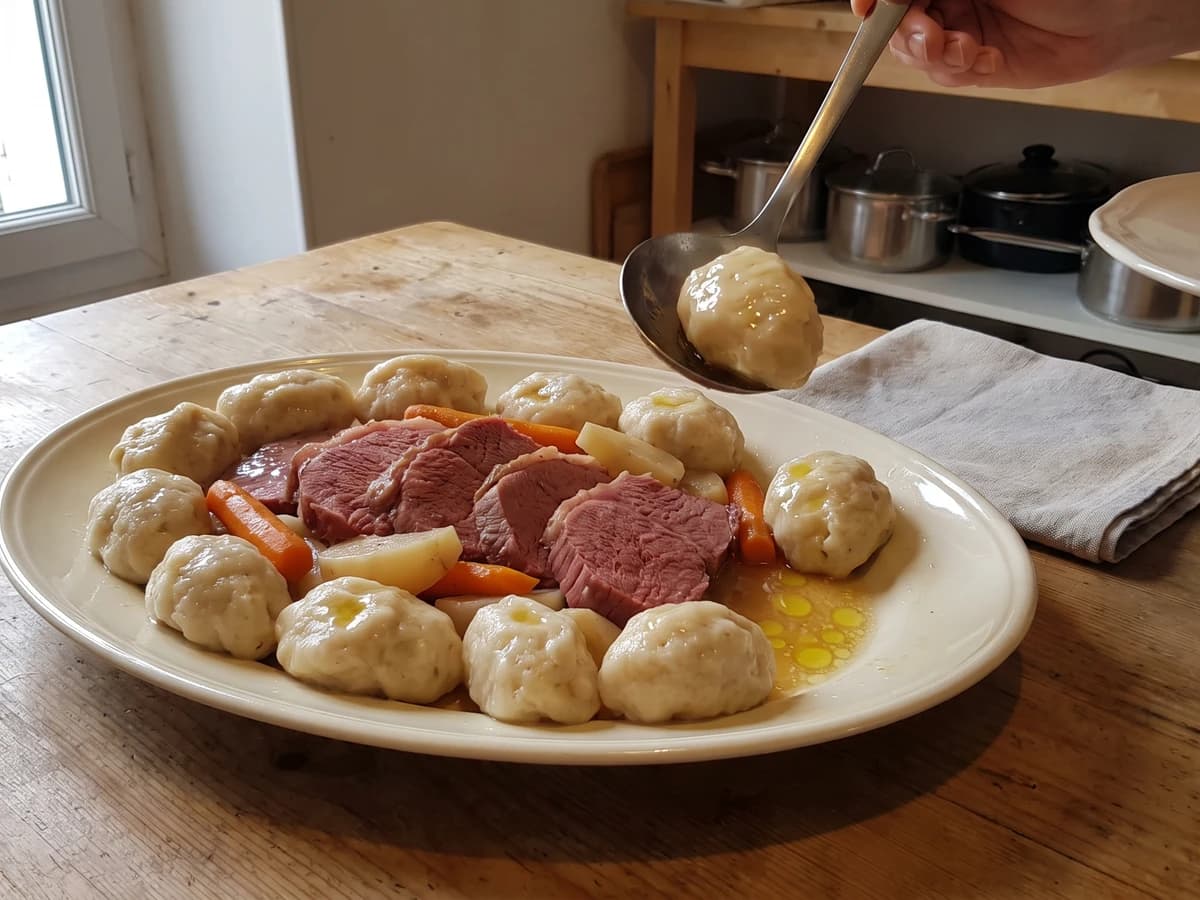
Boulettes au suif, poached beside salt beef, turn equal weights of flour and finely chopped suet into tender, rich dumplings. Keep the beef liquor at a bare tremble and the old garnish works beautifully at home.
A cooking platform built around craft, culture, and the stories behind what we eat.

Created by Chef Juliette
Based on No. 2185, Sorrel (Oseille), from Le Guide Culinaire (1907) by Auguste Escoffier
Oseille turns a fierce green leaf into a silken, ivory-green timbale, its acidity rounded by consommé, pale roux, egg yolks, cream, and enough cold butter to make the surface gleam.
Oseille teaches the discipline of rounding acidity without erasing it. Sorrel begins sharp enough to wake the mouth; two quiet hours with a pale roux and consommé make that edge deep and savory, then yolks, cream, and butter give the purée its satin body. This is not a quick green sauté, and its olive color is not a mistake.
The original entry assumed a saucier to watch the pot, consommé never far from the fire, and a tammy waiting for the final sieving. For four people, every stated amount for the roux, consommé, liaison, cream, and butter is reduced by exactly half. The entry gives no weight for the leaves, so 1 pound is the honest home measure: enough to fill a household saucepan before collapsing and to yield four generous portions. A covered ovenproof pan replaces constant brigade attention, and a fine-mesh sieve replaces the tammy. Those are scaffolding. The two-hour braise, thorough sieving, and yolk liaison are the dish, so they stay. One cook, one stove, one evening.
Before you touch the roux, drain the cooked leaves harder than feels necessary. Water carried into the pan weakens the consommé and leaves the finished purée loose and dull. Press until no more liquid falls. That complete draining is the step that decides the dish.
Sorrel grew in kitchen gardens across northern and central France, where its tart leaves flavored soups, omelets, and sauces for freshwater fish. This sieved, roux-bound preparation belongs particularly to the Parisian classical kitchen, which turned a familiar pot-herb into a smooth timbale accompaniment for eggs, fish, and veal. Its long braise was never intended to preserve a bright green color; it traded brightness for mellow acidity and the close texture prized at the formal table.
Quantity
12 packed cups (2.8 L / 450 g)
tough stems removed and leaves finely shredded
Quantity
1/4 cup (60 ml / 60 g), plus up to 1/4 cup (60 ml / 60 g) if needed
additional water kept hot for the braise
Quantity
2 tablespoons (30 ml / 28 g)
Quantity
2 tablespoons (30 ml / 14 g)
Quantity
1 1/2 cups (355 ml / 355 g)
preferably unsalted
Quantity
1/4 teaspoon (1.25 ml / 1.5 g), plus more if needed
Quantity
1/16 teaspoon (0.3 ml / 0.3 g)
Quantity
3
Quantity
3 tablespoons plus 1/2 teaspoon (47.5 ml / 48 g)
Quantity
5 tablespoons (75 ml / 71 g)
cut into small pieces
Quantity
2 tablespoons (30 ml / 30 g)
heated, for finishing
| Ingredient | Quantity |
|---|---|
| fresh sorrel leavestough stems removed and leaves finely shredded | 12 packed cups (2.8 L / 450 g) |
| wateradditional water kept hot for the braise | 1/4 cup (60 ml / 60 g), plus up to 1/4 cup (60 ml / 60 g) if needed |
| unsalted butter for the roux | 2 tablespoons (30 ml / 28 g) |
| all-purpose flour | 2 tablespoons (30 ml / 14 g) |
| prepared clear consommépreferably unsalted | 1 1/2 cups (355 ml / 355 g) |
| fine salt | 1/4 teaspoon (1.25 ml / 1.5 g), plus more if needed |
| granulated sugar | 1/16 teaspoon (0.3 ml / 0.3 g) |
| large egg yolks | 3 |
| heavy cream | 3 tablespoons plus 1/2 teaspoon (47.5 ml / 48 g) |
| cold unsalted buttercut into small pieces | 5 tablespoons (75 ml / 71 g) |
| strong veal stockheated, for finishing | 2 tablespoons (30 ml / 30 g) |
Put the shredded sorrel in a large bowl of cold water, stir it well, then lift the leaves out so the grit remains behind. Repeat in two fresh waters, or until no sand settles in the bowl. Transfer the wet leaves to a 4-quart nonreactive saucepan, add the measured water, cover, and cook over low heat for 6 to 8 minutes, stirring twice, until every leaf has collapsed. The green will turn muted almost at once. That is exactly right.
Tip the sorrel into a fine-mesh sieve and let it drain for 10 minutes. Press firmly with the back of a ladle, turn the leaves over, and press again until no more cooking water falls. Do not wring the leaves into dry fibers, but leave no free liquid behind. This keeps the measured consommé, rather than stray washing water, in command of the finished consistency.
Melt the 2 tablespoons of butter in a heavy 2-quart ovenproof saucepan over medium-low heat. Stir in the flour and cook for 2 minutes without allowing it to color; this is a roux blanc, a pale roux whose work is thickening, not browning. Mix in the drained sorrel, then add the consommé in four additions, stirring each one smooth before adding the next. Add the salt and sugar and bring the mixture only to a bare simmer. If the roux gathers into lumps, take the pan off the heat and whisk until smooth before continuing. Ça se rattrape, and the later sieving will catch anything stubborn.
Heat the oven to 300°F (150°C). Cover the saucepan tightly and braise the oseille for 2 full hours, stirring from the bottom every 30 minutes. It should remain moist but dense, with a deep olive color and no raw flour taste. If the edges begin to dry, stir in hot water 1 tablespoon at a time. If you smell the first hint of scorching, do not scrape the bottom; lift the unburned mixture into a clean pan and continue. Burnt fond cannot be hidden, but the upper portion can still be saved.
While the oseille is still hot, force it through a clean fine-mesh sieve with a sturdy ladle or flexible scraper. Scrape the smooth purée from the underside and discard the wiry fibers left behind. A blender is not the equivalent here; it chops the fibers and whips air into the purée. The sieve supplies the close, calm texture once provided by a tammy. Return the purée to a clean saucepan.
Whisk the egg yolks for about 2 minutes, until pale and foamy, then pass them through the cleaned sieve. Whisk about 1/2 cup of the hot sorrel purée into the yolks a little at a time, then stir this liaison back into the saucepan. Heat over the gentlest flame, stirring constantly, until the purée lightly coats the spoon and reaches 160°F (71°C). Never let it simmer. If tiny curds appear, pull the pan off the heat immediately, whisk in 1 tablespoon of the measured cold cream, and strain once more. Ça se rattrape if you move quickly.
Take the pan off the heat and stir in the cream, using what remains if a spoonful went to rescue the liaison. Monter au beurre, whisk in the cold butter one piece at a time, adding each only after the last has disappeared. The finished oseille should be thick enough to mound softly, yet glossy enough to settle at its edges. If butter begins to bead on the surface, keep the pan off the heat and whisk in 1 teaspoon of cold water to restore the emulsion. Taste for salt, spoon into a warmed timbale, and lightly spoon the hot strong veal stock over the surface. À table!
1 serving (about 235g)
Culinary guides, cultural storytelling, and the editorial depth that makes cooking meaningful.
Discover Culinary ExplorerChef Juliette
Boulettes au suif, poached beside salt beef, turn equal weights of flour and finely chopped suet into tender, rich dumplings. Keep the beef liquor at a bare tremble and the old garnish works beautifully at home.

Chef Juliette
Bread, flour, frangipane, and rice become four cool, supple panades for binding forcemeats, each changing body and flavor while preserving tenderness. The finest Mousselines need none, and knowing that distinction is the lesson.

Chef Juliette
Panade au pain is bread, milk, salt, heat, and attention: stir until the paste releases cleanly, butter it against a skin, and you have the quiet binder behind tender French farces.

Chef Juliette
Panade de farine teaches the drying stroke behind pâte à choux: flour meets boiling buttered water, then stays over the fire until the paste gathers, smooths, and quits the pan cleanly.