Chef Juliette
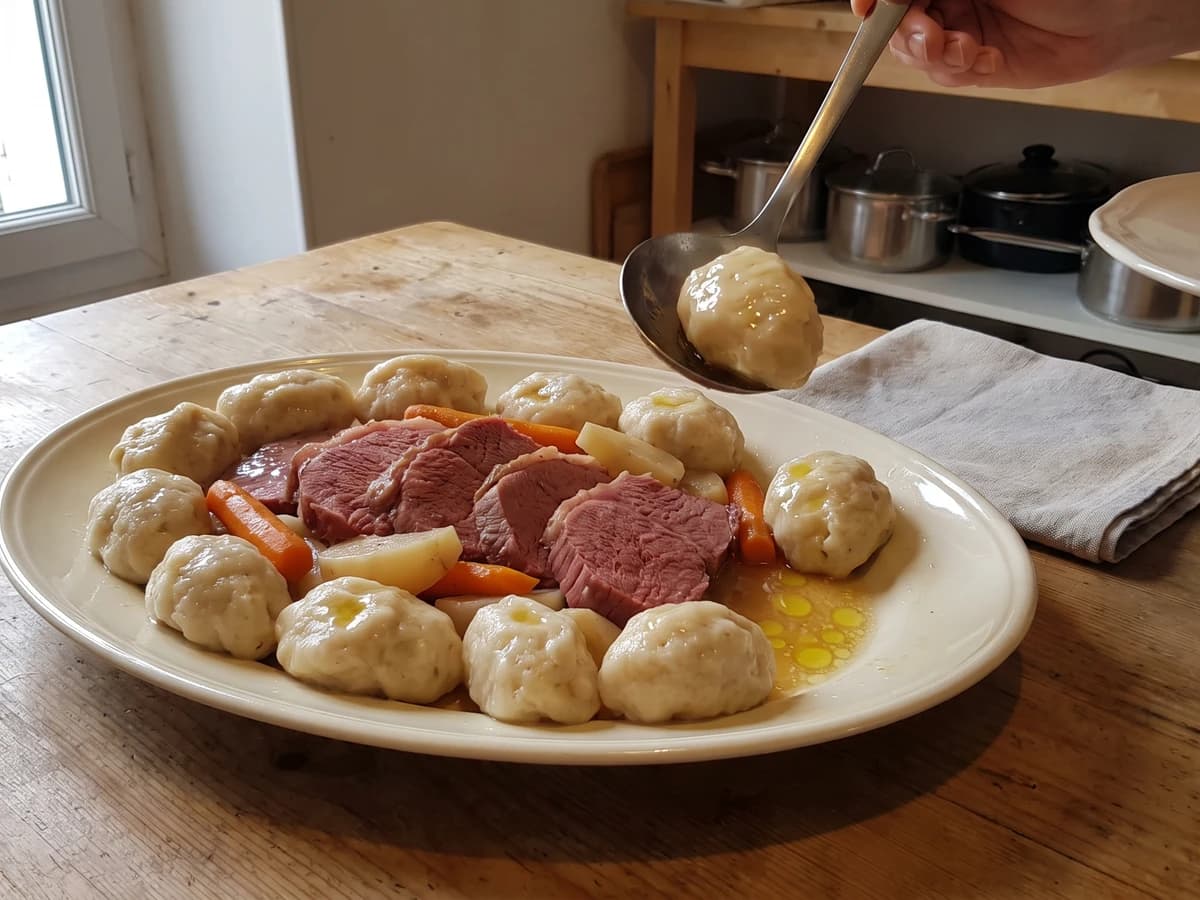
Suet Dumpling
Boulettes au suif, poached beside salt beef, turn equal weights of flour and finely chopped suet into tender, rich dumplings. Keep the beef liquor at a bare tremble and the old garnish works beautifully at home.
A cooking platform built around craft, culture, and the stories behind what we eat.

Created by Chef Juliette
Based on No. 2140, Soufflé aux Épinards aux Truffes, from Le Guide Culinaire (1907) by Auguste Escoffier
Spinach, butter, and eggs rise around a fine lattice of black truffle in this delicate savory soufflé, scaled from the classical timbale to one home oven and four generous side servings.
Soufflé aux Épinards aux Truffes (spinach soufflé with truffles) teaches that lift begins before you whisk an egg white: the spinach must surrender its water. A wet purée weighs the batter down; a dry, butter-glossed one gives the eggs something light enough to carry. Done properly, it rises deeply green beneath a bronzed crown, with black truffle opening across the top in a fine lattice.
The source entry is terse because it expects the preceding spinach soufflé formula to be in the brigade cook's hands; its new instruction is the lattice of fine truffle slices in place of anchovy. A saucier, a stockpot never off the fire, and a salamander were ordinary brigade supports, yet none performs the essential work here. At home, a saucepan builds the roux-bound base, one 1½-quart dish replaces the large timbale, and four ramekins stand honestly for the small cassolettes. The quantity changes because four people are eating, not forty. One cook, one stove, one evening.
The brigade's staging can go. The dish itself cannot: real butter, a firm roux, spinach dried with patience, egg whites folded gently, and the truffle lattice laid just before baking. Before you meet the whisk, dry the spinach until your spoon leaves a clean trail across the pan. That is the step that decides the soufflé.
Soufflés aux légumes belong to the Parisian table of cuisine classique, where concentrated vegetable purées were lightened with egg whites and carried out in a large timbale as a vegetable course. This spinach and truffle form is explicitly paired with an anchovy version: fine truffle slices take the same lattice position, exchanging briny force for the perfume of black truffle while leaving the soufflé base untouched. Small cassolettes let the preparation travel from vegetable course to garnish beside a substantial roast, proof that the change in vessel was service practice, not a separate dish.
Quantity
12 packed cups (2.8 L / 680 g)
tough stems removed
Quantity
4 tablespoons (60 ml / 56 g)
softened and divided
Quantity
¼ cup (60 ml / 30 g)
Quantity
¾ cup (180 ml / 185 g)
Quantity
4
separated
Quantity
1
Quantity
¼ cup very thin slices (60 ml / 30 g)
cut into narrow lamellae for the lattice
Quantity
2 tablespoons (30 ml / 36 g)
Quantity
¾ teaspoon (4 ml / 4.5 g)
Quantity
¼ teaspoon (1 ml / 0.5 g)
| Ingredient | Quantity |
|---|---|
| fresh spinach leavestough stems removed | 12 packed cups (2.8 L / 680 g) |
| unsalted buttersoftened and divided | 4 tablespoons (60 ml / 56 g) |
| all-purpose flour | ¼ cup (60 ml / 30 g) |
| whole milk | ¾ cup (180 ml / 185 g) |
| large eggsseparated | 4 |
| additional large egg white | 1 |
| whole black truffle, fresh or preservedcut into narrow lamellae for the lattice | ¼ cup very thin slices (60 ml / 30 g) |
| fine sea salt for blanching | 2 tablespoons (30 ml / 36 g) |
| fine sea salt for the soufflé base | ¾ teaspoon (4 ml / 4.5 g) |
| ground white pepper | ¼ teaspoon (1 ml / 0.5 g) |
Set a rack in the lower third of the oven and heat it to 400°F (200°C). With 1 tablespoon (15 ml / 14 g) of the butter, coat the bottom and sides of a 1½-quart (1.4 L) straight-sided soufflé dish, brushing upward along the walls to encourage an even climb. For garnish portions, butter four 8-ounce (240 ml) cassolettes instead. Chill the prepared dish while you make the base. Slice the truffle very thinly, patting preserved truffle dry so it won't slide across the batter.
Bring a large pot of water to a vigorous boil and add the blanching salt. Drop in the spinach, pressing it beneath the water, and cook just until every leaf collapses and turns a vivid dark green, 60 to 90 seconds. Drain at once and rinse briefly under cold water to stop the cooking. Gather the spinach in a clean towel and wring firmly until no more water falls. If a pressed handful still releases beads, squeeze again. Wet spinach cannot carry a soufflé.
Chop the spinach very finely, or pulse it briefly into a coarse purée. Melt 1 tablespoon (15 ml / 14 g) of the butter in a wide pan over medium heat, add the spinach, and cook for 5 to 8 minutes, stirring and folding constantly. It is ready when it gathers into a soft paste, looks glossy rather than wet, and a spoon drawn across the pan leaves a clean trail. You should have about 1 packed cup (240 ml / 250 g). If liquid still pools around it, keep cooking. Ça se rattrape, but only while the spinach is still in the pan.
Melt the remaining 2 tablespoons (30 ml / 28 g) butter in a heavy saucepan over medium-low heat. Stir in the flour and cook for 2 minutes without allowing it to color; this roux must lose its raw flour taste while staying pale. Add the milk gradually, whisking smooth after each addition, then cook until the base is very thick and pulls cleanly from the pan, about 3 minutes. If it is lumpy, whisk firmly or pass it through a fine sieve. If it runs from the spoon, cook it longer; the base must stand in a mound.
Stir the dried spinach into the roux base with the ¾ teaspoon salt and white pepper, beating until no pale streaks remain. Taste now and adjust the seasoning if needed, because the egg whites will soften it. Transfer the mixture to a broad bowl and let it cool until warm rather than hot, 5 to 8 minutes. Beat in the 4 yolks one at a time. A hot base scrambles yolks and steals their thickening power, so give it those few minutes.
Beat all 5 egg whites in a spotless bowl until they form glossy medium-stiff peaks whose tips bend slightly. Stir one-quarter of the whites firmly into the spinach base to lighten it, then fold in the remainder in three additions, cutting down through the center and lifting the heavier base over the whites. Stop as soon as only a few white ribbons remain. If overfolding makes the mixture loose and glossy, divide it among the cassolettes; their shorter climb gives the weakened batter a better chance. Ça se rattrape.
Spoon the mixture into the chilled dish, filling it no more than three-quarters full, and level the surface without pressing out the air. Run a clean thumb around the inside rim to cut a shallow channel, which helps the crown rise straight. Arrange the fine truffle slices over the surface in a loose crisscross lattice, leaving small spaces between them so the batter can expand. Do not press them down.
Put the soufflé into the oven immediately and bake the large dish for 23 to 27 minutes. Do not open the door during the first 20 minutes. It is ready when it has risen well above the rim, the crown is butter-gold around the truffle lattice, and the center gives a slight, unified tremble when the dish is moved. Bake cassolettes for 13 to 16 minutes, leaving their door closed for at least the first 10. A wobble is tenderness; a liquid ripple needs another 2 minutes.
Carry the soufflé directly to the table and serve it with a broad spoon, cutting through the truffle lattice so every portion receives some. A soufflé settles as it waits because that is its nature, not because the cook has failed. The large timbale is the vegetable for four; the cassolettes belong beside a roast or another substantial centerpiece. À table!
1 serving (about 195g)
Culinary guides, cultural storytelling, and the editorial depth that makes cooking meaningful.
Discover Culinary ExplorerChef Juliette
Boulettes au suif, poached beside salt beef, turn equal weights of flour and finely chopped suet into tender, rich dumplings. Keep the beef liquor at a bare tremble and the old garnish works beautifully at home.

Chef Juliette
Bread, flour, frangipane, and rice become four cool, supple panades for binding forcemeats, each changing body and flavor while preserving tenderness. The finest Mousselines need none, and knowing that distinction is the lesson.

Chef Juliette
Panade au pain is bread, milk, salt, heat, and attention: stir until the paste releases cleanly, butter it against a skin, and you have the quiet binder behind tender French farces.

Chef Juliette
Panade de farine teaches the drying stroke behind pâte à choux: flour meets boiling buttered water, then stays over the fire until the paste gathers, smooths, and quits the pan cleanly.