Chef Juliette
Suet Dumpling
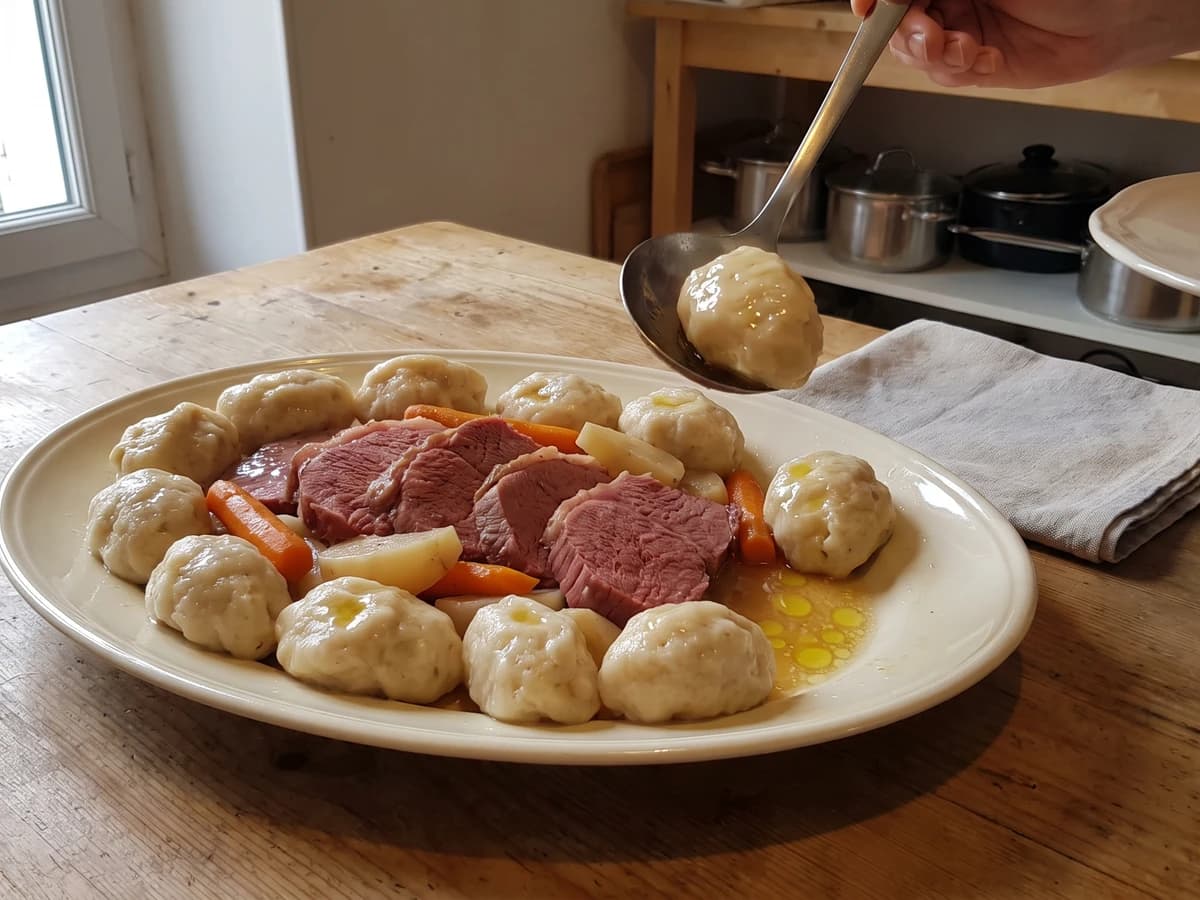
Boulettes au suif, poached beside salt beef, turn equal weights of flour and finely chopped suet into tender, rich dumplings. Keep the beef liquor at a bare tremble and the old garnish works beautifully at home.
A cooking platform built around craft, culture, and the stories behind what we eat.

Created by Chef Juliette
Based on No. 2107, Scotch Kale (Chou Frisé), Spring Cabbage (Choux De Printemps), Broccoli Leaves, Turnip-tops, from Le Guide Culinaire (1907) by Auguste Escoffier
Four sturdy market greens, two proper treatments: boil them briskly à l’anglaise for clean freshness, or finish them gently au beurre until tender and glossy. The deciding skill is moisture control.
Verdures à l’anglaise ou au beurre (Scotch kale, spring cabbage, broccoli leaves, and turnip-tops, boiled or butter-stewed) teach the cleanest lesson in the vegetable canon: moisture is an ingredient. À l’anglaise needs abundant salted water and speed; au beurre needs a lid, modest heat, and just enough water to keep the butter from catching. Nothing more. These are leaves meant to taste of themselves.
The old entry assumed a légumier, the vegetable cook, with a great kettle already boiling and another pair of hands ready to serve the greens the instant they were done. At home, a large pot or lidded skillet replaces that brigade machinery, and the batch is reduced to four portions. The kettle and extra hands were scaffolding; the hard boil for à l’anglaise and the close butter finish for au beurre are the dish. No stock, roux, cream, garlic, or acid is added because the source gives them no place here.
The finished greens should be tender but still themselves, clean and mineral from the boiling pot or supple and butter-glossed from the skillet. The one step that matters before you touch the pan is sorting: remove the tough ribs and keep leaves of one tenderness together, because no sauce can make an underdone stem and an overdone leaf agree.
This preparation belongs to the classical Parisian vegetable station rather than to a single French province, where sturdy market greens were treated according to texture instead of being given a borrowed regional identity. À l’anglaise entered French kitchen language for green vegetables cooked briskly in abundant salted water and brought directly to table, while au beurre kept the same produce in butter until supple and glazed. Here à l’anglaise means plainly boiled, not the breadcrumb coating the same phrase can name elsewhere.
Quantity
1½ pounds (680 g / about 10 to 12 packed cups)
choose one, weigh after trimming, and wash
Quantity
12 cups (2.8 L / 2.8 kg)
Quantity
2 tablespoons (30 ml / 36 g)
Quantity
5 tablespoons (75 ml / 70 g)
divided
Quantity
¾ teaspoon (3.75 ml / 4 g)
Quantity
up to ½ cup (120 ml / 120 g)
| Ingredient | Quantity |
|---|---|
| Scotch kale, spring cabbage, broccoli leaves, or turnip-topschoose one, weigh after trimming, and wash | 1½ pounds (680 g / about 10 to 12 packed cups) |
| water, for à l’anglaise | 12 cups (2.8 L / 2.8 kg) |
| fine sea salt, for à l’anglaise | 2 tablespoons (30 ml / 36 g) |
| unsalted butter, for au beurredivided | 5 tablespoons (75 ml / 70 g) |
| fine sea salt, for au beurre | ¾ teaspoon (3.75 ml / 4 g) |
| hot water, for au beurre (optional) | up to ½ cup (120 ml / 120 g) |
Discard yellow or damaged leaves. Pull the tough central ribs from Scotch kale and broccoli leaves, trim coarse stalks from turnip-tops, and remove the hard core from spring cabbage. Cut broad leaves into 1½-inch (4 cm) ribbons, leaving small tender leaves whole. Wash them in two changes of cold water until no grit remains, then drain. Keep the leaves slightly damp for au beurre, but do not leave water pooled among them.
Choose one method. For à l’anglaise, follow steps 3 and 4, then go directly to step 7. For au beurre, skip to steps 5 and 6 before serving. Do not boil the greens fully and then stew them again; that muddles the two preparations and softens the leaves past their proper point.
Bring the water to a strong rolling boil in a large pot and add the salt. Drop in the greens, pressing them under only until they wilt, then cook uncovered. Allow 3 to 5 minutes for spring cabbage, 4 to 6 minutes for turnip-tops, 5 to 7 minutes for broccoli leaves, or 7 to 10 minutes for Scotch kale. The thickest vein should yield cleanly between your fingers while the leaf still holds its shape. If the water does not return to the boil within a minute, the pot is crowded. Lift out half and cook in two batches. Ça se rattrape.
Drain the greens the instant they are tender and shake the colander firmly. Do not rinse them, because cold water steals the heat and leaves more moisture to remove. Return them to the empty hot pot for 20 seconds, turning once, just long enough to dry the surface. If they have gone soft and watery, spread them in a wide dry skillet and turn over medium heat until the excess water leaves; they will not regain their bite, but they can still become a generous au beurre serving.
Melt 4 tablespoons (60 ml / 56 g) of the butter in a wide lidded sauté pan over medium-low heat. Add the damp greens and salt, turning until every leaf wears a fine coat of butter. Add 2 tablespoons (30 ml / 30 g) hot water for tender spring cabbage or turnip-tops, or ¼ cup (60 ml / 60 g) for sturdier broccoli leaves or Scotch kale. Cover and cook gently, turning twice, until tender: about 5 to 8 minutes for spring cabbage, 6 to 10 minutes for turnip-tops, 8 to 12 minutes for broccoli leaves, or 12 to 18 minutes for Scotch kale. If the pan catches before the leaves soften, lower the heat and add hot water a tablespoon at a time. Ça se rattrape.
Uncover the pan and raise the heat to medium. Turn the greens until the remaining water has evaporated and the pan sounds of a gentle sizzle rather than a slosh. If the leaves are tender but swimming, lift them out, reduce the liquid to a spoonful, then return them. Take the pan off the heat and toss in the remaining 1 tablespoon (15 ml / 14 g) butter. If the butter sits as an oily pool, add 1 teaspoon (5 ml / 5 g) hot water and toss firmly off the heat; the butter and vegetable juices will come back into a light emulsion.
For à l’anglaise, tip the hot, thoroughly drained greens into a warmed shallow serving bowl with no further dressing. For au beurre, transfer the glossy greens with every drop of their butter. Both preparations suffer from waiting, so bring them straight to the table. À table!
1 serving (about 160g)
Culinary guides, cultural storytelling, and the editorial depth that makes cooking meaningful.
Discover Culinary ExplorerChef Juliette
Boulettes au suif, poached beside salt beef, turn equal weights of flour and finely chopped suet into tender, rich dumplings. Keep the beef liquor at a bare tremble and the old garnish works beautifully at home.

Chef Juliette
Bread, flour, frangipane, and rice become four cool, supple panades for binding forcemeats, each changing body and flavor while preserving tenderness. The finest Mousselines need none, and knowing that distinction is the lesson.

Chef Juliette
Panade au pain is bread, milk, salt, heat, and attention: stir until the paste releases cleanly, butter it against a skin, and you have the quiet binder behind tender French farces.

Chef Juliette
Panade de farine teaches the drying stroke behind pâte à choux: flour meets boiling buttered water, then stays over the fire until the paste gathers, smooths, and quits the pan cleanly.