Chef Juliette
Suet Dumpling
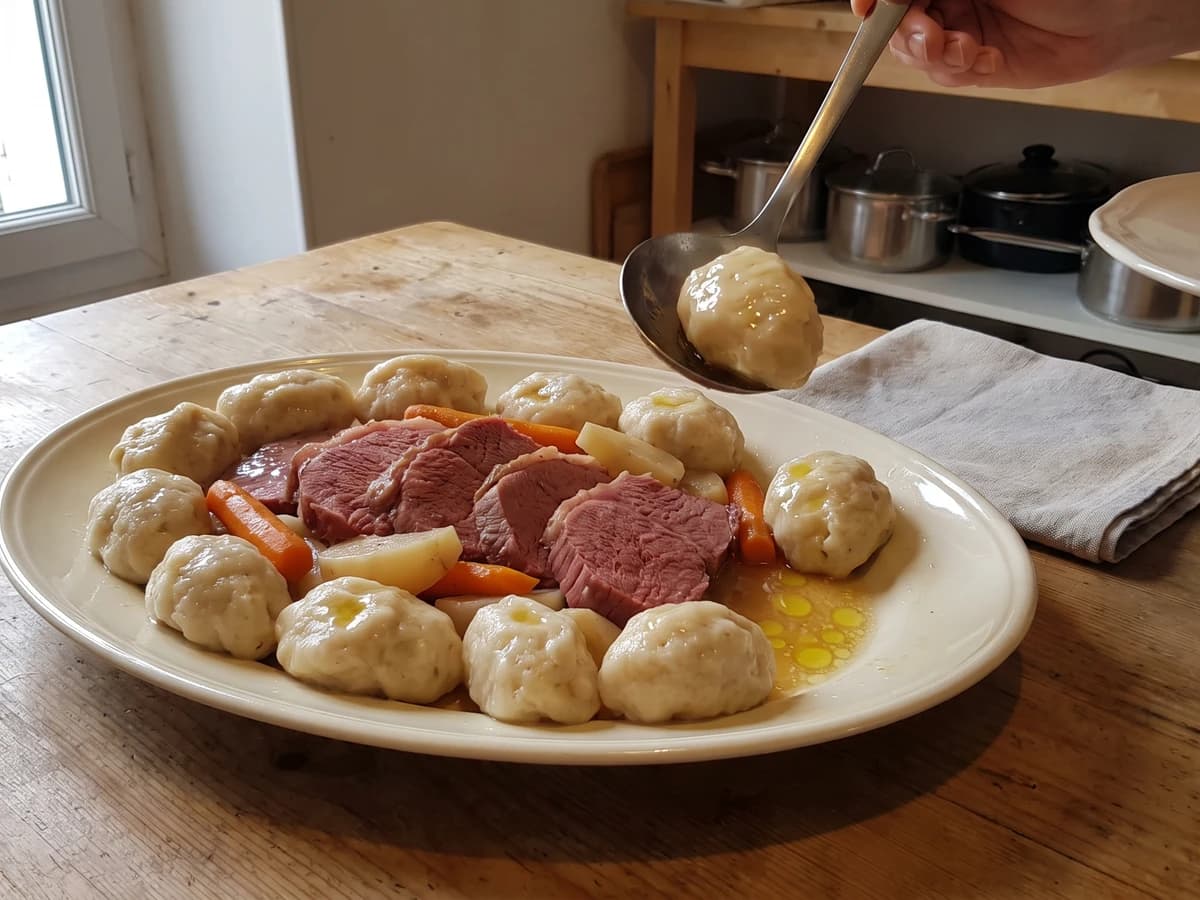
Boulettes au suif, poached beside salt beef, turn equal weights of flour and finely chopped suet into tender, rich dumplings. Keep the beef liquor at a bare tremble and the old garnish works beautifully at home.
A cooking platform built around craft, culture, and the stories behind what we eat.
Created by Chef Juliette
Based on No. 2105, Cabbages for Garnish.—B, from Le Guide Culinaire (1907) by Auguste Escoffier
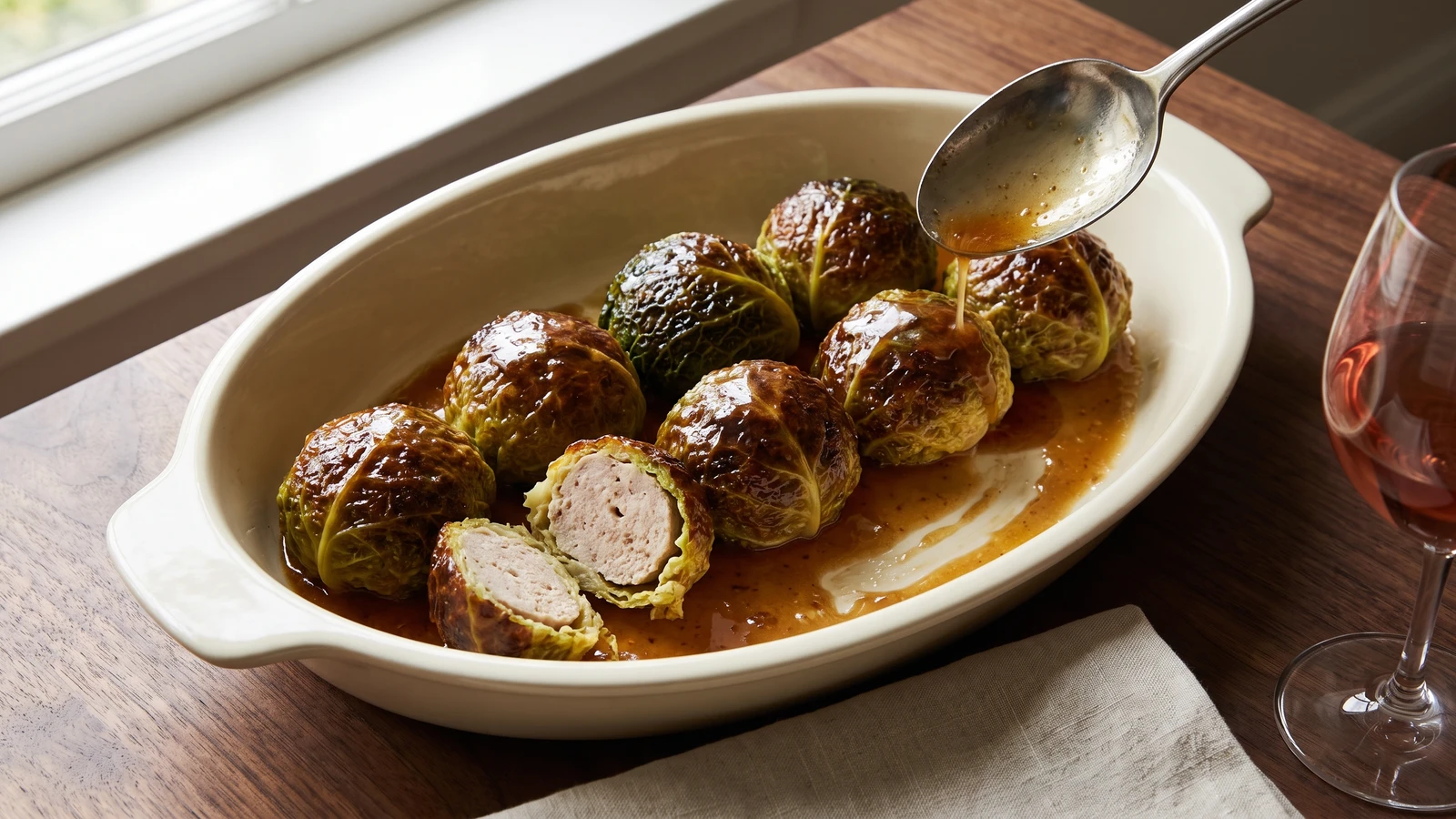
Eight glossy parcels of Savoy cabbage hide a cold-set heart of smooth pork forcemeat, poaching gently as the leaves braise, then receiving a final coat of their own buttered juices.
Choux pour Garnitures, B (braised cabbage balls with pork forcemeat) teach a small, exact lesson: the cabbage and its filling must finish cooking together. The farce fine de porc (smooth pork forcemeat) must stay cold and sit precisely at the centre. Warm farce loses its fine emulsion, while an off-centre portion reaches the edge too soon and can split the parcel.
The brigade entry assumes cabbage already prepared by a preceding method, farce waiting at the garde-manger station, stock never off the fire, and enough hands to shape service quantities. A saucier and a salamander contribute nothing here. The home translation uses a food processor, good unsalted chicken stock, and one lidded sauté pan to make eight balls for four people. The book's pigeon’s-egg measure becomes a 1-ounce, or 28 to 30 gram, oval that a home cook can repeat accurately.
Separate stations and great quantities were scaffolding for the brigade, so they go. Blanching and squeezing the cabbage, keeping the farce cold, enclosing it completely, and braising at a bare tremble are the dish, so they stay. Before you touch the pan, remember the one thing that decides the result: cold filling, dead-centre.
These petits choux belong to the Parisian classical garnish repertoire, where a garnish meant a carefully cooked accompaniment to a roast or braise, not a decorative afterthought. French household cooks had long enclosed meat in cabbage leaves, and the classical kitchen translated that practical union into small, uniform balls that could be portioned neatly at service. The pigeon’s-egg measure is not whimsy but a working ratio, small enough for the pork to poach in the time the cabbage becomes tender.
Quantity
1 small cabbage (about 1½ pounds / 680 g)
10 large outer leaves kept whole and 10 ounces / 280 g tender inner leaves finely shredded
Quantity
1 tablespoon (15 ml / 18 g) for blanching, plus ¾ teaspoon (3.75 ml / 4.5 g)
divided
Quantity
5 ounces / 140 g
very cold and cut into ½-inch pieces
Quantity
1¾ ounces / 50 g
very cold and cut into ½-inch pieces
Quantity
1 large (2 tablespoons / 30 ml / 30 g)
very cold
Quantity
3 tablespoons (45 ml / 45 g)
very cold
Quantity
¼ teaspoon (1.25 ml / 0.5 g)
Quantity
1/16 teaspoon (0.3 ml / 0.1 g)
Quantity
3 tablespoons (45 ml / 42 g)
divided
Quantity
1 small (about 4 ounces / 115 g)
thinly sliced
Quantity
1 small (about 2 ounces / 60 g)
thinly sliced
Quantity
2 thick slices (about 2 ounces / 60 g)
cut crosswise into thirds
Quantity
1
2 thyme sprigs, 2 parsley stems, and 1 bay leaf
Quantity
1½ cups (360 ml / 360 g)
| Ingredient | Quantity |
|---|---|
| Savoy cabbage10 large outer leaves kept whole and 10 ounces / 280 g tender inner leaves finely shredded | 1 small cabbage (about 1½ pounds / 680 g) |
| fine sea saltdivided | 1 tablespoon (15 ml / 18 g) for blanching, plus ¾ teaspoon (3.75 ml / 4.5 g) |
| boneless pork shouldervery cold and cut into ½-inch pieces | 5 ounces / 140 g |
| pork fatbackvery cold and cut into ½-inch pieces | 1¾ ounces / 50 g |
| large egg whitevery cold | 1 large (2 tablespoons / 30 ml / 30 g) |
| heavy creamvery cold | 3 tablespoons (45 ml / 45 g) |
| ground white pepper | ¼ teaspoon (1.25 ml / 0.5 g) |
| freshly grated nutmeg | 1/16 teaspoon (0.3 ml / 0.1 g) |
| unsalted butterdivided | 3 tablespoons (45 ml / 42 g) |
| yellow onionthinly sliced | 1 small (about 4 ounces / 115 g) |
| carrotthinly sliced | 1 small (about 2 ounces / 60 g) |
| unsmoked streaky baconcut crosswise into thirds | 2 thick slices (about 2 ounces / 60 g) |
| bouquet garni2 thyme sprigs, 2 parsley stems, and 1 bay leaf | 1 |
| good unsalted chicken stock | 1½ cups (360 ml / 360 g) |
Chill the food-processor bowl and blade for 15 minutes. Add the pork shoulder, fatback, ½ teaspoon of the fine salt, the white pepper, and nutmeg. Pulse in short bursts until the mixture becomes smooth and tacky, scraping the bowl as needed. Add the egg white and process only until absorbed, then add all but 1 teaspoon of the cold cream in three additions. Stop as soon as the farce looks satiny and holds together on a spoon. If it becomes shiny, greasy, or slack, it has grown too warm. Stop, chill the bowl and blade for 15 minutes, then pulse in the reserved teaspoon of cream. Ça se rattrape. Poach a teaspoonful in barely simmering water until completely cooked, taste it, and adjust with a little of the remaining salt. Cover and refrigerate the farce.
Bring a large pot of water to a boil and add the tablespoon of blanching salt. Lower in the 10 whole outer leaves and blanch for 2 to 3 minutes, just until flexible without becoming limp. Lift them into cold water. Add the shredded inner cabbage to the boiling water and blanch for 4 minutes, then drain and refresh it in cold water as well. Cooling stops the cooking and preserves the cabbage's fresh green colour.
Spread the whole leaves on towels and blot them carefully. Gather the shredded cabbage in a clean towel and squeeze hard until no more water runs from it. Melt 1 tablespoon of the butter in a wide pan, add the shredded cabbage and ¼ teaspoon of the remaining salt, and stir over medium heat for 5 to 7 minutes, until it is butter-glossed and no moisture hisses from the pan. Wet cabbage loosens the parcels and dilutes the braise, so if it still weeps when pressed, keep cooking. Spread it on a tray and let it cool completely.
Divide the chilled farce into eight oval portions of 1 ounce / 28 to 30 g each, about the size of the pigeon’s egg named by the book. Divide the cooled shredded cabbage into eight equal portions. Trim the thick central rib from each whole leaf without cutting through the tender end, then lay a leaf cupped-side up. Flatten one portion of shredded cabbage in its centre, press a hollow into it, and set a farce oval in the hollow. Mold the shredded cabbage completely around the pork, then fold the whole leaf tightly over it to make a compact ball about 2 inches / 5 cm across. Use two leaves as repairs or discard them if every parcel closes cleanly. If a leaf tears, overlap a piece from a spare leaf over the opening. Keep the finished balls cold while you shape the rest.
Heat the oven to 325°F / 160°C. Scatter the onion and carrot across the base of a 12-inch / 30 cm lidded ovenproof sauté pan. Lay the bacon over the vegetables and tuck in the bouquet garni. Arrange the cabbage balls snugly on top, seam-side down, and dot them with 1 tablespoon of the butter. Warm the chicken stock in a small saucepan until it just begins to simmer.
Pour the hot stock down the side of the pan until it reaches roughly halfway up the cabbage balls. Bring it to the barest tremble on the stove. Cover the surface with a cartouche (a round of buttered parchment set directly over the food), put on the lid, and transfer the pan to the oven. Braise for 40 to 50 minutes, until a fine skewer enters the cabbage without resistance and the pork centres register at least 160°F / 71°C. A hard boil tightens the farce and pushes at the seams, so lower the oven to 300°F / 150°C if the liquid bubbles vigorously. If a parcel opens, turn the split toward the pan wall, cover it with a spare piece of leaf, and wedge it gently against its neighbour while it finishes.
Lift the cabbage balls onto a warm shallow serving dish. Strain the braising liquid into a saucepan, pressing lightly on the vegetables, then discard the bacon, vegetables, and bouquet garni. Skim any obvious surface fat and boil the liquid until about ½ cup / 120 ml remains and it lightly coats a spoon. If it tastes fully seasoned before reaching that point, stop reducing. Off the heat, whisk in the final tablespoon of cold butter until the juices turn glossy. If the glaze separates, whisk in a teaspoon of cold stock away from the heat. Spoon it generously over the cabbage balls and serve two to each guest. À table!
1 serving (about 250g)
Culinary guides, cultural storytelling, and the editorial depth that makes cooking meaningful.
Discover Culinary ExplorerChef Juliette
Boulettes au suif, poached beside salt beef, turn equal weights of flour and finely chopped suet into tender, rich dumplings. Keep the beef liquor at a bare tremble and the old garnish works beautifully at home.

Chef Juliette
Bread, flour, frangipane, and rice become four cool, supple panades for binding forcemeats, each changing body and flavor while preserving tenderness. The finest Mousselines need none, and knowing that distinction is the lesson.

Chef Juliette
Panade au pain is bread, milk, salt, heat, and attention: stir until the paste releases cleanly, butter it against a skin, and you have the quiet binder behind tender French farces.

Chef Juliette
Panade de farine teaches the drying stroke behind pâte à choux: flour meets boiling buttered water, then stays over the fire until the paste gathers, smooths, and quits the pan cleanly.