Chef Juliette
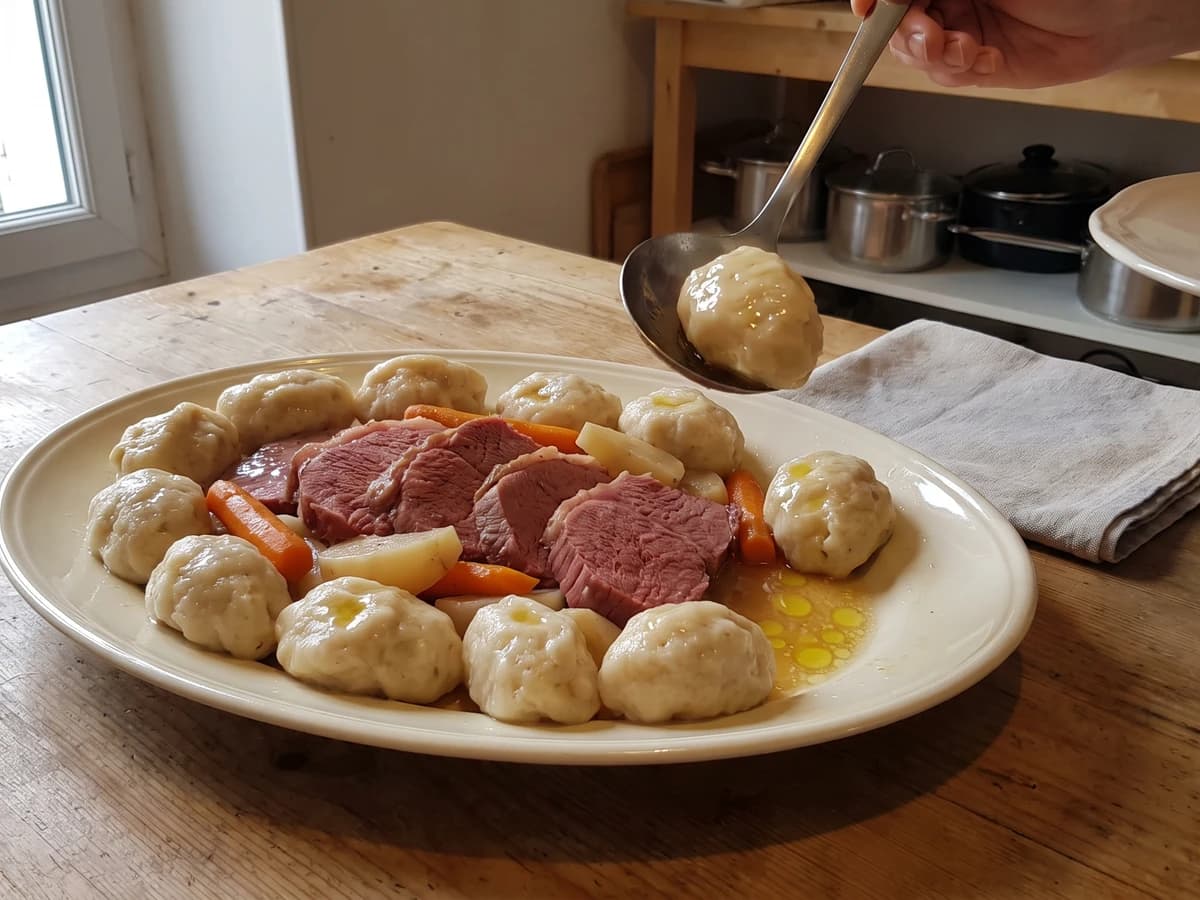
Suet Dumpling
Boulettes au suif, poached beside salt beef, turn equal weights of flour and finely chopped suet into tender, rich dumplings. Keep the beef liquor at a bare tremble and the old garnish works beautifully at home.
A cooking platform built around craft, culture, and the stories behind what we eat.
Created by Chef Juliette
Based on No. 2104, Cabbages for Garnish.—A, from Le Guide Culinaire (1907) by Auguste Escoffier
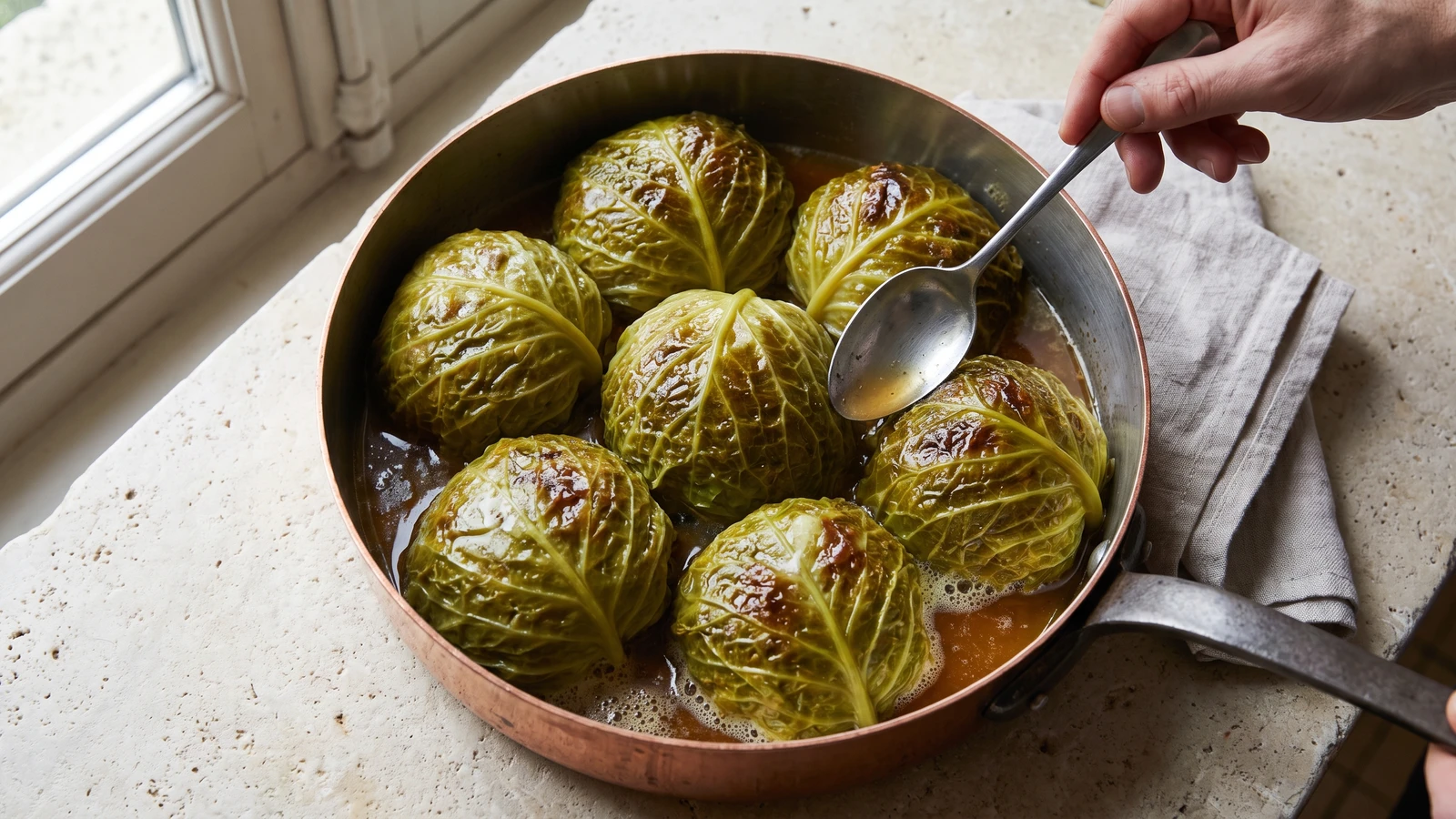
Eight tender cabbage parcels, each leaf wrapped around its own peppery heart, braised close together over bacon and aromatics until they hold their shape and shine with reduced pan juices.
Choux pour Garniture, Méthode A (cabbage balls for garnish) teaches a small but serious rule: shape holds only when the cabbage is thoroughly drained and the parcels are packed closely enough to support one another. The filling is simply the chopped heart of the same cabbage, salted and peppered, so there is nowhere for carelessness to hide. You get tender leaves outside, savory softness within, and eight neat parcels generous enough to serve as a side.
The old entry sends the brigade cook from shaping straight to Braised Cabbage. It assumed a commis making service quantities, a sautépan already laid with bacon and aromatics, and a stockpot never off the fire. Your honest equivalent is one covered 10-inch pan, good unsalted stock, and the oven holding a gentle heat. The brigade's separate pan work is scaffolding and can go. The blanching, draining, wrapping, tight packing, and slow braise are the dish, so they stay. One cook, one stove, one evening.
Before touching the pan, know this: squeeze the chopped cabbage until it no longer gives up water. If it remains wet, dry it briefly in a skillet before shaping. Ça se rattrape. Thorough draining is the step that decides whether the choux pour garniture remain round or slump into the braising liquor.
Choux pour garniture belongs to the Parisian classical garnish repertoire, where vegetables were shaped and portioned with the same care given to the roast or braise they accompanied. Unlike the large meat-filled chou farci associated with Auvergne and other regional tables, Méthode A wraps cabbage around its own seasoned heart, making a composed vegetable garnish rather than a separate main dish. It passed naturally into bourgeois home cooking because the parcels could be prepared ahead, packed into one pan, and served neatly around pork, duck, beef, or game.
Quantity
1 medium head (about 2 lb / 900 g)
Quantity
1 tablespoon plus 1 teaspoon (20 ml / 24 g)
divided
Quantity
1/2 teaspoon (2.5 ml / 1 g)
Quantity
4 thick slices (4 oz / 115 g)
cut into broad strips
Quantity
2 tablespoons (30 ml / 28 g)
divided
Quantity
1/2 cup (120 ml / 75 g)
diced
Quantity
1/3 cup (80 ml / 45 g)
thinly sliced
Quantity
1 small bouquet
1 bay leaf, 2 thyme sprigs, and 4 parsley stems
Quantity
2 cups (480 ml / 480 g)
| Ingredient | Quantity |
|---|---|
| firm green cabbage | 1 medium head (about 2 lb / 900 g) |
| fine sea saltdivided | 1 tablespoon plus 1 teaspoon (20 ml / 24 g) |
| freshly ground black pepper | 1/2 teaspoon (2.5 ml / 1 g) |
| unsmoked streaky baconcut into broad strips | 4 thick slices (4 oz / 115 g) |
| unsalted butterdivided | 2 tablespoons (30 ml / 28 g) |
| yellow oniondiced | 1/2 cup (120 ml / 75 g) |
| carrotthinly sliced | 1/3 cup (80 ml / 45 g) |
| bouquet garni1 bay leaf, 2 thyme sprigs, and 4 parsley stems | 1 small bouquet |
| unsalted light chicken stock | 2 cups (480 ml / 480 g) |
Heat the oven to 325°F (165°C). Cut a cone around the cabbage core without separating the head. Bring a large pot of water to a boil and add 1 tablespoon (18 g) of the salt. Lower in the cabbage. As its outer leaves soften, loosen them one at a time with tongs until you have 8 broad, intact leaves, about 3 to 5 minutes. If the leaves are small, take 16 and use two for each ball, exactly as the source directs. Continue parboiling the remaining cabbage for 5 minutes, then transfer everything to cold water. The leaves should bend without cracking but still possess enough strength to hold the filling.
Spread the whole leaves on clean towels and shave down each thick central rib without cutting through the leaf. Drain the remaining cabbage, remove its hard core, and chop the tender portion finely. Gather the chopped cabbage in a clean kitchen towel and twist firmly until no more water runs out. Season it evenly with the remaining 1 teaspoon (6 g) salt and the pepper. This dryness is the principle of the dish: wet filling produces loose parcels and a thin braise.
Rub a lidded 10-inch (25 cm) sautépan or shallow casserole with 1 tablespoon (14 g) of the butter. Scatter the onion and carrot across the bottom, lay the bacon strips over them, and tuck in the bouquet garni. This small aromatic bed replaces the brigade pan that the original entry assumed was already waiting; it protects the cabbage from direct heat while seasoning the stock beneath it.
Lay a cabbage leaf concave side up and place about 1/3 cup (80 ml / 65 g) chopped cabbage near its centre. Fold the rib end over the filling, bring in both sides, and roll the leaf around itself. Cup it between your hands to form a compact ball about 2 1/2 inches (6 cm) wide. Repeat to make 8. Arrange each ball seam-side down in the prepared pan, packing them snugly enough that they touch and support one another.
Pour the stock down the side of the pan so it reaches roughly halfway up the cabbage balls without washing over their folds. Bring it just to a bare simmer on the stovetop. Cover the cabbage directly with a round of baking parchment, put on the lid, and transfer the pan to the oven. Complete the cooking by the gentle method named Braised Cabbage in the source, braising for 50 to 60 minutes, until a thin knife passes through a parcel without resistance. The liquid should barely tremble. If it boils hard or falls below one-quarter of the parcels, lower the oven by 25°F (15°C) and add a little hot stock.
Lift the cabbage balls and bacon onto a warm plate, keeping the parcels seam-side down, and discard the bouquet garni. Boil the braising liquid and softened vegetables until reduced to about 1/2 cup (120 ml) and lightly thickened, 6 to 10 minutes. If it becomes too salty before it coats a spoon, stop reducing and loosen it with a tablespoon of hot water. Return the cabbage and bacon for 2 minutes, then take the pan off the heat and swirl in the remaining 1 tablespoon (14 g) butter. Spoon the glossy juices and vegetables over the parcels and serve two per person. À table!
1 serving (2 cabbage balls, about 250g)
Culinary guides, cultural storytelling, and the editorial depth that makes cooking meaningful.
Discover Culinary ExplorerChef Juliette
Boulettes au suif, poached beside salt beef, turn equal weights of flour and finely chopped suet into tender, rich dumplings. Keep the beef liquor at a bare tremble and the old garnish works beautifully at home.

Chef Juliette
Bread, flour, frangipane, and rice become four cool, supple panades for binding forcemeats, each changing body and flavor while preserving tenderness. The finest Mousselines need none, and knowing that distinction is the lesson.

Chef Juliette
Panade au pain is bread, milk, salt, heat, and attention: stir until the paste releases cleanly, butter it against a skin, and you have the quiet binder behind tender French farces.

Chef Juliette
Panade de farine teaches the drying stroke behind pâte à choux: flour meets boiling buttered water, then stays over the fire until the paste gathers, smooths, and quits the pan cleanly.