Chef Juliette
Suet Dumpling
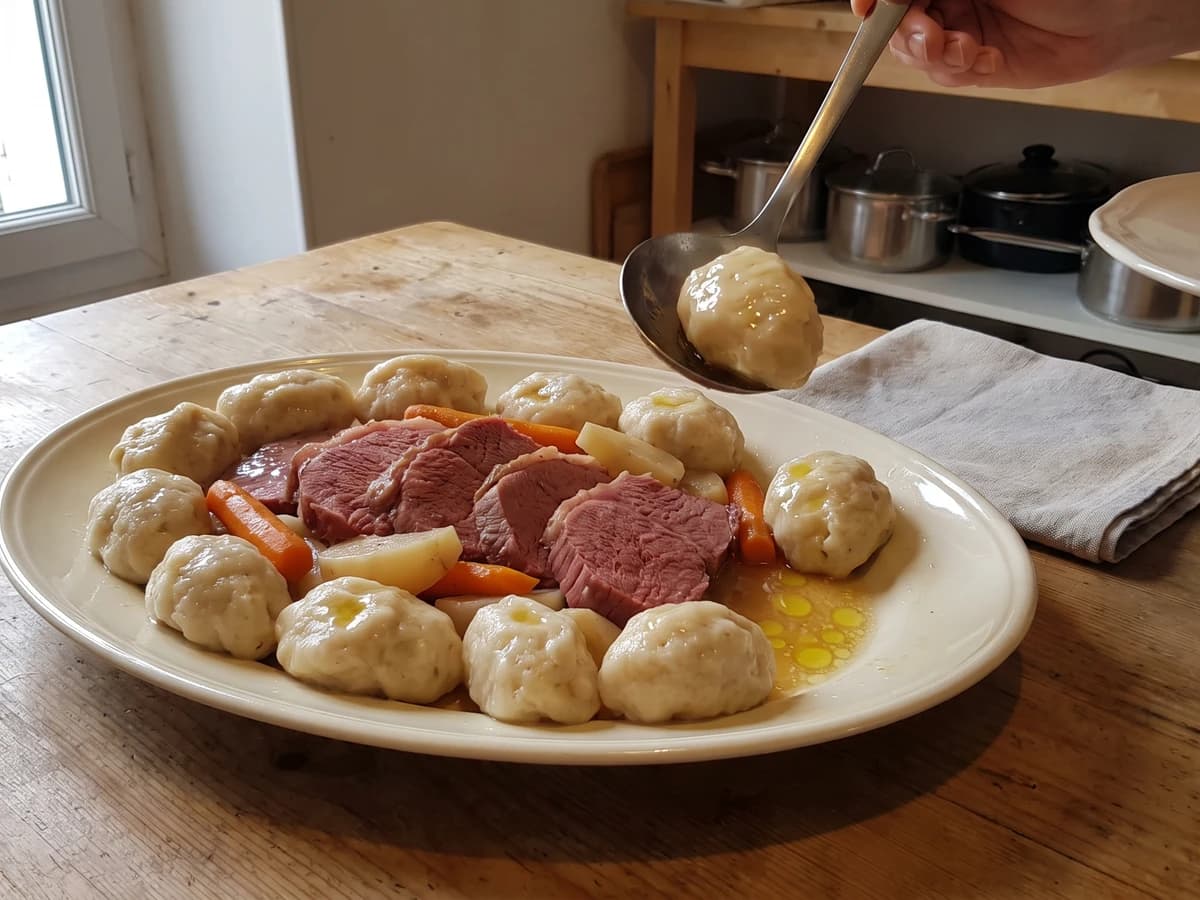
Boulettes au suif, poached beside salt beef, turn equal weights of flour and finely chopped suet into tender, rich dumplings. Keep the beef liquor at a bare tremble and the old garnish works beautifully at home.
A cooking platform built around craft, culture, and the stories behind what we eat.
Created by Chef Juliette
Based on No. 2095, Cabbages (Choux), from Le Guide Culinaire (1907) by Auguste Escoffier
Seven cabbages, seven jobs: choose the right head, then braise, boil, butter, or warm it as choucroute. Classification comes before heat, and one well-cooked vegetable is enough for supper.
Choux (cabbages) teach a principle larger than any one side dish: variety decides method. White cabbage belongs to choucroute; red can be a vegetable, hors-d’œuvre, or condiment; Savoy wants a braise; kale and spring greens want à l'anglaise (boiled in well-salted water, drained thoroughly, and finished with butter); cauliflower, broccoli, sprouts, and young kohlrabi each have their own timing. Put them all in one mixed pan and you have ignored the useful part of the entry.
The original entry assumed a vegetable station with broad pots, several pans, and fermented choucroute already in the larder. There is no saucier's work to reproduce and no stockpot to imitate. The honest home translation is one branch for four people, a medium pot or covered sauté pan, and good prepared choucroute for the white-cabbage route. The brigade's seven-way taxonomy is scaffolding, while matching each cabbage to its proper treatment is the part that must stay. One cook, one stove, one evening.
Control the water. Use enough to cook the vegetable, then drain or reduce it away before the final butter goes in; free water dilutes both flavor and sheen. Choose the cabbage class before the knife comes down. That decision is the step that matters most.
This classification belongs to the professional French vegetable repertoire rather than a single regional table. Its strongly regional branch is choucroute in Alsace, where fermented white cabbage became both a pantry staple and the foundation of a composed dish, while classical kitchens used à l'anglaise for tender greens and flower vegetables. The name à l'anglaise describes the treatment, not the origin of the cabbage: abundant salted water, thorough draining, and butter at service.
Quantity
4 cups (950 ml / 600 g)
drained
Quantity
10 cups (2.4 L / 900 g)
finely shredded
Quantity
1 medium head (about 2 pounds / 900 g)
cut through the core into 8 wedges
Quantity
10 cups (2.4 L / 675 g)
chopped, with tough stalks removed
Quantity
8 cups (1.9 L / 900 g)
Quantity
10 cups (2.4 L / 900 g)
trimmed, with large sprouts halved
Quantity
4 medium bulbs (about 2 pounds / 900 g)
bulbs peeled and cubed, leaves chopped
Quantity
3 tablespoons (45 ml / 42 g)
divided
Quantity
3 quarts (2.8 L / 2.8 kg)
Quantity
3/4 cup (180 ml / 180 g)
Quantity
1 tablespoon (15 ml / 18 g)
divided
Quantity
2 tablespoons (30 ml / 30 g)
| Ingredient | Quantity |
|---|---|
| White route: prepared choucroute (fermented white cabbage) (optional)drained | 4 cups (950 ml / 600 g) |
| Red route: red cabbage (optional)finely shredded | 10 cups (2.4 L / 900 g) |
| Savoy route: Savoy cabbage (optional)cut through the core into 8 wedges | 1 medium head (about 2 pounds / 900 g) |
| Kale or spring-green route: kale or spring greens (optional)chopped, with tough stalks removed | 10 cups (2.4 L / 675 g) |
| Cauliflower or broccoli route: florets and tender leaves (optional) | 8 cups (1.9 L / 900 g) |
| Brussels-sprout route: Brussels sprouts (optional)trimmed, with large sprouts halved | 10 cups (2.4 L / 900 g) |
| Kohlrabi route: kohlrabi with young leaves (optional)bulbs peeled and cubed, leaves chopped | 4 medium bulbs (about 2 pounds / 900 g) |
| unsalted butterdivided | 3 tablespoons (45 ml / 42 g) |
| water for boiling routes (optional) | 3 quarts (2.8 L / 2.8 kg) |
| water for braised or choucroute routes (optional) | 3/4 cup (180 ml / 180 g) |
| fine sea saltdivided | 1 tablespoon (15 ml / 18 g) |
| Red route: red wine vinegar (optional) | 2 tablespoons (30 ml / 30 g) |
Set out only the cabbage and branch ingredients you intend to cook; each quantity makes four side-dish servings. Follow one of Steps 2 through 8, then finish with Step 9. Remove bruised outer leaves, but keep any sound tender leaves from cauliflower, broccoli, or kohlrabi, because the source treats them as vegetables in their own right.
For the white route, melt 2 tablespoons of the butter in a saucepan over medium-low heat. Add the drained choucroute and 1/2 cup of the braising water, cover, and warm gently for 15 minutes, turning it twice so the strands heat evenly. Uncover and cook until no water pools beneath it, then fold in the remaining butter. Taste before adding salt, since fermentation has already seasoned the cabbage. If the acidity bites too sharply, rinse one-third of the choucroute briefly, squeeze it dry, and mix it back in. Ça se rattrape.
For the red route, melt 2 tablespoons of the butter in a wide covered pan. Add the shredded cabbage and 1 teaspoon of the salt, then turn it through the butter for 5 minutes until it glistens and begins to settle. Add 1 tablespoon of the vinegar and all 3/4 cup of the braising water. Cover and cook gently for 20 to 25 minutes, stirring twice, until tender but still distinct. Uncover, reduce away the remaining liquid, and finish with the last butter and vinegar. Serve hot as a vegetable, cool as an hors-d’œuvre, or offer a smaller spoonful as a condiment. If the pan dries before the cabbage softens, add water by the tablespoon; if anything catches, move the clean cabbage to another pan and leave the scorched layer behind.
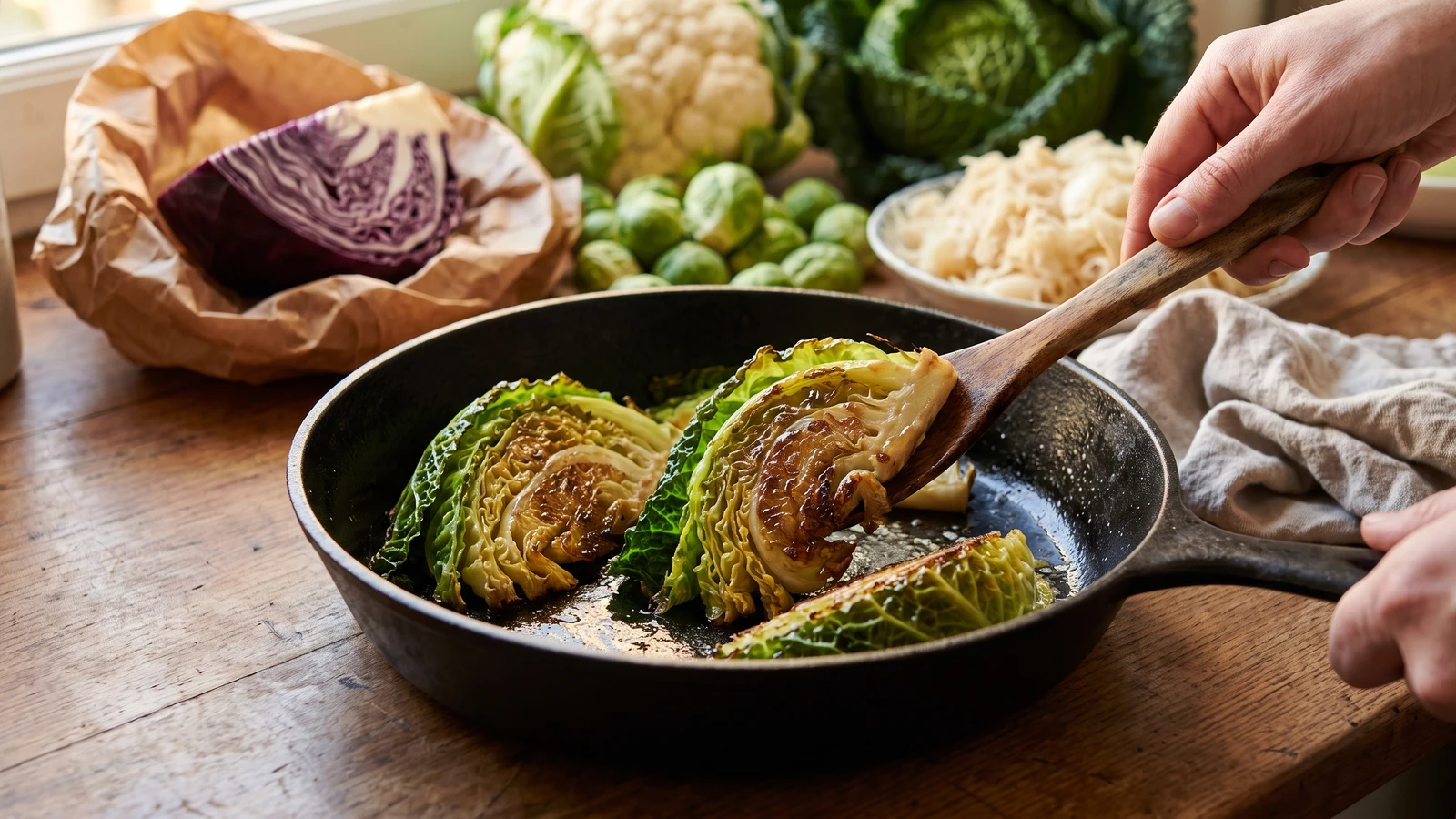
For the Savoy route, melt 2 tablespoons of the butter in a wide pan with a lid. Lay in the wedges cut-side down and let them color for 3 to 4 minutes, then turn them onto the other cut side. Add the braising water and 1 teaspoon of the salt, cover, and cook over gentle heat for 18 to 22 minutes, turning once, until a knife slips through the core without resistance. Uncover and reduce the liquid until it clings lightly to the leaves, then add the remaining butter and spoon the glaze over the wedges. If the cabbage is tender while liquid still sloshes in the pan, lift the wedges out before reducing; return them only for the final butter.
For kale or spring greens à l'anglaise, bring the boiling water and remaining salt to a full boil in a large pot. Add the greens and cook uncovered until tender, about 4 to 6 minutes for spring greens or 6 to 10 minutes for mature kale. Drain thoroughly, press out free water with the back of a spoon, and return the greens to the dry pot with all the butter. Toss over medium heat until each leaf shines. If the greens have gone softer than intended, chop them finely and beat in the butter; serve them as tender chopped greens instead of pretending they still have bite. Never apologize at your own table.
For cauliflower or broccoli à l'anglaise, bring the salted boiling water back to a full boil. Add cauliflower florets for 6 to 8 minutes, or broccoli florets for 3 to 5 minutes, adding the tender leaves for the final 2 minutes. Drain at once and return everything to the empty pot over low heat for 30 seconds, turning gently so clinging water evaporates. Add the butter and coat without breaking the florets. If they become too soft, crush them coarsely with the butter and serve at once; a good buttery purée is better than a watery floret.
For Brussels sprouts, boil them in the salted water for 6 to 9 minutes, depending on size, until a knife enters the center with slight resistance. Drain very well. Melt the butter in a wide sauté pan, add the sprouts, and turn them for 3 to 4 minutes until glossy, with a few cut faces taking a butter-gold edge. If they enter the pan waterlogged, spread them in one layer and leave them undisturbed until the moisture cooks away; stirring constantly only keeps them wet.
For kohlrabi, peel the bulbs deeply enough to remove every fibrous layer, then cut them into even 3/4-inch cubes. Boil the cubes in the salted water for 10 to 14 minutes, adding the chopped young leaves for the final 4 minutes. Drain thoroughly and turn both bulbs and leaves through the butter over medium heat until coated and bright. If a cube remains stringy, the peeling was too timid; trim away the fibrous edge and simmer it a little longer. Higher heat won't soften a tough outer layer.
Taste the chosen preparation only after its excess water has gone and the butter has coated it; this is when salt can be judged honestly. Transfer it to a warmed serving dish, carrying any reduced buttery juices with it, and bring it straight to the table. Cooking well is not cooking fancy. À table!
1 serving (about 205g)
Culinary guides, cultural storytelling, and the editorial depth that makes cooking meaningful.
Discover Culinary ExplorerChef Juliette
Boulettes au suif, poached beside salt beef, turn equal weights of flour and finely chopped suet into tender, rich dumplings. Keep the beef liquor at a bare tremble and the old garnish works beautifully at home.

Chef Juliette
Bread, flour, frangipane, and rice become four cool, supple panades for binding forcemeats, each changing body and flavor while preserving tenderness. The finest Mousselines need none, and knowing that distinction is the lesson.

Chef Juliette
Panade au pain is bread, milk, salt, heat, and attention: stir until the paste releases cleanly, butter it against a skin, and you have the quiet binder behind tender French farces.

Chef Juliette
Panade de farine teaches the drying stroke behind pâte à choux: flour meets boiling buttered water, then stays over the fire until the paste gathers, smooths, and quits the pan cleanly.