Chef Juliette
Suet Dumpling
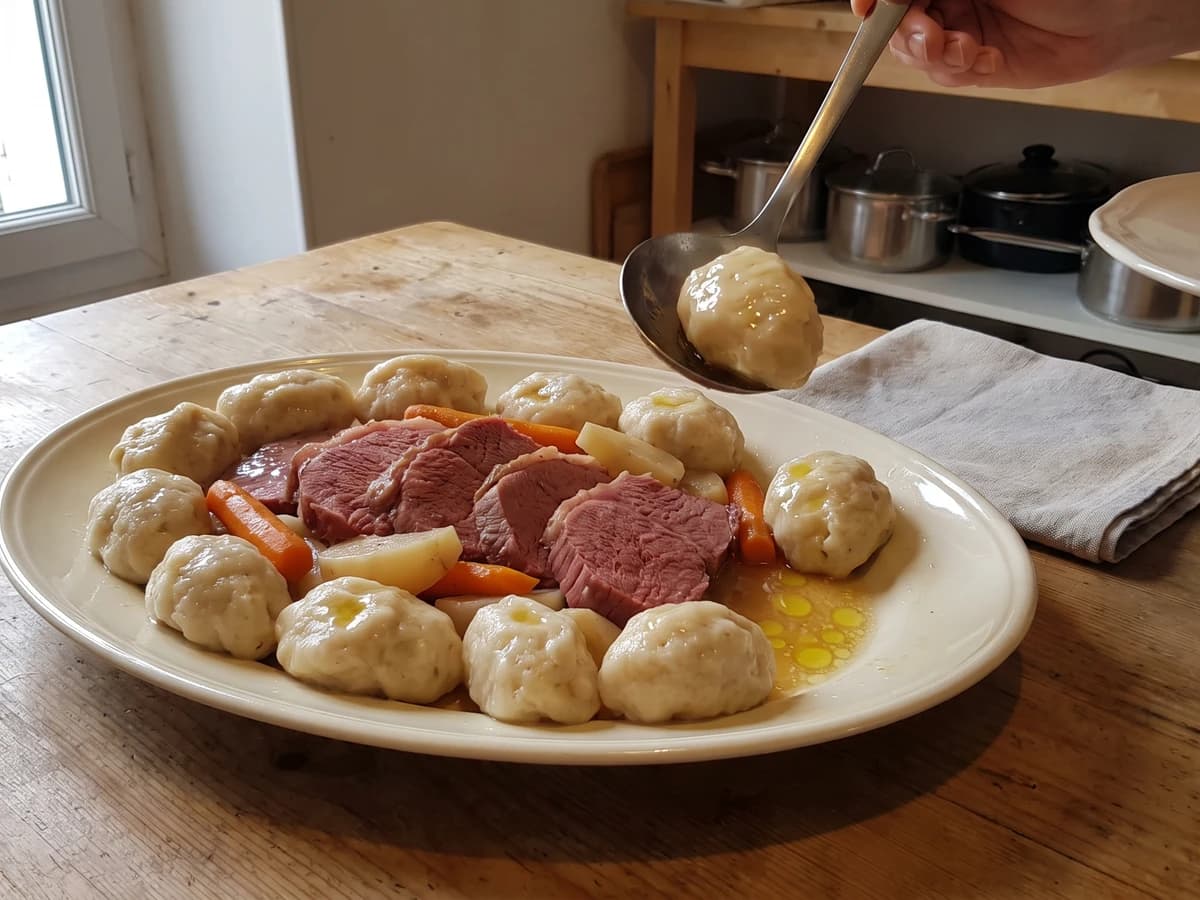
Boulettes au suif, poached beside salt beef, turn equal weights of flour and finely chopped suet into tender, rich dumplings. Keep the beef liquor at a bare tremble and the old garnish works beautifully at home.
A cooking platform built around craft, culture, and the stories behind what we eat.
Created by Chef Juliette
Based on No. 2094, Endives or Brussels Chicory, from Le Guide Culinaire (1907) by Auguste Escoffier
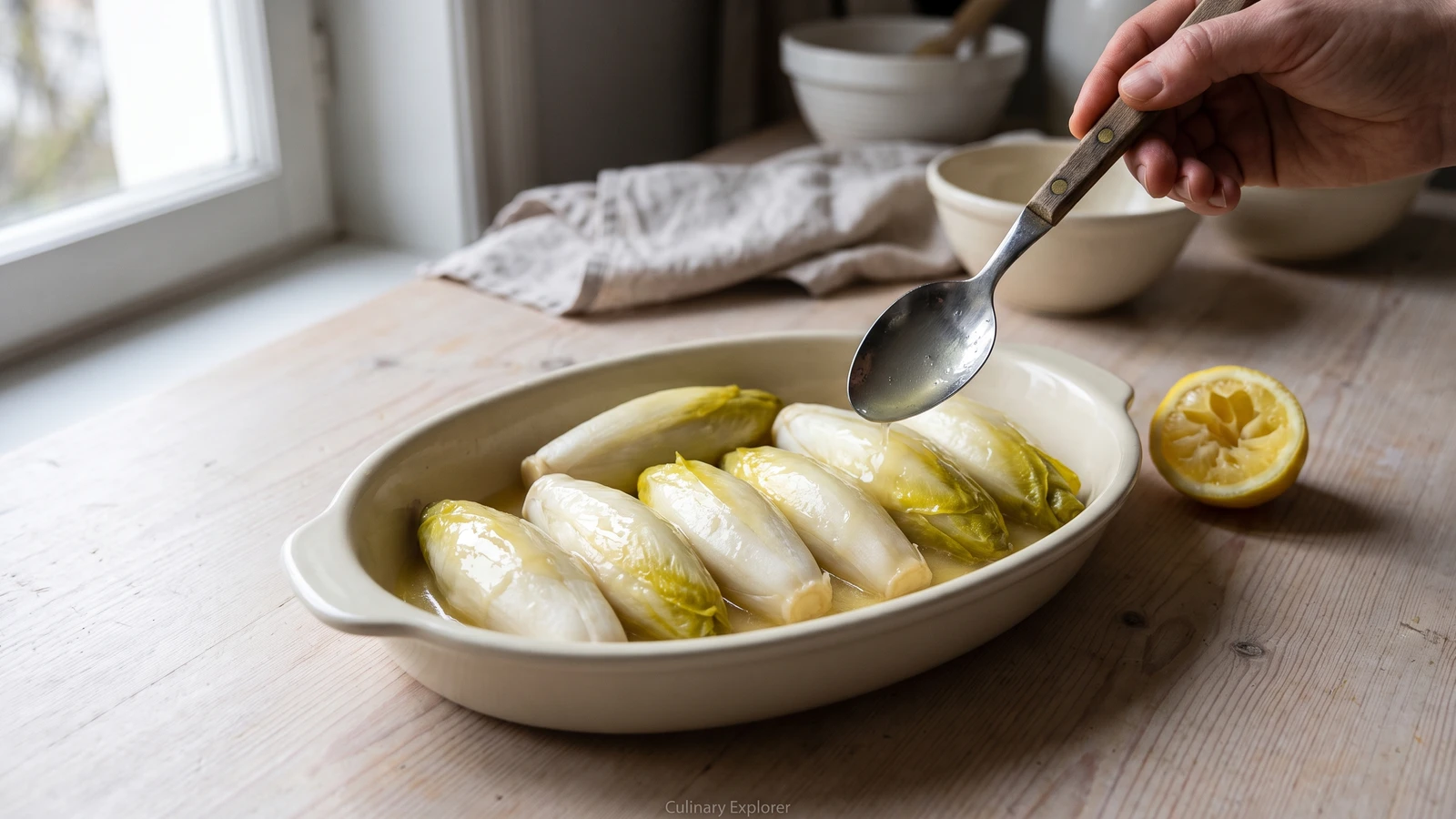
Endives de Bruxelles étuvées turn four plain ingredients into a pale, buttery side: keep the lid closed, let the lemon guard their colour, and cook until the bitter core softens.
Endives de Bruxelles étuvées (butter-stewed Belgian endives) teach the quiet discipline of étuver, cooking gently under a lid in almost no liquid. The endives contribute their own water while butter softens their bitterness and lemon keeps the pale leaves from greying. This isn't boiling, and it isn't a sauté. The scant liquor and the closed pan are the technique.
The original formula assumed three pounds of endives, a well-tinned saucepan, and the steady low heat found at the side of a working range. Your honest equivalents are a heavy stainless-steel pan, the smallest burner, and half the batch for four people. Only the scale and heat source change; the proportions, covered cooking, and thirty-five minutes remain. A brigade might cook a large preparative batch for holding and later garnishes, but that holding stage is scaffolding and can go. The lemon-butter étuvage is the dish itself and must stay.
Bring the scant liquor quickly to the boil, lower the heat at once, and keep the lid closed. That trapped moisture decides whether the endives become tender and glossy or catch against the pan before their firm cores surrender. One cook, one stove, one evening.
Endive de Bruxelles belongs to the market-gardening tradition around Brussels, where chicory roots are forced in darkness to produce tightly folded, ivory leaves; in Belgium and northern France it is also called chicon. French classical kitchens carried this Belgian vegetable into their repertoire as both a plain buttered side and a preparative garnish for more elaborate dishes. Its bitterness is not a fault to be hidden with sugar: gentle covered cooking rounds it while preserving enough backbone to accompany roasted and braised meats.
Quantity
6 medium, about 1½ lb (680 g)
washed and carefully trimmed
Quantity
1½ tablespoons (22 ml / 23 g), from ½ medium lemon
freshly squeezed
Quantity
1 tablespoon (15 ml / 14 g)
Quantity
¼ cup (60 ml / 60 g)
Quantity
⅛ teaspoon (0.6 ml / 0.8 g)
| Ingredient | Quantity |
|---|---|
| Belgian endiveswashed and carefully trimmed | 6 medium, about 1½ lb (680 g) |
| fresh lemon juicefreshly squeezed | 1½ tablespoons (22 ml / 23 g), from ½ medium lemon |
| unsalted butter | 1 tablespoon (15 ml / 14 g) |
| water | ¼ cup (60 ml / 60 g) |
| fine salt | ⅛ teaspoon (0.6 ml / 0.8 g) |
Discard any bruised outer leaves and rinse the endives under cold water, opening the leaves only enough to remove trapped grit. Pare away the browned tip of each root, but leave the firm core intact. Cut too deeply and the heads loosen into separate leaves during cooking; the core is what holds each endive together.
Put the lemon juice, water, salt, and butter into a heavy 11-inch (28 cm) stainless-steel sauté pan. Arrange the endives snugly in one layer, turning them through the liquor once so their surfaces are lightly moistened, then cover with a tight-fitting lid. The lemon belongs in from the beginning because it protects the pale colour while the leaves soften.
Set the covered pan over medium-high heat and bring the liquor quickly to a boil, about 2 to 3 minutes. As soon as you hear lively bubbling, lower the heat to its gentlest setting and étuver for 30 to 35 minutes. Keep the lid closed and rotate the pan once by its handle rather than repeatedly uncovering it; the small quantity of water is calculated to work with trapped condensation. If the bubbling falls silent and the butter begins to smell nutty before the endives are tender, the pan is drying. Pull it off the heat and add 1 tablespoon (15 ml / 15 g) water down the side. Ça se rattrape.
After 30 minutes, pierce the thick end of one head with a paring knife. The blade should enter without meeting a hard core, while the leaves remain together and retain their tapered shape. If there is resistance, cover again and cook for the remaining 5 minutes, adding another spoonful of water only if the pan is nearly dry.
Transfer the endives to a warm serving dish and spoon the remaining lemon-butter liquor over them. If the endives have released enough water to leave a thin puddle, hold them aside and boil the liquor briskly for 1 to 2 minutes, just until it gathers into a light, glossy coating, then pour it over. Serve the heads whole beside roast veal, pork, beef, or lamb. À table!
1 serving (about 180g)
Culinary guides, cultural storytelling, and the editorial depth that makes cooking meaningful.
Discover Culinary ExplorerChef Juliette
Boulettes au suif, poached beside salt beef, turn equal weights of flour and finely chopped suet into tender, rich dumplings. Keep the beef liquor at a bare tremble and the old garnish works beautifully at home.

Chef Juliette
Bread, flour, frangipane, and rice become four cool, supple panades for binding forcemeats, each changing body and flavor while preserving tenderness. The finest Mousselines need none, and knowing that distinction is the lesson.

Chef Juliette
Panade au pain is bread, milk, salt, heat, and attention: stir until the paste releases cleanly, butter it against a skin, and you have the quiet binder behind tender French farces.

Chef Juliette
Panade de farine teaches the drying stroke behind pâte à choux: flour meets boiling buttered water, then stays over the fire until the paste gathers, smooths, and quits the pan cleanly.