
Chef Juliette
Carottes Glacées pour Garnitures
Carottes Glacées prove that a garnish can teach a whole sauce lesson: carrots cook in butter, sugar, salt, and water until their own liquor reduces to a brilliant, clinging coat.
A cooking platform built around craft, culture, and the stories behind what we eat.
Created by Chef Juliette
Based on No. 2087, Brionne (Chow-chow), from Le Guide Culinaire (1907) by Auguste Escoffier
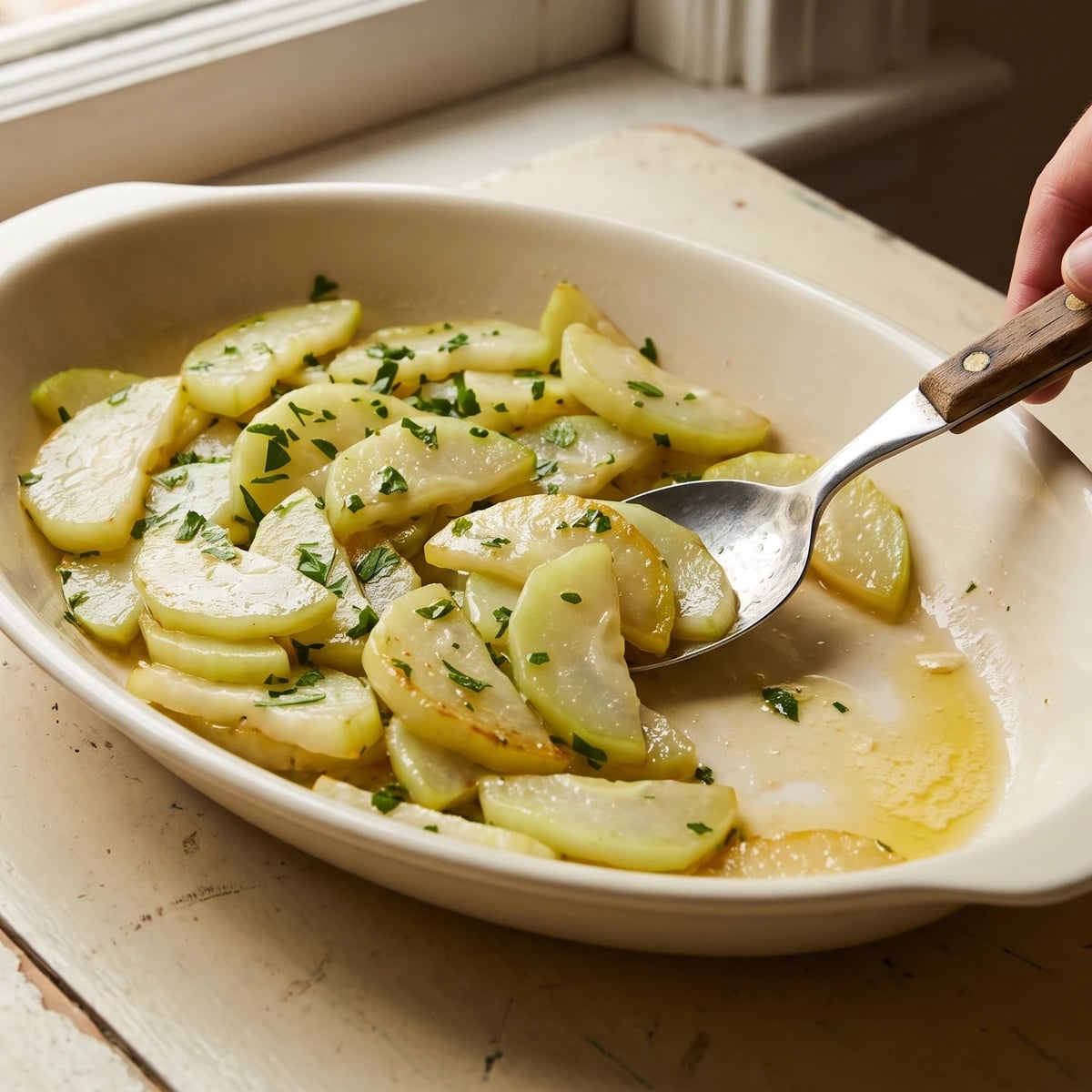
Brionne sautée au beurre turns the quiet chayote into a proper French side: tender, translucent slices with butter-gold edges, lemon, and parsley. Dry it well after blanching, because water decides the pan.
Brionne sautée au beurre (butter-sautéed chayote) teaches a plain but unforgiving vegetable lesson: water must leave before butter can brown. The brionne should be tender and almost translucent, with pale-gold edges and a thin, lemon-bright butter glaze, not wet, crunchy, or collapsed.
The source entry is culinary shorthand rather than a proportioned formula. It assumes a brigade cook who can turn without explanation to established cucumber, vegetable-marrow, or cardoon preparations, with vegetables blanched ahead for service. This home version selects the simplest path the entry explicitly permits, the marrow treatment, and scales it to four side portions. Trays of precooked vegetables and long holding are brigade scaffolding, so they go. The blanch, careful drying, and monter au beurre (finishing with an emulsified butter glaze) are the dish, so they stay. One cook, one stove, one evening.
The decisive step comes before the skillet: after blanching, spread the slices wide and dry them completely. Wet brionne sheds water into the butter and simmers; dry brionne takes color. If water appears anyway, ça se rattrape, and the method tells you exactly how.
Chayote's botanical home is Mesoamerica, not metropolitan France; French-speaking tables naturalized it under different names, christophine in the Antilles, chouchou in Réunion, and brionne or chow-chow in classical metropolitan writing. The canon valued it when cucumbers and vegetable marrows had left the market, treating its mild flesh through those familiar methods or through cardoon preparations. In this title, chow-chow names the vegetable, not the chopped pickle relish known elsewhere.
Quantity
2 medium, about 1½ pounds (680 g)
peeled, seeded, and sliced into ¼-inch (6 mm) half-moons
Quantity
6 cups (1.4 L / 1.4 kg)
Quantity
2 teaspoons (10 ml / 12 g)
divided
Quantity
3 tablespoons (45 ml / 42 g)
divided
Quantity
2 teaspoons (10 ml / 10 g)
Quantity
⅛ teaspoon (0.6 ml / 0.3 g)
Quantity
2 tablespoons (30 ml / 8 g)
finely chopped
| Ingredient | Quantity |
|---|---|
| brionnes (chayotes)peeled, seeded, and sliced into ¼-inch (6 mm) half-moons | 2 medium, about 1½ pounds (680 g) |
| water | 6 cups (1.4 L / 1.4 kg) |
| fine sea saltdivided | 2 teaspoons (10 ml / 12 g) |
| unsalted butterdivided | 3 tablespoons (45 ml / 42 g) |
| fresh lemon juice | 2 teaspoons (10 ml / 10 g) |
| ground white pepper | ⅛ teaspoon (0.6 ml / 0.3 g) |
| flat-leaf parsleyfinely chopped | 2 tablespoons (30 ml / 8 g) |
Halve each brionne lengthwise, remove the pale central seed, and peel away the skin. Slice the flesh into even ¼-inch (6 mm) half-moons. Equal thickness matters more than speed: thin scraps collapse before thick pieces become tender. Chayote can leave a tacky sap on the hands, so peel it under cool running water or wear kitchen gloves, then rinse the slices.
Bring the water and 1½ teaspoons of the salt to a full boil in a saucepan. Add the brionne, return the water to a gentle boil, and cook for 6 to 9 minutes, until the edges turn translucent and a knife enters the thickest slice with slight resistance. Do not cook until soft; the skillet must finish the work. Reserve 2 tablespoons of the cooking water, then drain.
Spread the drained brionne in one layer over a clean kitchen towel. Blot the tops and leave the slices uncovered for 5 minutes, turning them once, until no droplets remain. This is the step that decides the dish. Moisture left on the surface cools the skillet and makes the vegetable simmer in its own water instead of taking color.
Melt 1 tablespoon of the butter in a wide heavy skillet over medium-high heat. When the foam subsides, add half the brionne in one uncrowded layer. Leave it untouched for about 2 minutes, then turn and cook until lightly golden at several edges, 1 to 2 minutes more. Transfer it to a warm plate and repeat with another tablespoon of butter and the remaining slices. If the vegetable releases water, lift it from the skillet and boil the liquid away completely before returning it with a small piece of the reserved butter. Ça se rattrape.
Return all the brionne to the skillet and lower the heat. Add the remaining butter, lemon juice, white pepper, and the remaining salt to taste. Toss and shake the pan for 1 minute, until the butter and lemon form a thin glaze that clings to every slice. If the butter looks greasy instead of coating the vegetable, add the reserved cooking water 1 teaspoon at a time while tossing. A controlled drop of water binds the glaze after the browning is finished.
Take the skillet off the heat, scatter in the parsley, and turn the slices once more. Taste for salt and lemon. Serve at once while the brionne is tender, glossy, and still distinct at the edges. Cooking well is not cooking fancy. À table!
1 serving (about 175g)
Culinary guides, cultural storytelling, and the editorial depth that makes cooking meaningful.
Discover Culinary Explorer
Chef Juliette
Carottes Glacées prove that a garnish can teach a whole sauce lesson: carrots cook in butter, sugar, salt, and water until their own liquor reduces to a brilliant, clinging coat.

Chef Juliette
Carottes à la Crème teaches the order that makes the dish: glaze the carrots to a syrup first, add the cream boiling, then reduce until each piece wears a shining ivory coat.

Chef Juliette
Carottes à la Vichy prove that a glaze is made by reduction, not decoration: even carrot coins cooked until tender and brilliant, then finished with parsley at the last moment.

Chef Juliette
Purée de Carottes turns humble carrots and rice into a butter-glossed, perfectly stable purée: sieve it fine, dry it fiercely, then loosen it until the spoon leaves one soft furrow.