Chef Juliette
Suet Dumpling
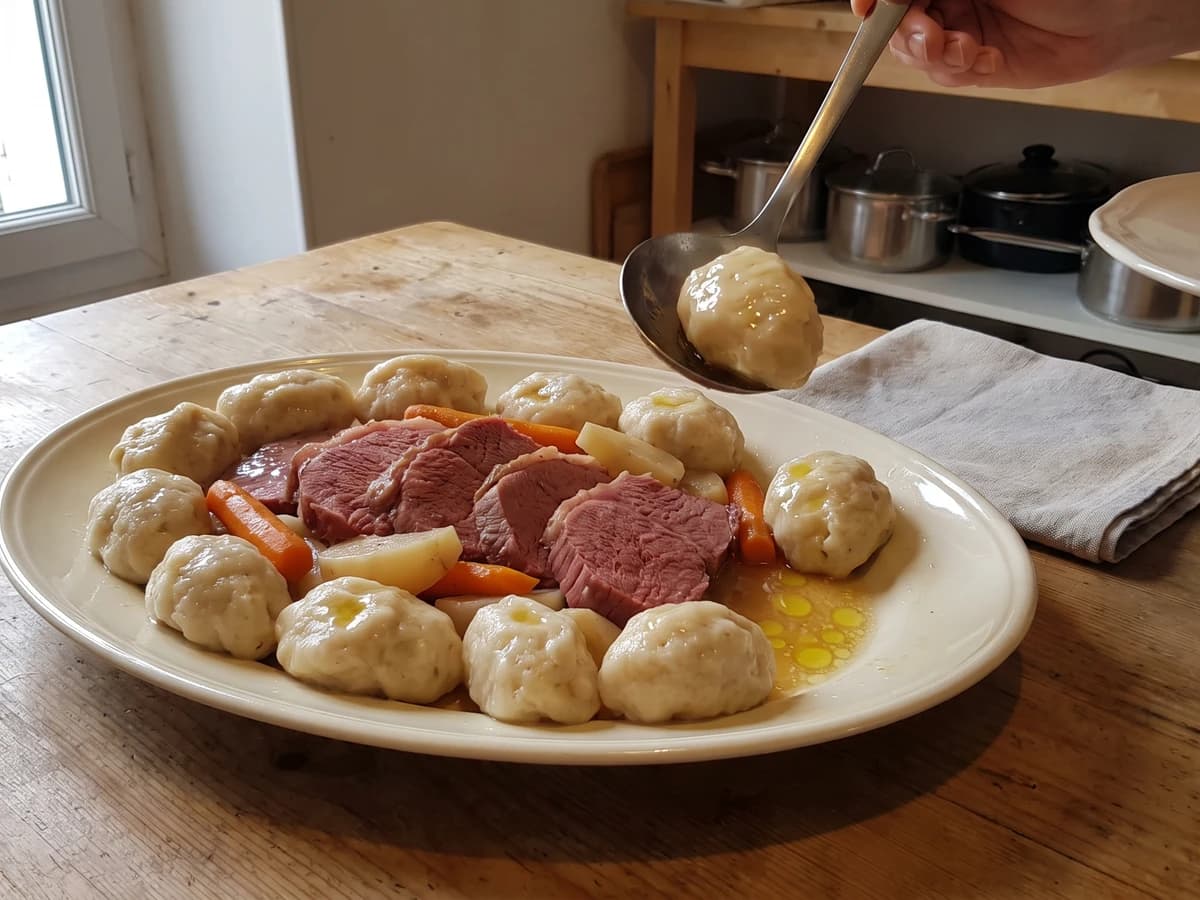
Boulettes au suif, poached beside salt beef, turn equal weights of flour and finely chopped suet into tender, rich dumplings. Keep the beef liquor at a bare tremble and the old garnish works beautifully at home.
A cooking platform built around craft, culture, and the stories behind what we eat.
Created by Chef Juliette
Based on No. 2067, Purée de Céleri-rave (Celeriac), from Le Guide Culinaire (1907) by Auguste Escoffier
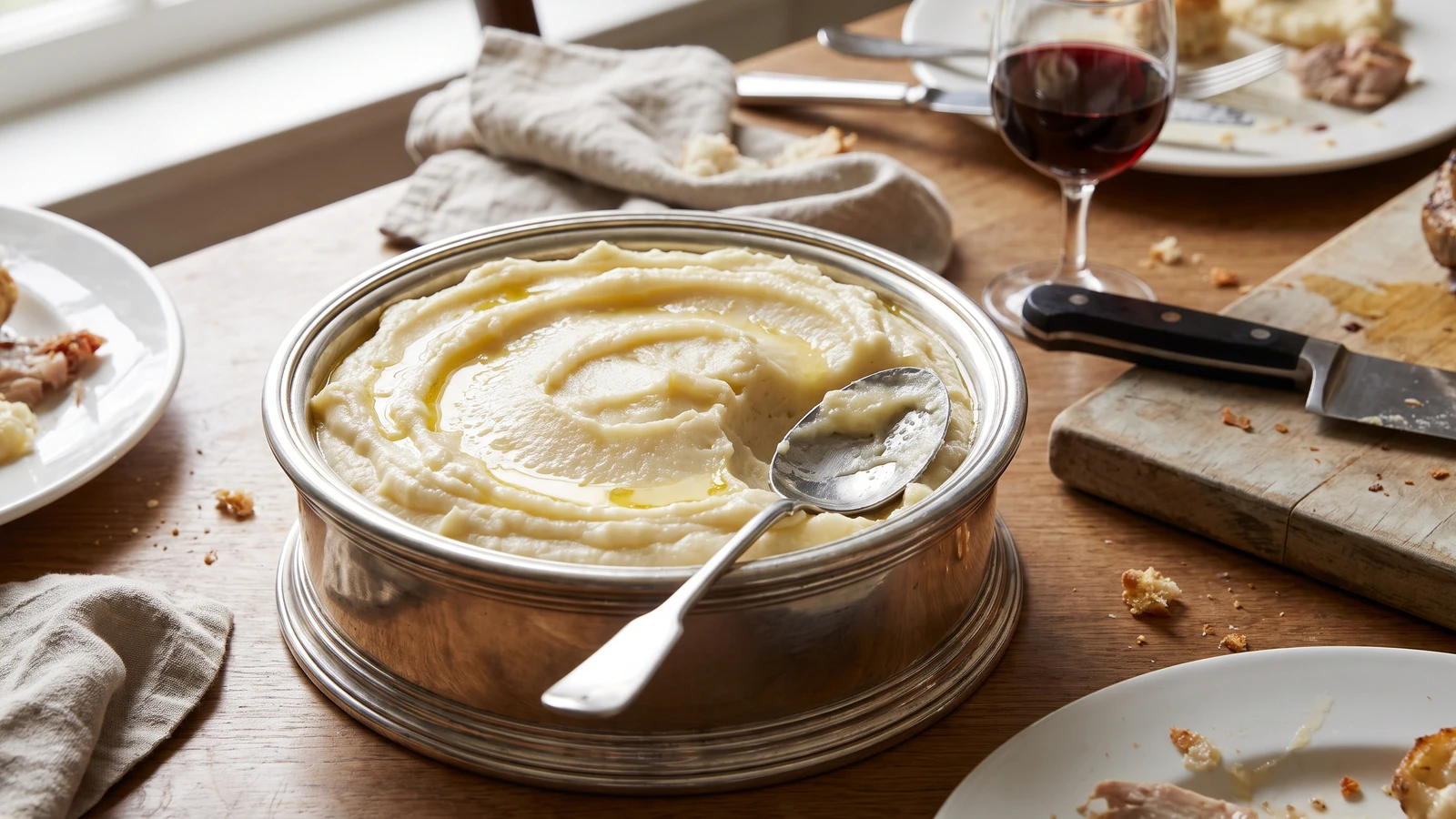
Purée de céleri-rave turns a knobbly root into silk by one decisive act: dry it fiercely before milk goes in, then finish with butter off the heat for a purée that holds a spoon and melts.
Purée de céleri-rave (celeriac purée) teaches the discipline behind every fine root purée: water must leave before milk enters. Celeriac holds more moisture and less starch than potato, so one measured third of plain-boiled potato supplies structure while preserving the root's clean, celery-like character. Butter goes in during the drying, milk restores suppleness, and a final piece of butter gives the surface its quiet gloss.
The source entry assumed a tamis (fine drum sieve), which it calls a tammy, a broad sauté pan over a fierce professional range, and a saucier with another pair of hands to add potato while the celeriac was being pressed. For one cook, one stove, one evening, a food mill or sturdy fine-mesh sieve does the same work. The roots are pressed and weighed separately before combining, a small change that preserves the specified one-third proportion without requiring a brigade.
The brigade quantity and tammy are scaffolding and can go. The ratio, smooth sieving, 3 oz butter per pound of combined purée, fierce drying, correction with milk, and final butter away from the heat are the dish itself, so every one stays. Watch the trail left by your spatula: when it remains open for a second, the purée is dry enough to receive the milk. That is the step that matters most.
Purée de céleri-rave is not the emblem of a single province; it belongs to the cuisine bourgeoise of Paris and to the root-cellar tables of Alsace and Lorraine, where celeriac has long accompanied roast poultry, beef, and game. Classical kitchens carried the household mash into formal service by passing it through a tamis and controlling its moisture over fierce heat. The potato is not careless filler but measured texture control, held to one-third the celeriac purée so the wetter root gains body without losing its identity.
Quantity
About 4 cups (1 1/3 lb / 600 g) after peeling
cut into 1-inch / 2.5 cm pieces
Quantity
About 1 1/2 cups (7 oz / 200 g) after peeling
cut into 2-inch / 5 cm chunks; after boiling, use exactly one-third the weight of the celeriac purée
Quantity
1 tablespoon (15 ml / 18 g), plus more to finish
Quantity
Up to 2/3 cup (160 ml / 150 g); use exactly 3 oz per 1 lb (85 g per 454 g) combined purée
cubed
Quantity
1/2 cup (120 ml / 123 g), as needed
warmed
Quantity
2 tablespoons (30 ml / 28 g)
chilled and diced
| Ingredient | Quantity |
|---|---|
| celeriaccut into 1-inch / 2.5 cm pieces | About 4 cups (1 1/3 lb / 600 g) after peeling |
| floury potato, such as Russetcut into 2-inch / 5 cm chunks; after boiling, use exactly one-third the weight of the celeriac purée | About 1 1/2 cups (7 oz / 200 g) after peeling |
| fine sea salt | 1 tablespoon (15 ml / 18 g), plus more to finish |
| unsalted buttercubed | Up to 2/3 cup (160 ml / 150 g); use exactly 3 oz per 1 lb (85 g per 454 g) combined purée |
| whole milkwarmed | 1/2 cup (120 ml / 123 g), as needed |
| unsalted butter for finishingchilled and diced | 2 tablespoons (30 ml / 28 g) |
Put the celeriac in a saucepan, cover it generously with cold water, and add the measured salt. Bring to a steady simmer and cook for 18 to 25 minutes, until a knife passes through the thickest piece without grainy resistance. In a second saucepan, cover the potato with fresh unsalted water and simmer for 15 to 20 minutes, until completely tender but not collapsing. Keep the roots separate because their cooked weights determine the book's exact proportion.
Drain both roots thoroughly. While they are still hot, pass all the celeriac through a fine-disk food mill or press it firmly through a sturdy fine-mesh sieve. Weigh the celeriac purée. Rice the potato separately, then weigh out exactly one-third as much potato as celeriac purée and fold the two together without beating. Do not add the remaining potato merely to use it up; the proportion gives body without hiding the celeriac.
Weigh the combined purée, then measure 3 oz butter for every 1 lb purée (85 g for every 454 g, or 18.75 g for every 100 g). Put both in a wide, heavy sauté pan over high heat. Stir and fold continuously for 5 to 8 minutes, scraping the entire pan floor, until the watery sheen disappears, the butter sheen remains, and a track drawn by the spatula stays open for a full second. Fierce heat means rapid, controlled evaporation, not scorching. If the purée begins to catch, lift the pan from the heat while stirring and lower the flame slightly. If browned flecks appear, transfer the unscorched purée to a clean pan without scraping the bottom. Ça se rattrape.
Lower the heat to medium and beat in the warm milk one tablespoon at a time. Stop when the purée falls from the spoon in a heavy ribbon, settles into a soft mound, and holds gentle furrows without standing stiffly. If it becomes loose, return it to high heat and stir until the spatula track holds again before proceeding. If it is too firm, add another spoonful of milk. The milk restores suppleness only after the excess water has been driven away.
Take the pan completely off the heat. Monter au beurre (finish with butter) by beating in the chilled butter a few pieces at a time until the purée is glossy and supple. If butter forms a separate slick at the edge, the purée was too hot; let it stand for 30 seconds, then beat in a teaspoon of warm milk until the emulsion returns. Taste and correct the salt. Spoon the purée generously into a warmed timbale or deep serving bowl and serve at once. À table!
1 serving (about 275g)
Culinary guides, cultural storytelling, and the editorial depth that makes cooking meaningful.
Discover Culinary ExplorerChef Juliette
Boulettes au suif, poached beside salt beef, turn equal weights of flour and finely chopped suet into tender, rich dumplings. Keep the beef liquor at a bare tremble and the old garnish works beautifully at home.

Chef Juliette
Bread, flour, frangipane, and rice become four cool, supple panades for binding forcemeats, each changing body and flavor while preserving tenderness. The finest Mousselines need none, and knowing that distinction is the lesson.

Chef Juliette
Panade au pain is bread, milk, salt, heat, and attention: stir until the paste releases cleanly, butter it against a skin, and you have the quiet binder behind tender French farces.

Chef Juliette
Panade de farine teaches the drying stroke behind pâte à choux: flour meets boiling buttered water, then stays over the fire until the paste gathers, smooths, and quits the pan cleanly.