Chef Juliette
Suet Dumpling
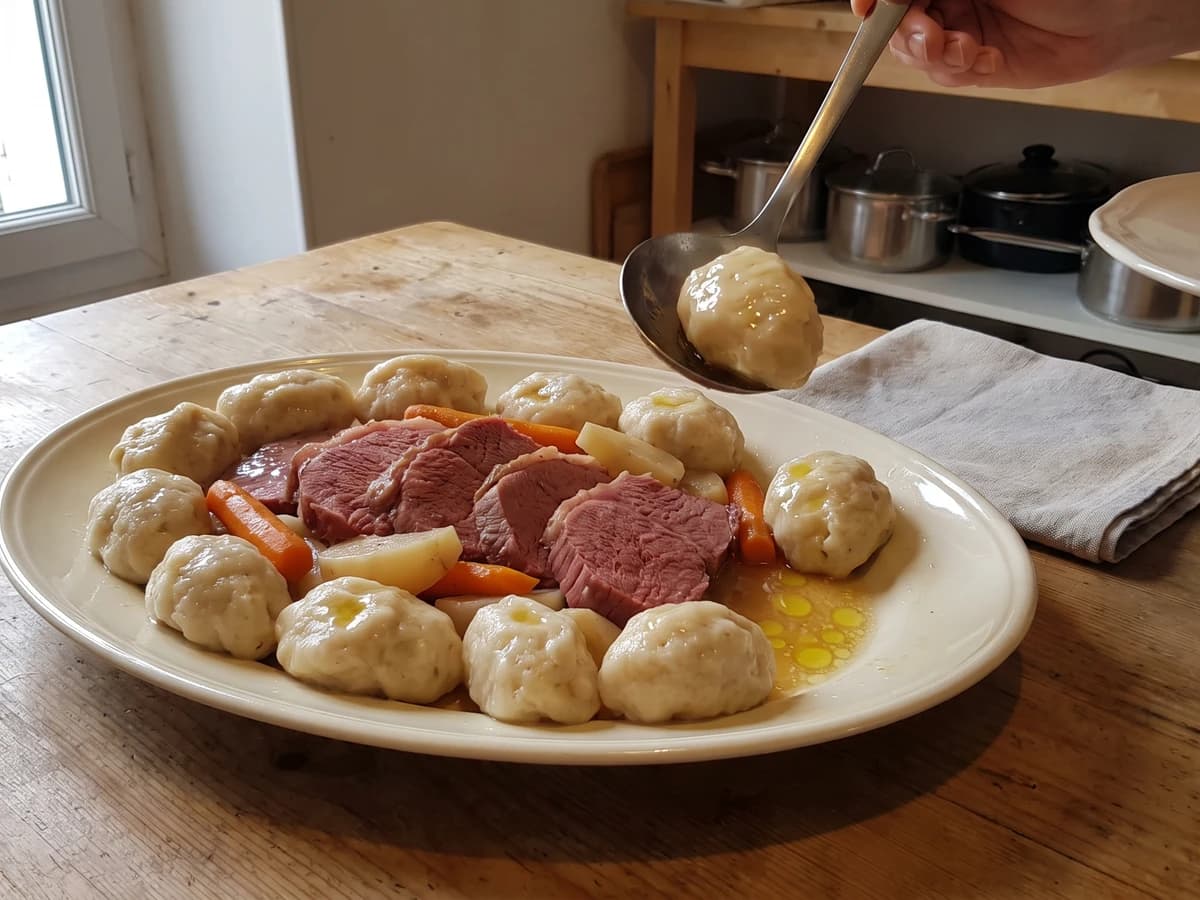
Boulettes au suif, poached beside salt beef, turn equal weights of flour and finely chopped suet into tender, rich dumplings. Keep the beef liquor at a bare tremble and the old garnish works beautifully at home.
A cooking platform built around craft, culture, and the stories behind what we eat.
Created by Chef Juliette
Based on No. 2065, Various Preparations of Celery, from Le Guide Culinaire (1907) by Auguste Escoffier
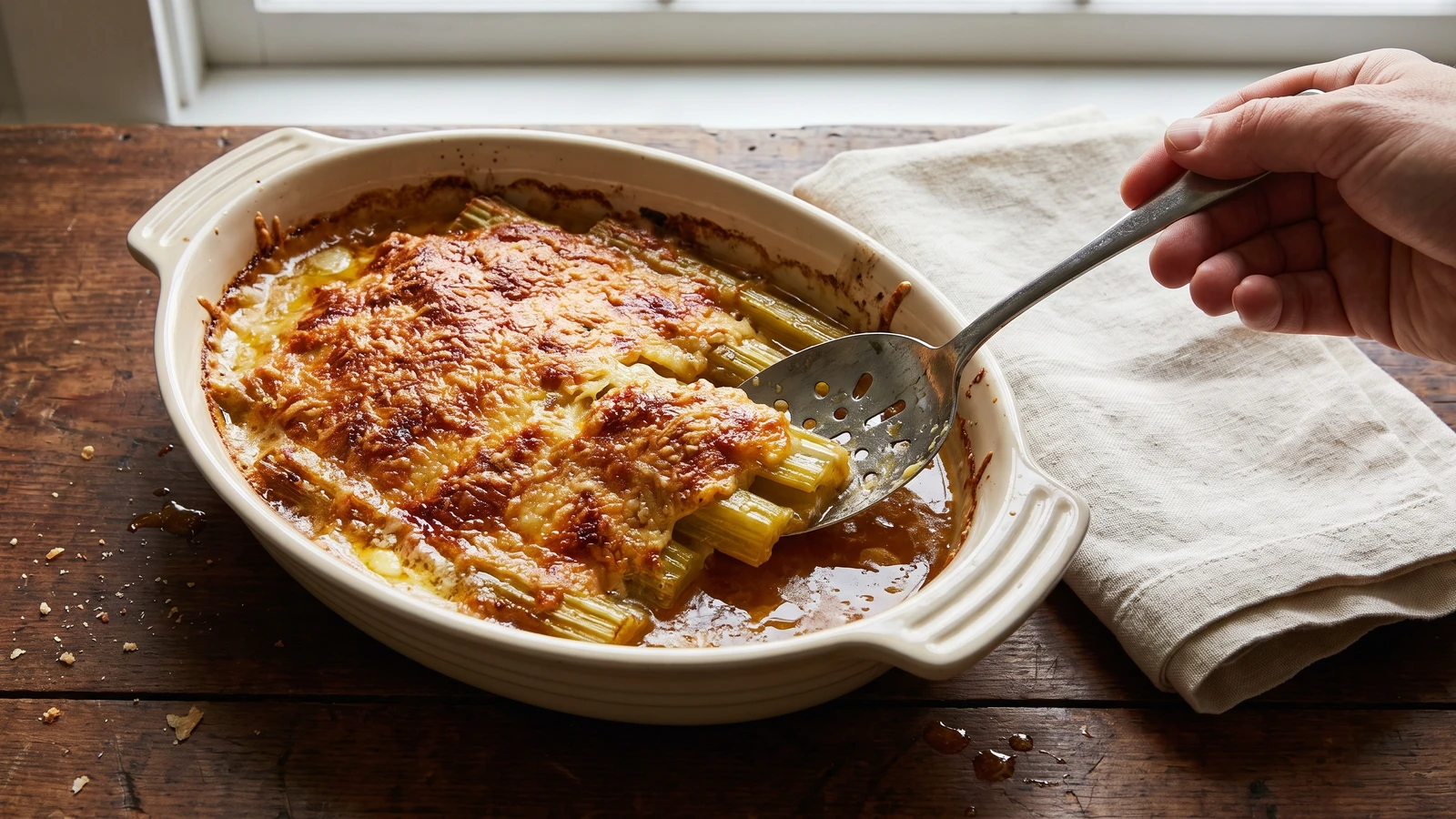
One gentle braise turns celery into six classical dishes: glossy with jus, bronzed under Parmesan or Mornay, crisped à la Milanaise, or dressed à l'Italienne or with Hollandaise.
Préparations diverses de céleri teach one of the canon's most useful truths: once a vegetable has been blanched and braised properly, its finish can change while its character stays intact. The celery must become tender enough for a knife to enter without resistance, yet hold its long shape. That is the one true thing to know before you touch the pan.
The old entry is deliberately terse because it assumes the cardoon treatments are already known, with a saucier beside the stove, stock never off the fire, and a salamander waiting to glaze each dish. At home, braise one modest batch in good prepared stock, reduce its liquor in a small saucepan, then choose one finish; a domestic broiler supplies the fierce top heat. The parallel pans and brigade portions were scaffolding, so they go. The blanch, the slow braise, and the finished sauce stay, because they are the dish. One cook, one stove, one evening.
Watch the braise, not the clock. A hard boil splits the ribs and drives out their sweetness; a bare tremble turns celery satin-soft while it stays whole. If the pot runs dry or the celery softens too quickly, the rescue sits inside the method. The gentle braise is the step that decides every version.
These preparations belong to the Parisian classical and bourgeois table, where cooks organized vegetables by families of technique as readily as sauces. Celery could inherit the formulas used for cardoons because both offer long, ribbed stalks that welcome blanching, braising, and a rich finish, though celery is more aromatic and cooks much faster. The Italian names, au Parmesan, à la Milanaise, and à l'Italienne, record Italian methods absorbed into the French canon; they do not turn the dish Provençal or assign it to one French region.
Quantity
2 (about 1 lb 12 oz / 800 g)
tough outer ribs removed and strings peeled
Quantity
12 cups (2.8 L / 2.8 kg)
Quantity
2 tablespoons (30 ml / 30 g)
Quantity
2 teaspoons (10 ml / 12 g)
divided
Quantity
3 tablespoons (45 ml / 42 g)
divided, for braising
Quantity
1 (about 4 oz / 115 g)
thinly sliced
Quantity
1 (about 3 oz / 85 g)
thinly sliced
Quantity
2 cups (480 ml / 480 g)
Quantity
1
1 bay leaf, 2 thyme sprigs, and 4 parsley stems
Quantity
¼ teaspoon (1.25 ml / 0.6 g)
Quantity
¾ cup (180 ml / 60 g)
for the au Parmesan finish
Quantity
2 tablespoons (30 ml / 28 g)
diced, for the au Parmesan finish
Quantity
1¼ cups (300 ml / 315 g)
warmed
Quantity
¼ cup (60 ml / 20 g)
for the Sauce Mornay finish
Quantity
1 tablespoon (15 ml / 14 g)
diced, for the Sauce Mornay finish
Quantity
½ cup (120 ml / 50 g)
for the à la Milanaise finish
Quantity
½ cup (120 ml / 40 g)
for the à la Milanaise finish
Quantity
3 tablespoons (45 ml / 42 g)
for the à la Milanaise finish
Quantity
1¼ cups (300 ml / 320 g)
warmed
Quantity
1¼ cups (300 ml / 285 g)
held warm
Quantity
1¼ cups (300 ml / 300 g)
heated
| Ingredient | Quantity |
|---|---|
| large celery heartstough outer ribs removed and strings peeled | 2 (about 1 lb 12 oz / 800 g) |
| cold water | 12 cups (2.8 L / 2.8 kg) |
| fresh lemon juice | 2 tablespoons (30 ml / 30 g) |
| fine sea saltdivided | 2 teaspoons (10 ml / 12 g) |
| unsalted butterdivided, for braising | 3 tablespoons (45 ml / 42 g) |
| small onionthinly sliced | 1 (about 4 oz / 115 g) |
| small carrotthinly sliced | 1 (about 3 oz / 85 g) |
| unsalted light chicken or vegetable stock | 2 cups (480 ml / 480 g) |
| bouquet garni1 bay leaf, 2 thyme sprigs, and 4 parsley stems | 1 |
| freshly ground white pepper | ¼ teaspoon (1.25 ml / 0.6 g) |
| finely grated Parmesan (optional)for the au Parmesan finish | ¾ cup (180 ml / 60 g) |
| unsalted butter (optional)diced, for the au Parmesan finish | 2 tablespoons (30 ml / 28 g) |
| finished Sauce Mornay (optional)warmed | 1¼ cups (300 ml / 315 g) |
| finely grated Parmesan (optional)for the Sauce Mornay finish | ¼ cup (60 ml / 20 g) |
| unsalted butter (optional)diced, for the Sauce Mornay finish | 1 tablespoon (15 ml / 14 g) |
| fine dry breadcrumbs (optional)for the à la Milanaise finish | ½ cup (120 ml / 50 g) |
| finely grated Parmesan (optional)for the à la Milanaise finish | ½ cup (120 ml / 40 g) |
| unsalted butter (optional)for the à la Milanaise finish | 3 tablespoons (45 ml / 42 g) |
| finished Sauce Italienne (optional)warmed | 1¼ cups (300 ml / 320 g) |
| finished Sauce Hollandaise (optional)held warm | 1¼ cups (300 ml / 285 g) |
| finished plain gravy (optional)heated | 1¼ cups (300 ml / 300 g) |
Separate the celery hearts into long ribs. Remove any bruised ends, peel away the coarse strings with a vegetable peeler, and cut the ribs into even 5-inch (12 cm) lengths; split exceptionally thick ribs lengthwise. Put them immediately into the cold water mixed with the lemon juice so the cut surfaces stay pale.
Bring the lemon water to a full boil and add 1½ teaspoons of the salt. Blanchir, briefly boil, the celery for 6 to 8 minutes, until the raw stiffness has relaxed but the ribs remain distinctly firm. Drain carefully. This blanch removes harshness and starts the thick ribs cooking evenly; skip it and the outside may collapse before the centre yields.
Heat the oven to 350°F (180°C). Spread the onion and carrot across a wide lidded braising pan and dot them with 2 tablespoons of the butter. Arrange the celery snugly over them, add the remaining ½ teaspoon salt, the white pepper, bouquet garni, and enough stock to reach halfway up the ribs. Butter a cartouche, a parchment lid cut to the pan, with the remaining tablespoon of butter and press its buttered side against the celery. Cover the pan.
Braise for 35 to 45 minutes, checking after 30. The liquid beneath the paper should barely tremble, and a narrow knife should enter the thickest rib without force while the celery still holds together. If the liquid boils hard, lower the heat and add a few spoonfuls of cold stock. If the ribs have already softened enough to split, stop moving them, finish the cooking uncovered in their serving dish, and choose the Mornay or au Parmesan treatment to hold them together. Ça se rattrape.
Lift the celery into a warm dish without breaking the ribs. Strain the braising liquor into a small saucepan, pressing gently on the onion and carrot, then reduce it over lively heat to about 1 cup (240 ml / 240 g), glossy enough to coat a spoon lightly. If it tastes too salty before it gains body, add unsalted stock a little at a time and reduce more gently. Choose one of the following six finishes; they are alternatives, not a procession.
Arrange the celery in a warmed serving dish and spoon over enough reduced braising liquor to glaze the ribs lightly. Nap them with the hot finished plain gravy and hold at the barest simmer for 2 minutes, just long enough for sauce and vegetable to meet. If the gravy is too thick to flow, loosen it with a spoonful of the braising liquor.
Heat the broiler and set a rack about 6 inches (15 cm) below it. Arrange half the celery in a buttered shallow gratin dish, moisten with 2 tablespoons of reduced braising liquor, and scatter over half the Parmesan. Repeat, dot with the diced butter, and broil for 3 to 5 minutes, until the cheese is deeply bronzed and the rim bubbles. Warm the celery before broiling; the fierce heat is for color, not for reheating a cold centre.
Arrange the warm celery in a shallow gratin dish and nap it completely with the finished Sauce Mornay. If the sauce sits in a heavy mound, loosen it with 1 or 2 tablespoons of reduced braising liquor; if it runs like milk, reduce it before it touches the celery. Scatter over the Parmesan, dot with butter, and broil until the ivory sauce bubbles at the edges and wears an even bronze crown.
Arrange the warm celery in one layer in a shallow gratin dish. Mix the breadcrumbs with the Parmesan and scatter them evenly over the ribs. Cook the butter in a small pale pan until it becomes beurre noisette, butter browned to a hazelnut color, then spoon it over the crumbs. Broil briefly until the coating is crisp and bronze, rotating the dish if one side colors faster.
Bring the finished Sauce Italienne to a bare simmer in a wide pan. Nestle the braised celery into it and warm for 4 to 5 minutes, turning the ribs once with care so the sauce coats rather than drowns them. Transfer the celery to a warm serving dish and spoon the mushroom-rich sauce over it.
Warm the celery gently in a little reduced braising liquor, then drain and blot the ribs so water cannot send the finished Sauce Hollandaise sliding onto the plate. Arrange them on a warm platter and spoon the Hollandaise over at the final moment. Keep this version away from the broiler; Hollandaise is an emulsion and fierce heat breaks it.
Whichever finish you chose, serve the celery in its long ribs and spoon any sauce gathered in the dish back over the top. Let the gratinéed versions settle for 3 minutes; serve the Hollandaise version at once. Cooking well is not cooking fancy. À table!
1 serving (about 250g)
Culinary guides, cultural storytelling, and the editorial depth that makes cooking meaningful.
Discover Culinary ExplorerChef Juliette
Boulettes au suif, poached beside salt beef, turn equal weights of flour and finely chopped suet into tender, rich dumplings. Keep the beef liquor at a bare tremble and the old garnish works beautifully at home.

Chef Juliette
Bread, flour, frangipane, and rice become four cool, supple panades for binding forcemeats, each changing body and flavor while preserving tenderness. The finest Mousselines need none, and knowing that distinction is the lesson.

Chef Juliette
Panade au pain is bread, milk, salt, heat, and attention: stir until the paste releases cleanly, butter it against a skin, and you have the quiet binder behind tender French farces.

Chef Juliette
Panade de farine teaches the drying stroke behind pâte à choux: flour meets boiling buttered water, then stays over the fire until the paste gathers, smooths, and quits the pan cleanly.