
Chef Juliette
Carottes Glacées pour Garnitures
Carottes Glacées prove that a garnish can teach a whole sauce lesson: carrots cook in butter, sugar, salt, and water until their own liquor reduces to a brilliant, clinging coat.
A cooking platform built around craft, culture, and the stories behind what we eat.
Created by Chef Juliette
Based on No. 2062, Purée de Carottes, from Le Guide Culinaire (1907) by Auguste Escoffier
Purée de Carottes turns humble carrots and rice into a butter-glossed, perfectly stable purée: sieve it fine, dry it fiercely, then loosen it until the spoon leaves one soft furrow.
Purée de Carottes (silken carrot purée) teaches dessécher, drying a wet purée over strong heat until it can take butter and liquid without slumping or weeping. The rice isn't there to make the carrots taste of rice. At one quarter of their weight, it supplies the quiet starch that binds the water. Know this before touching the pan: the rice prevents weeping only if you still drive off the excess moisture after sieving.
The original recipe assumed a saucier stirring over fierce fire, a stockpot of consommé never off the flame, and enough hands to fry triangular croûtons at the last moment. One cook uses a wide, heavy sauté pan, good prepared consommé or whole milk, and a four-person batch, but the governing ratios stay exact: rice at one quarter the weight of the carrots, finishing butter at three ounces per pound of sieved purée. The separate stockpot and brigade quantity are scaffolding, so they can go. The cooking, fine sieving, hard drying with butter, and freshly fried croûtons are the dish, so they stay.
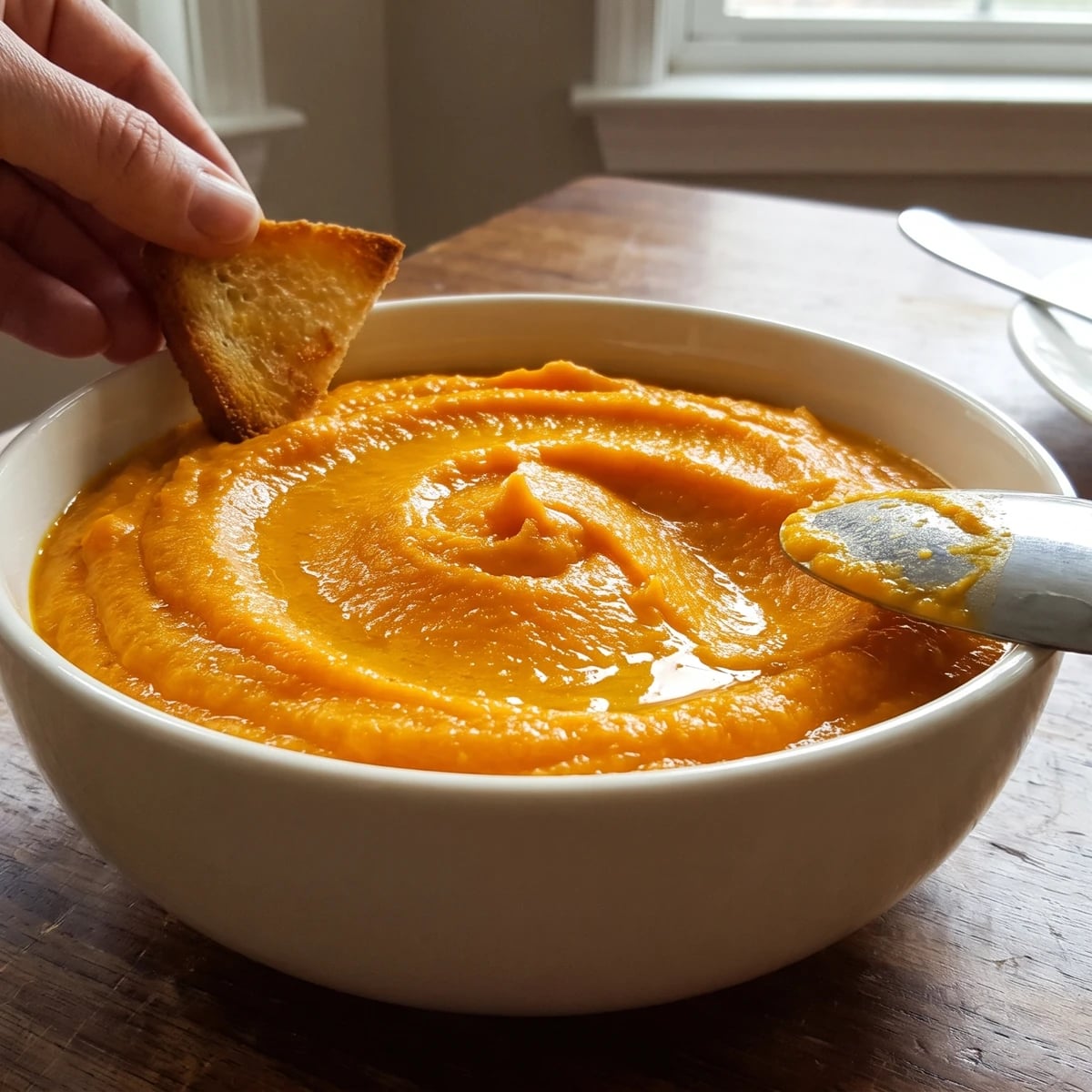
The finished purée should be warm carrot-orange, perfectly smooth, and glossy with butter, holding a soft mound without standing stiffly. The decisive moment is the sauté pan. Keep the scraper moving until the purée leaves a clean path across the pan floor and any pooled butter has disappeared back into it.
Purée de carottes belongs to the Parisian classical garnish repertoire and the cuisine bourgeoise table rather than to one French province; it was commonly served from a timbale beside braised veal. Rice was not a shortcut but a classical liaison, giving watery root vegetables enough starch to hold butter and added liquid without weeping. As the preparation moved from grand kitchens to home tables, its scale changed, but the sequence remained: cook, sieve, dessécher, then loosen.
Quantity
1 pound (454 g)
peeled and sliced ¼ inch (6 mm) thick
Quantity
½ cup plus 2 tablespoons (150 ml / 113 g)
weighed at exactly one quarter the weight of the carrots
Quantity
4 cups (960 ml / 960 g)
or enough to cover the carrots and rice generously
Quantity
2 teaspoons (10 ml / 8 g)
Quantity
1 tablespoon (15 ml / 14 g)
Quantity
1 teaspoon (5 ml / 6 g)
divided
Quantity
3 ounces (6 tablespoons / 90 ml / 85 g) per 1 pound (454 g) sieved purée, usually 7 to 9 tablespoons (105 to 135 ml / 100 to 128 g)
Quantity
½ to 1 cup (120 to 240 ml / 120 to 240 g)
warmed
Quantity
4 slices (about 4 ounces / 115 g)
crusts removed and cut into small triangles
Quantity
3 tablespoons (45 ml / 42 g)
| Ingredient | Quantity |
|---|---|
| carrotspeeled and sliced ¼ inch (6 mm) thick | 1 pound (454 g) |
| plain white riceweighed at exactly one quarter the weight of the carrots | ½ cup plus 2 tablespoons (150 ml / 113 g) |
| wateror enough to cover the carrots and rice generously | 4 cups (960 ml / 960 g) |
| granulated sugar | 2 teaspoons (10 ml / 8 g) |
| unsalted butter for cooking | 1 tablespoon (15 ml / 14 g) |
| fine saltdivided | 1 teaspoon (5 ml / 6 g) |
| unsalted butter for drying and enriching | 3 ounces (6 tablespoons / 90 ml / 85 g) per 1 pound (454 g) sieved purée, usually 7 to 9 tablespoons (105 to 135 ml / 100 to 128 g) |
| whole milk or prepared consomméwarmed | ½ to 1 cup (120 to 240 ml / 120 to 240 g) |
| day-old pain de mie for Croûtonscrusts removed and cut into small triangles | 4 slices (about 4 ounces / 115 g) |
| unsalted butter for frying the Croûtons | 3 tablespoons (45 ml / 42 g) |
Weigh the peeled carrots before slicing, then weigh out rice equal to exactly one quarter of that amount. For 1 pound (454 g) carrots, use 4 ounces (113 g) rice. Rinse the rice briefly under cold water and drain it. Keep the carrot slices even so they become tender at the same moment as the rice.
Put the carrots, rice, water, sugar, cooking butter, and ¾ teaspoon of the salt into a 4-quart saucepan. Bring to a boil, then lower the heat and simmer steadily, partially covered, for 20 to 25 minutes. Both ingredients must be completely yielding: a carrot slice should collapse under the back of a spoon, and no firm grain should remain at the centre of the rice. Drain as soon as they reach that point, then leave them in the colander for 2 minutes so loose water runs away.
While the carrots and rice remain warm, rub them through a fine-mesh sieve in small batches with a flexible scraper or the back of a sturdy ladle. Scrape the underside of the sieve into the bowl after every batch. Work patiently until only dry carrot fibres and any stubborn grains remain. Weigh the finished purée, then calculate the finishing butter at 3 ounces (85 g) for every 1 pound (454 g) of purée. This weighing replaces the judgment and large quantities of the brigade without changing its ratio.
Transfer the sieved purée and its measured finishing butter to a wide, heavy sauté pan. Set it over medium-high heat and stir without pause, scraping broadly across the floor and into the corners, for 6 to 10 minutes. The source's fierce fire meant fierce evaporation with a saucier always at the pan; controlled strong heat and a moving scraper are its honest home equivalent. At first the butter may melt into a yellow pool around the purée. Keep stirring. Ça se rattrape: as the excess water cooks away, the rice will bind the butter back into the carrots. The purée is ready when it gathers into one glossy mass, leaves a clean path behind the scraper for 2 seconds, and shows no separate slick of butter. If you see dark specks from catching, lift the unmarked purée into a clean pan immediately and leave the scorched layer behind.
Lower the heat and beat in ½ cup (120 ml / 120 g) of the warmed milk or consommé, a few spoonfuls at a time. Milk keeps the flavour sweet and rounded; consommé makes the purée more savoury, especially beside braised veal. Add only enough of the remaining liquid to reach the consistence of an ordinary purée: smooth and spoonable, holding a soft mound before slowly settling. Taste and add the remaining salt if needed. If too much liquid goes in, return the pan to medium heat and stir until the clean path behind the scraper appears again.
Melt the Croûton butter in a skillet over medium heat. When the foam subsides, add the bread triangles in one uncrowded layer and fry them until deep butter-gold underneath, then turn and colour the second side. Lift them out immediately and drain briefly. Croûtons are pieces of bread fried in butter, and here their crisp edges are the necessary contrast to the soft purée, so make them at the last moment.
Spoon the Purée de Carottes into a warmed timbale or deep round serving bowl. Shape it into a generous mound and draw one broad furrow across the surface with the serving spoon so the butter sheen catches the light. Arrange the triangular Croûtons around the rim and serve at once, particularly with braised veal. À table!
1 serving (about 240g)
Culinary guides, cultural storytelling, and the editorial depth that makes cooking meaningful.
Discover Culinary Explorer
Chef Juliette
Carottes Glacées prove that a garnish can teach a whole sauce lesson: carrots cook in butter, sugar, salt, and water until their own liquor reduces to a brilliant, clinging coat.

Chef Juliette
Carottes à la Crème teaches the order that makes the dish: glaze the carrots to a syrup first, add the cream boiling, then reduce until each piece wears a shining ivory coat.

Chef Juliette
Carottes à la Vichy prove that a glaze is made by reduction, not decoration: even carrot coins cooked until tender and brilliant, then finished with parsley at the last moment.

Chef Juliette
A pale short-paste shell holds silken, lightly sweet carrot purée beneath neat glazed half-discs, their butter syrup catching the light: a classical tart poised between vegetable course and sweet.