Chef Juliette
Bouillabaisse à la Marseillaise
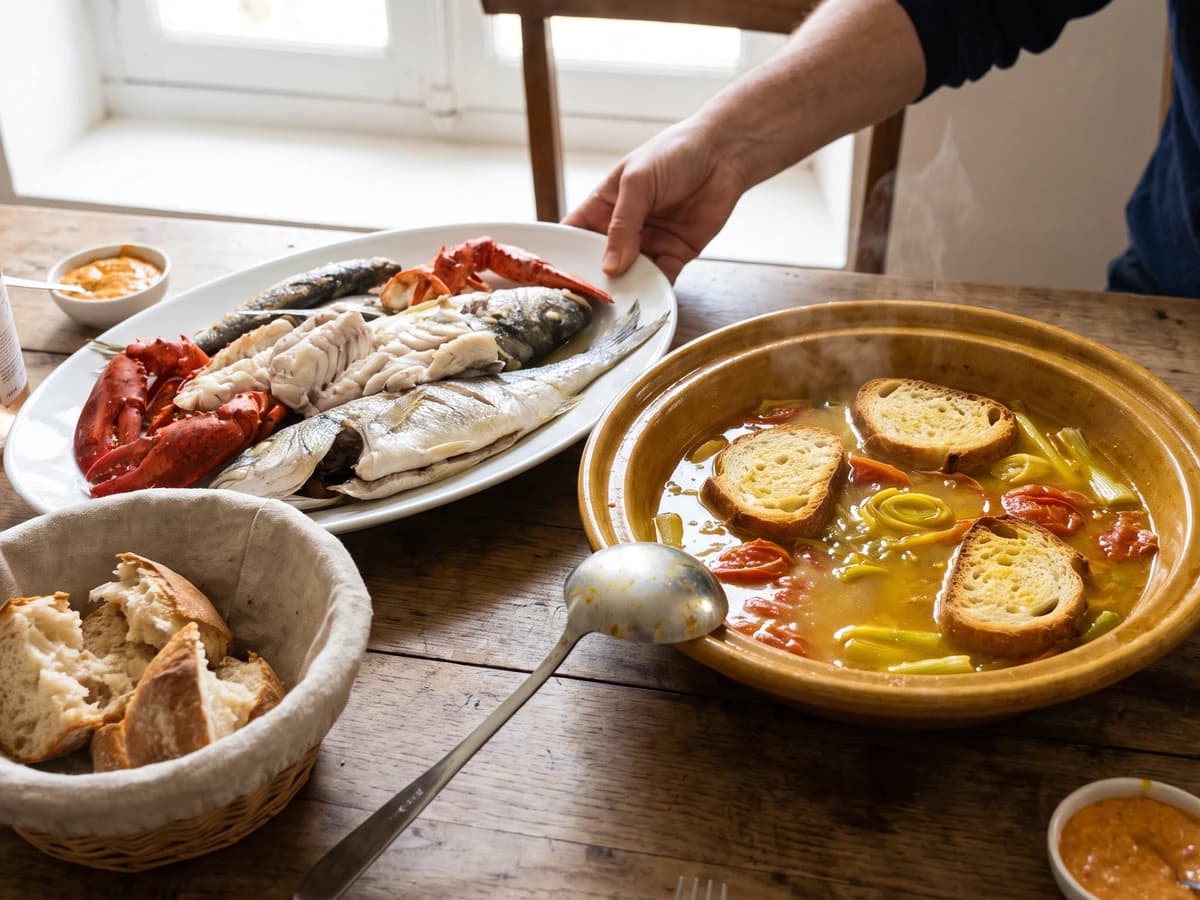
Marseille's great fish stew, saffron-gold and garlic-scented, proves that a hard boil can be the careful choice: it binds olive oil into broth before the whole pot meets bread.
A cooking platform built around craft, culture, and the stories behind what we eat.
Created by Chef Juliette
Based on No. 206, Ordinary Royale, from Le Guide Culinaire (1907) by Auguste Escoffier
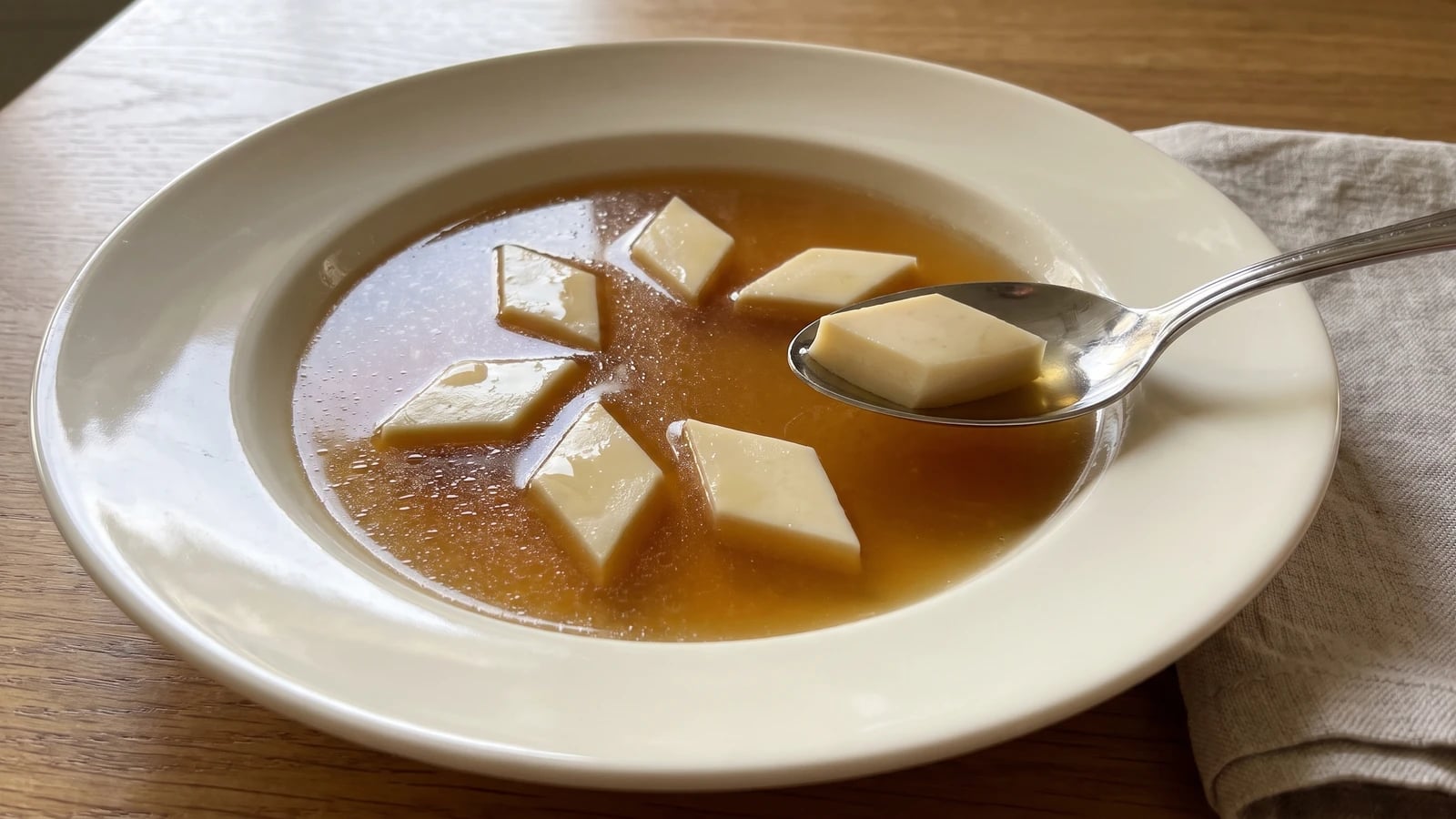
Royale ordinaire turns clear consommé and chervil into a tender, jewel-cut custard: gentle heat keeps it silken, full cooling keeps every diamond neat, and one small mould serves four bowls beautifully.
Royale ordinaire (plain consommé custard) teaches restraint by heat. The one true thing to know before touching a pan is that its bain-marie, a hot-water bath, must never boil. The eggs should set into a tender, close-grained slab, not puff into a sponge. Chervil perfumes it from within, then disappears; when the pale-gold diamonds meet clear broth, the effect is quiet and exact.
The source formula assumed a saucier on staff, clarified consommé never off the fire, muslin at hand, and a shelf of buttered Charlotte moulds. For one cook, I halve its exact proportions to one egg and three yolks with 284 ml of consommé, strain through damp cheesecloth, and use one shallow 20 cm square tin inside a roasting pan. The ranks of moulds and brigade volume were scaffolding, so they can go. The twenty-minute infusion, egg-to-broth ratio, careful straining, and non-boiling poach are the dish, so they stay. One cook, one stove, one evening.
Let the royale cool completely in its mould before cutting, because warm custard tears where cold custard gives clean diamonds. Watch the water more closely than the clock. The step that decides everything is simple: keep the bain-marie below a simmer.
Royale belongs to the formal French table, where clear consommés were finished with separately poached garnishes chosen as carefully as the broth. It traveled from grand kitchens into bourgeois dining rooms because a small mould and bain-marie could reproduce the same tender custard without a brigade, while herbs, vegetables, or shellfish gave each version its character. The name refers to the egg custard garnish, not to a particular soup, and royale ordinaire is the chervil-infused foundation from which more elaborate royales branch.
Quantity
1 cup plus 3 tablespoons (284 ml / 284 g)
well seasoned and free of surface fat
Quantity
1 loosely packed cup (240 ml / 14 g / ½ oz)
leaves and tender stems
Quantity
1
Quantity
3
Quantity
1 teaspoon (5 ml / 5 g)
softened, for the mould
| Ingredient | Quantity |
|---|---|
| finished clear consomméwell seasoned and free of surface fat | 1 cup plus 3 tablespoons (284 ml / 284 g) |
| fresh chervilleaves and tender stems | 1 loosely packed cup (240 ml / 14 g / ½ oz) |
| large egg | 1 |
| large egg yolks | 3 |
| unsalted buttersoftened, for the mould | 1 teaspoon (5 ml / 5 g) |
Heat the oven to 300°F (150°C). Butter the base and sides of an 8-inch (20 cm) square metal cake tin in a thin, complete layer. Place a folded kitchen towel in a deep roasting tin and set the buttered mould on it; the towel keeps the mould steady and softens the heat reaching its base. Heat enough water to come halfway up the mould, but don't let it boil.
Bring the consommé to a full boil in a small saucepan. Add the chervil, press it beneath the liquid, cover immediately, and take the pan completely off the heat. Leave it undisturbed for 20 minutes. This infusion is the whole seasoning of the royale, so keep the lid on and give the delicate herb time to surrender its fragrance.
Beat the whole egg and three yolks briskly in a heatproof bowl until fully blended, without trying to whip them pale. Pour in the hot consommé and chervil in a thin stream at first, whisking without pause, then add the remainder steadily. If a few fine egg threads appear, keep calm; the muslin will catch them and the royale can still set smoothly.
Line a fine-mesh sieve with two damp layers of muslin or cheesecloth and strain the mixture into a jug. Let the liquid pass under its own weight without pressing the chervil, which would cloud the custard and force out harsher flavours. Rest it for 2 minutes, then carefully skim away every patch of froth with a spoon or the corner of a clean paper towel. Foam left behind becomes holes in the finished royale. Pour the smooth mixture into the buttered mould.
Place the roasting tin in the oven, then pour the hot water around the mould until it reaches halfway up the sides. Poach for 15 to 20 minutes, keeping the bath completely below a simmer. The royale is ready when the edges are set, the centre quivers as one piece, and an instant-read thermometer reaches at least 160°F (71°C). If the water starts bubbling, draw the roasting tin forward, replace 1 cup (240 ml) of the bath with cool water, and lower the oven by 25°F (15°C). Ça se rattrape if you act before the custard puffs. If one rim has already puffed, cool it as directed and trim that porous edge away; the smooth centre remains good garnish.
Lift the mould from the bain-marie and place it on a rack. Leave the royale in its mould, exactly as the method requires, and cool for about 30 minutes. Cover without touching the surface, then refrigerate for at least 1 hour, until cold and firm throughout. Turning it out warm invites cracks, and no amount of confidence can cut a clean diamond from trembling custard.
Run a thin knife around the edge, cover the mould with a flat board, and invert it. If the royale clings, rest the base on a warm damp towel for 10 seconds and try again. Trim the edges, then cut the slab into ½-inch (1.25 cm) cubes, diamonds, or small decorative shapes with a damp knife. To serve, arrange the cold pieces in warmed bowls and ladle hot, never boiling, consommé around them. The broth warms the garnish without toughening it. À table!
1 serving (about 94g)
Culinary guides, cultural storytelling, and the editorial depth that makes cooking meaningful.
Discover Culinary ExplorerChef Juliette
Marseille's great fish stew, saffron-gold and garlic-scented, proves that a hard boil can be the careful choice: it binds olive oil into broth before the whole pot meets bread.
Chef Juliette
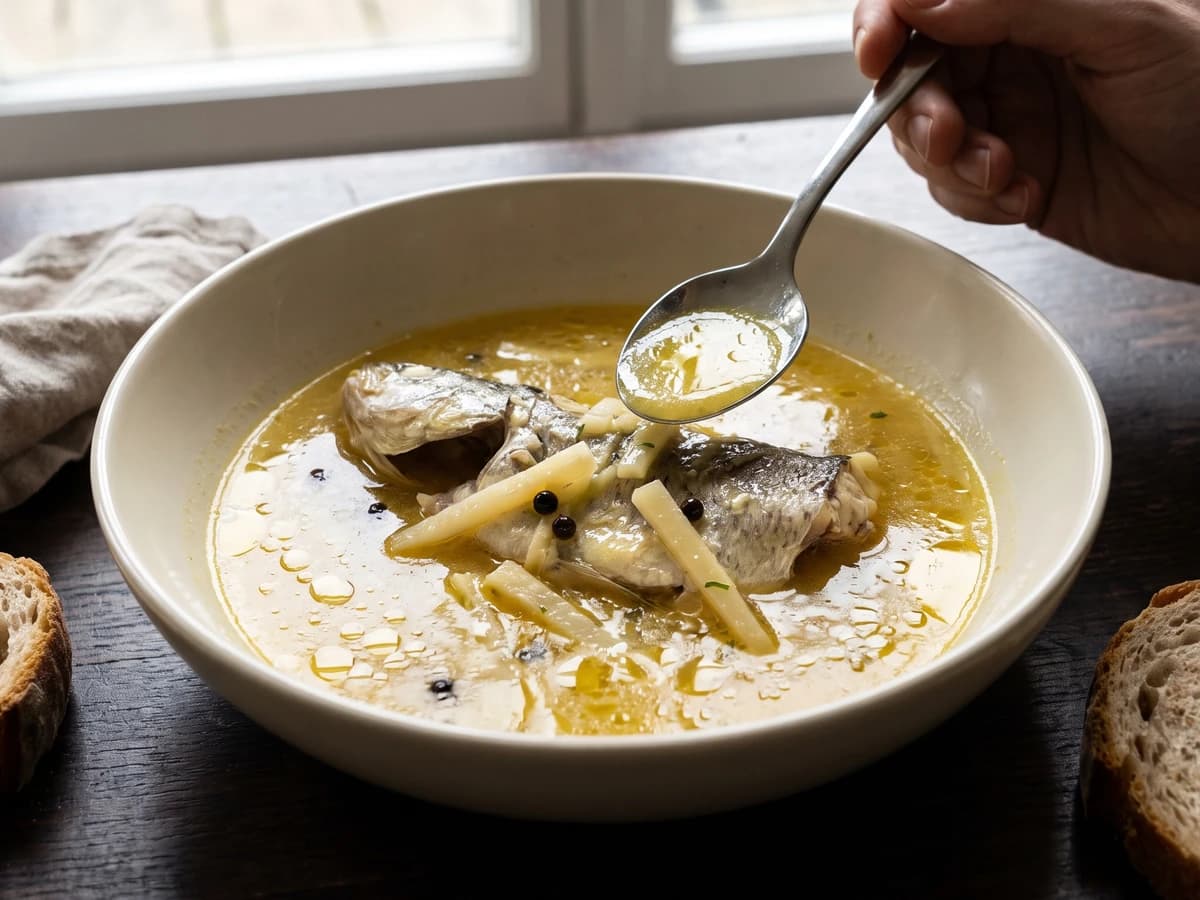
Waterzoi asks fresh, bone-in river fish to thicken its own buttery broth, with parsley root and pepper for company. No flour, no stockpot, just a brisk simmer watched closely.
Chef Juliette
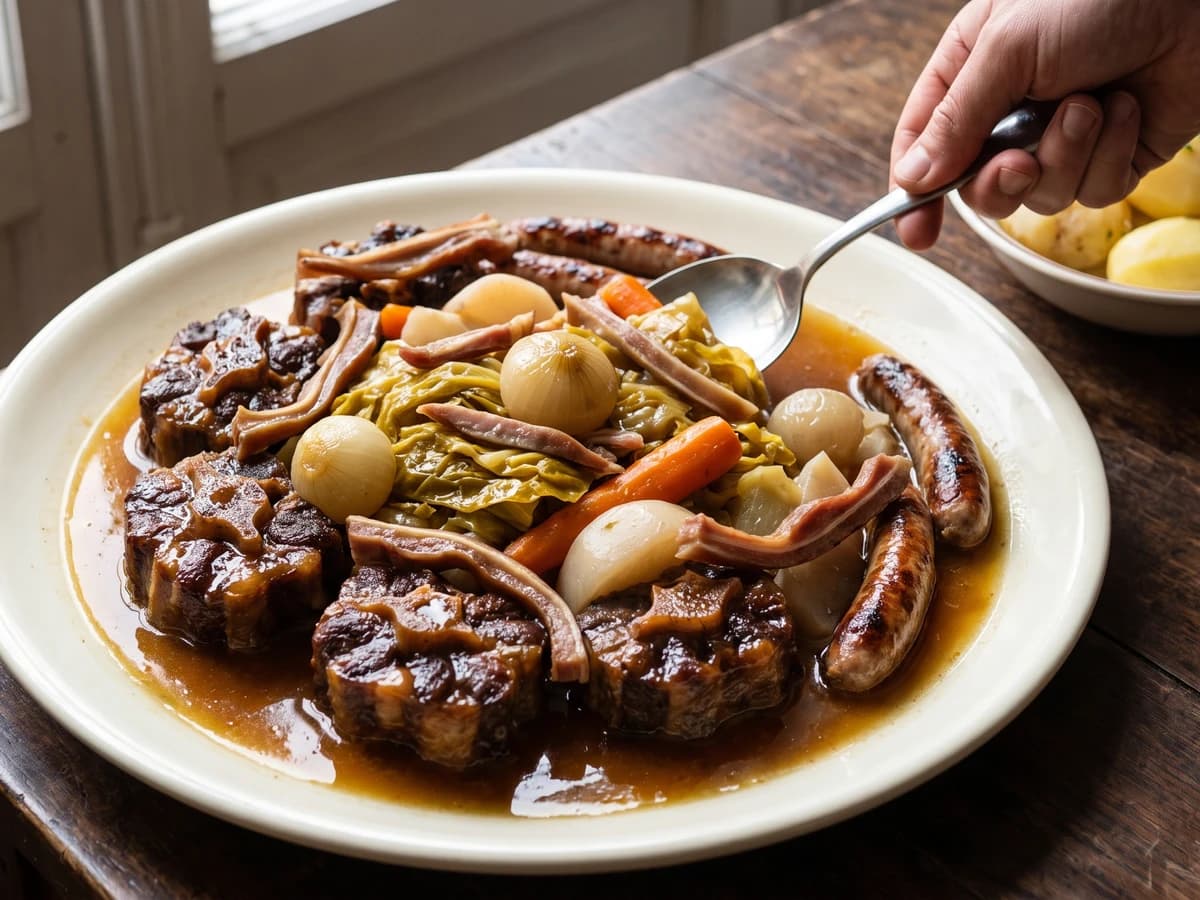
Queue de Bœuf en Hochepot gathers oxtail, pig's trotter and ear, cabbage, roots, and grilled chipolatas around a clear, gelatin-rich broth whose quiet simmer keeps every piece tender and distinct.
Chef Juliette
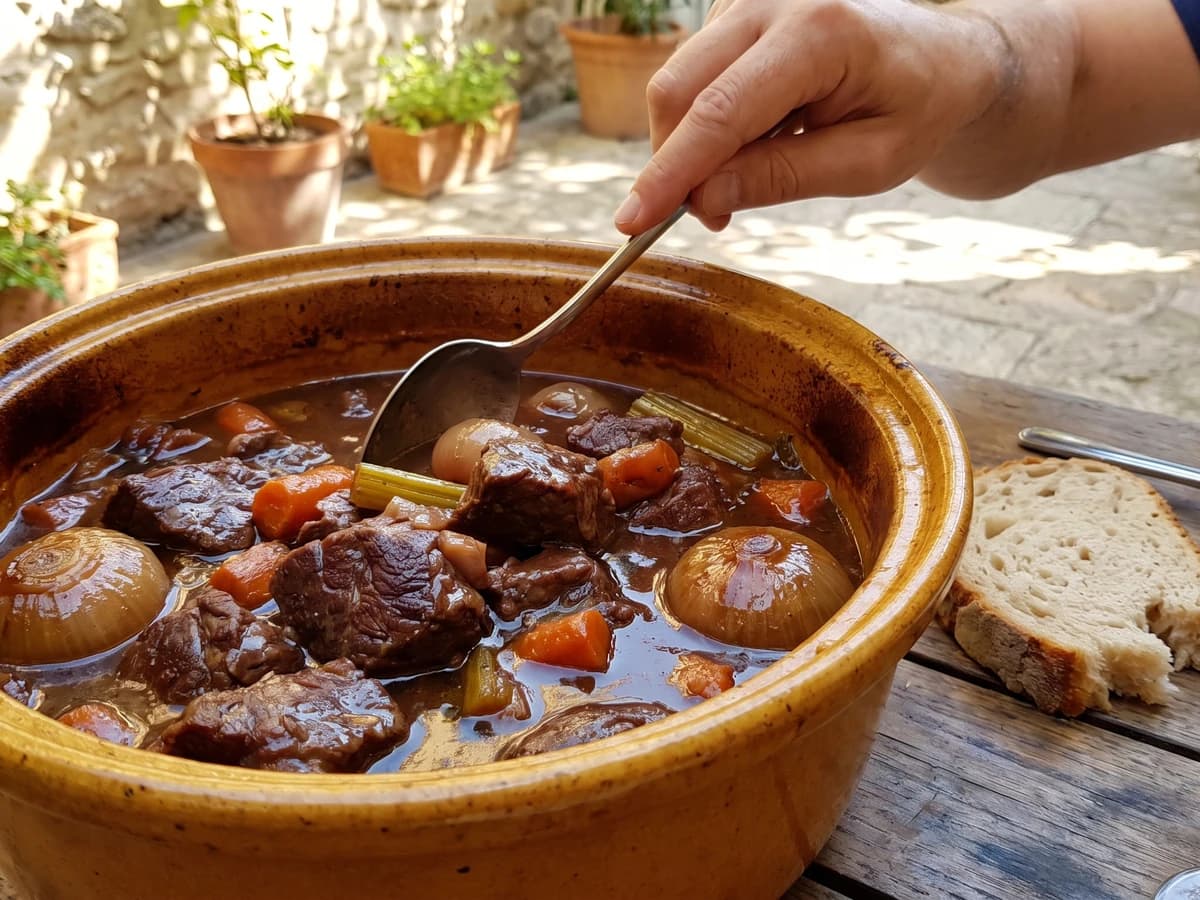
Beef shoulder larded with bacon, sharpened by red wine and vinegar, then sealed with garlic, vegetables, and dry lemon peel until the low oven turns it yielding and the gravy darkly glossy.