
Chef Juliette
John Dory (St. Pierre)
John Dory has the delicacy of sole and the firmness of turbot. A light flouring, a quick butter sauté, and nut-brown beurre noisette show exactly why looks never mattered.
A cooking platform built around craft, culture, and the stories behind what we eat.
Created by Chef Juliette
Based on No. 205, Forcemeat Balls or Quenelles, from Le Guide Culinaire (1907) by Auguste Escoffier
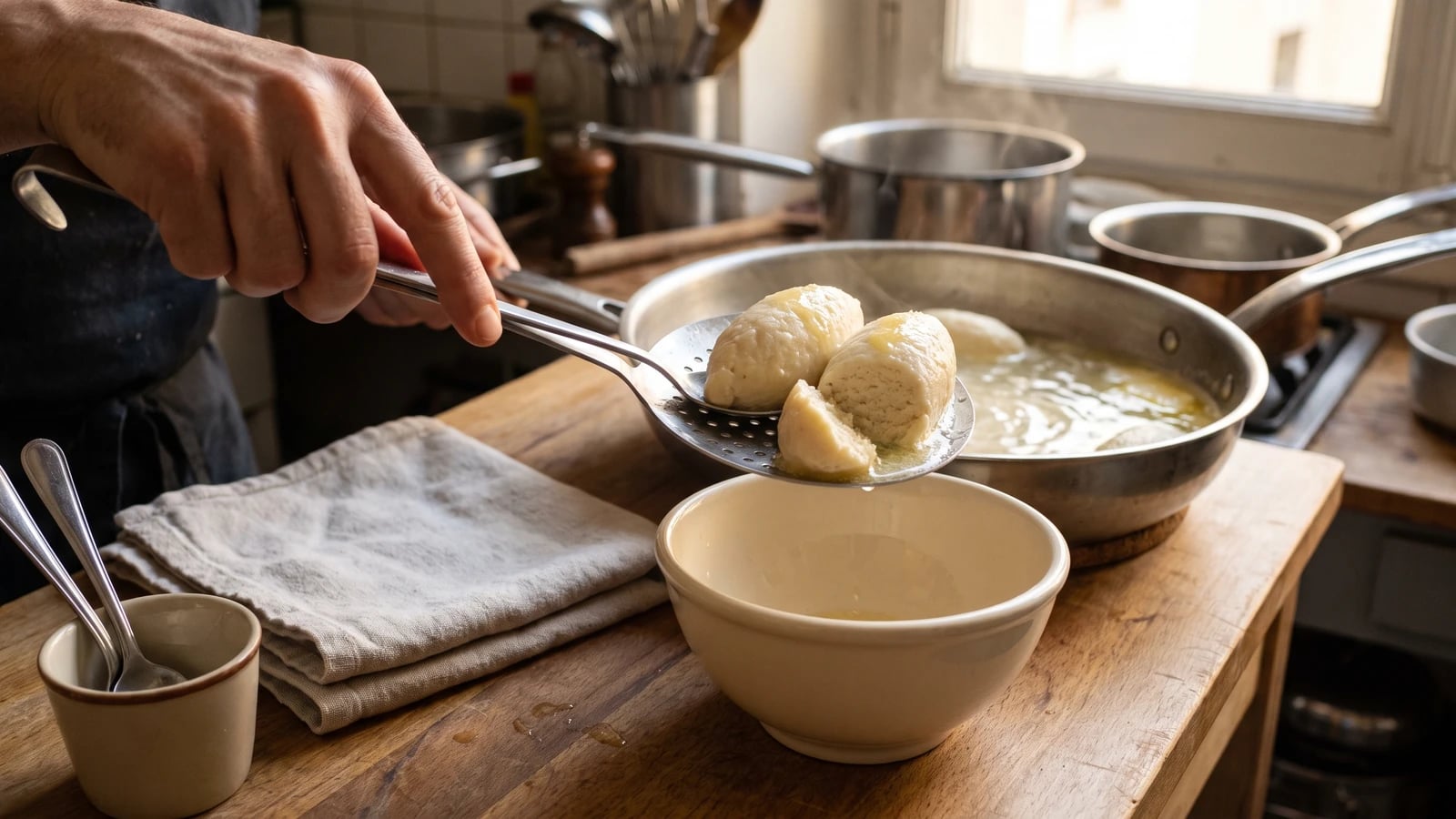
Quenelles de poisson prove that gentleness is a technique: cold mousseline shaped into smooth olives, then poached in water that barely shivers until every dumpling swells and holds its delicate centre.
Quenelles de mousseline de poisson (fish forcemeat dumplings) teach gentleness. The mousseline must stay cold, and the poaching water must only shiver. Let it boil and the delicate emulsion tightens into something stubborn; keep it calm and each quenelle swells into a pale, tender cushion.
The original entry assumes finished forcemeat, trays waiting beside the stove, and enough hands to roll, pipe, spoon, or mould each service batch. It even supplies a weighted-string contraption for cutting forcemeat from the finger. For one cook, one stove, one evening, two warm tablespoons and a buttered sauté pan do the work beautifully. The quarter-pound working portion stays, repeated four times for four people; the hanging weight goes because it is brigade scaffolding, not the dish.
Make one test quenelle before shaping the rest. It tells you whether the mousseline is cold enough, the water gentle enough, and the seasoning right. If it spreads or tightens, correct the remaining batch before committing it all. Ça se rattrape. That test, more than perfectly polished spoonwork, is the step that matters most.
Quenelles de brochet are inseparable from Lyon, where cooks turned the notoriously bony pike of the Rhône and Saône waterways into a smooth, delicate forcemeat by pounding and sieving the flesh. Across the classical French repertoire, quenelle also names a shape and method applied to many forcemeats; Lyon's pike dumpling is its most celebrated regional expression, not its only form. Bouchon tables serve generous quenelles in sauce, while grand kitchens mould smaller ones for soups and garnishes, but both depend on the same cold mixture and quiet poach.
Quantity
About 2 cups (475 ml / 454 g)
chilled and divided into four 1/4-pound (113 g) working portions
Quantity
10 cups (2.4 L / 2.4 kg)
divided between poaching and warming the spoons
Quantity
1 tablespoon (15 ml / 18 g)
Quantity
1 tablespoon (15 ml / 14 g)
softened, for the pan
Quantity
1/4 cup (60 ml / 30 g)
for the rolled method only
Quantity
4 cups (950 ml / 950 g)
for cooling poached quenelles made ahead
Quantity
2 cups (475 ml / 280 g)
for cooling poached quenelles made ahead
| Ingredient | Quantity |
|---|---|
| prepared fish mousseline forcemeatchilled and divided into four 1/4-pound (113 g) working portions | About 2 cups (475 ml / 454 g) |
| waterdivided between poaching and warming the spoons | 10 cups (2.4 L / 2.4 kg) |
| fine sea salt | 1 tablespoon (15 ml / 18 g) |
| unsalted buttersoftened, for the pan | 1 tablespoon (15 ml / 14 g) |
| all-purpose flour (optional)for the rolled method only | 1/4 cup (60 ml / 30 g) |
| cold water (optional)for cooling poached quenelles made ahead | 4 cups (950 ml / 950 g) |
| ice (optional)for cooling poached quenelles made ahead | 2 cups (475 ml / 280 g) |
Butter a wide 12-inch sauté pan or shallow metal tray, then chill it until the butter firms. Put 8 cups (1.9 L / 1.9 kg) of the water and all the salt in a wide saucepan; bring it to 180 to 185°F (82 to 85°C), where the surface shivers without bubbling. Heat the remaining 2 cups (475 ml / 475 g) of water in a cup for dipping the spoons. Keep the mousseline in the cold until the moment you shape it. Cold is its structure.
Dip two tablespoons in the hot water. Fill one with a small mound of mousseline, use the rounded back of the second to turn and smooth it into an olive, then lower it into the poaching water. Hold the water at a bare tremble until the test quenelle rises, swells, and feels softly firm, about 6 to 8 minutes. Its centre should reach 160°F (71°C). Cut it open: the interior should be fine-grained, moist, and evenly set. If it spreads, chill the mousseline for fifteen minutes and shape it on the cold buttered pan rather than piping or rolling it. If it turns rubbery, lower the water temperature and shorten the next poach. The cooked test cannot be softened, but the remaining batch can be saved. Ça se rattrape.
Work with one 1/4-pound (113 g) portion at a time and keep the rest cold. Hold one warm, wet tablespoon in each hand. Fill the first, press the convex side of the second gently over the mousseline to smooth it, then pass the mixture between the spoons two or three times until it forms a large olive. Turn it onto the chilled buttered pan. Make 12 main-course quenelles, three for each serving, without packing or compressing them.
Pour the salted poaching water gently down the side of the buttered pan until the quenelles are abundantly surrounded but not crowded. Set the pan over low heat, cover it, and keep the liquid at 180 to 185°F (82 to 85°C). Move the pan gently from time to time so nothing catches. Poach for 8 to 10 minutes, until the quenelles have swollen, risen toward the surface, and feel soft but resilient. Never let the water boil. If it does, pull the pan off the heat immediately, add a small splash of cold water, and return it over lower heat. If one quenelle begins to split, stop the heat and let the covered pan stand for two minutes before continuing more gently.
For immediate service, lift the quenelles with a skimmer, drain them briefly on a clean cloth, and place them directly into the hot finished sauce chosen for the menu. Warm them there without boiling and arrange three in each shallow bowl. If preparing them ahead, combine the cold water and ice, cool the poached quenelles completely, then drain them carefully on a cloth before covering and chilling. Handle them gently; a properly poached mousseline is tender by design. À table!
1 serving (about 115g)
Culinary guides, cultural storytelling, and the editorial depth that makes cooking meaningful.
Discover Culinary ExplorerChef Juliette
John Dory has the delicacy of sole and the firmness of turbot. A light flouring, a quick butter sauté, and nut-brown beurre noisette show exactly why looks never mattered.

Chef Juliette
Fresh haddock proves its delicacy in the meunière pan: a fine flour crust, moist pearly flakes, and beurre noisette sharpened with lemon and parsley, ready from one skillet in half an hour.

Chef Juliette
Éperlans à l’Anglaise turns small fish into a lesson in disciplined coating: boned smelts under a close, crisp crumb, pan-fried in clarified butter and finished with bright, half-melted maître d’hôtel butter.

Chef Juliette
Tiny smelts, shallot, mushrooms, white wine, gratin sauce, and fine bread raspings meet a fierce oven, where the fish must turn tender in the same breath the buttered crust bronzes.