
Chef Juliette
John Dory (St. Pierre)
John Dory has the delicacy of sole and the firmness of turbot. A light flouring, a quick butter sauté, and nut-brown beurre noisette show exactly why looks never mattered.
A cooking platform built around craft, culture, and the stories behind what we eat.
Created by Chef Juliette
Based on No. 1981, Canards Sauvages (Wild Duck), from Le Guide Culinaire (1907) by Auguste Escoffier
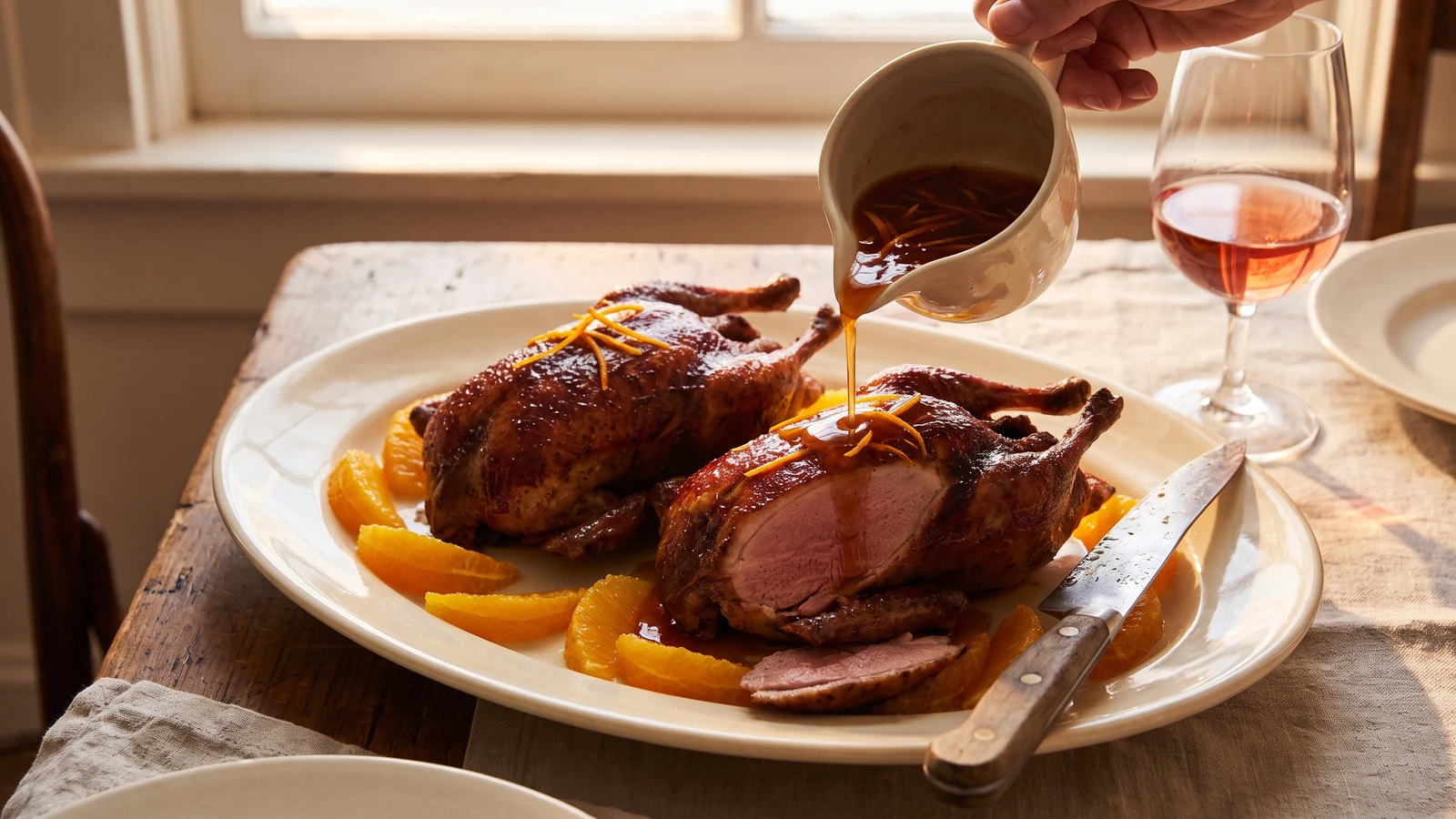
Canards Sauvages teaches the nerve of roasting lean game fiercely and stopping early: burnished skin, rosy breast, raw orange suprêmes, and clear Bigarrade sauce sharpened by caramel and vinegar.
Canards Sauvages à la Bigarrade (wild duck with bitter-orange sauce) teaches the discipline of stopping before lean game turns dry. The one true thing to know before touching the bird is this: wild duck wants fierce heat and very little time. It is roasted without barding, its skin burnished and its breast left frankly rosy, because another five minutes can turn delicacy into penance.
The old formula assumed an open hearth, a saucier tending clear stock, and enough hands to roast the birds, cut raw orange sections, and reduce the sauce at once. At home, a preheated cast-iron pan in the hottest oven replaces the fierce fire, while the Bigarrade base is prepared before the roast and finished with the pan juices during the birds' rest. Two young wild ducks feed four. The separate staff and stockpot never off the fire were brigade scaffolding; fierce heat, no bacon covering, an underdone centre, raw orange sections, and clear sauce served separately remain the dish itself. One cook, one stove, one evening.
The reward is dark, burnished skin over mineral, rosy meat, with a sauce that moves from caramel to vinegar to orange in one clean mouthful. Have the sauce base and orange suprêmes ready before the ducks enter the oven. The step that decides everything is the pull: check early, trust the thermometer, and never roast by hope.
Canards sauvages belong to the French hunting table and the classical Parisian repertoire, which distinguishes game birds by species and roasting time: teal receives the briefest fire, while widgeon and pintail are given only a few minutes more. The Bigarrade treatment brings bitter orange from the sauce kitchen to the game platter, where caramel, vinegar, citrus, and clear stock temper the dark, lean meat; the raw orange sections are part of that balance, not decoration. The same preparation also traveled across the Channel with an English-style apple sauce, proof that classical kitchens borrowed accompaniments readily while keeping the fierce-fire roast intact.
Quantity
2 whole (1½ to 2 lb / 680 to 900 g each)
plucked, eviscerated, and chilled
Quantity
2 teaspoons (10 ml / 12 g)
Quantity
1 teaspoon (5 ml / 2 g)
Quantity
1 tablespoon (15 ml / 14 g)
softened
Quantity
2 medium (about 1 lb / 450 g total)
peeled and cut into raw suprêmes
Quantity
1 medium, yielding ⅓ cup (80 ml / 80 g) juice
zest cut into fine julienne, then juiced
Quantity
1 tablespoon (15 ml / 15 g)
Quantity
2 tablespoons (30 ml / 25 g)
divided
Quantity
3 tablespoons (45 ml / 45 g)
Quantity
1 cup (240 ml / 240 g)
| Ingredient | Quantity |
|---|---|
| whole young wild mallard ducksplucked, eviscerated, and chilled | 2 whole (1½ to 2 lb / 680 to 900 g each) |
| fine sea salt | 2 teaspoons (10 ml / 12 g) |
| freshly ground black pepper | 1 teaspoon (5 ml / 2 g) |
| unsalted buttersoftened | 1 tablespoon (15 ml / 14 g) |
| sweet oranges for servingpeeled and cut into raw suprêmes | 2 medium (about 1 lb / 450 g total) |
| sweet orange for the saucezest cut into fine julienne, then juiced | 1 medium, yielding ⅓ cup (80 ml / 80 g) juice |
| fresh lemon juice | 1 tablespoon (15 ml / 15 g) |
| granulated sugardivided | 2 tablespoons (30 ml / 25 g) |
| red wine vinegar | 3 tablespoons (45 ml / 45 g) |
| clear unsalted duck or chicken stock | 1 cup (240 ml / 240 g) |
Set a rack in the upper third of the oven and heat it to 500°F (260°C), or the highest temperature the oven can hold, with a heavy shallow roasting pan or 12-inch cast-iron skillet inside for at least 20 minutes. Examine each duck carefully for pinfeathers, stray shot, and badly bloodshot tissue; remove all three, then dry the skin and cavity thoroughly. Season inside and out with the salt and pepper. Leave the birds uncovered while the sauce base is prepared. Do not cover them with bacon. Wild duck is lean, but barding shields the skin from the fierce heat that defines this roast.
Working over a bowl, slice the top and bottom from the two serving oranges, cut away peel and white pith, then release each segment from between its membranes. These are suprêmes, skinless citrus sections, and their clean acidity matters against the dark meat. Cover and reserve them with any collected juice. Blanch the fine julienne of zest from the remaining orange in boiling water for 1 minute, drain it, and repeat once; this removes harshness without erasing its bitter edge. Measure ⅓ cup of orange juice and combine it with the lemon juice.
Reserve 1 teaspoon of the sugar for final balancing, then spread the remainder in a small heavy saucepan. Melt it over medium heat without stirring, swirling the pan only when the edges begin to colour, until the caramel is a clear, deep amber. Remove the pan from the heat and add the vinegar carefully, keeping your face and hands back as it bubbles. The caramel may seize into a hard lump. Ça se rattrape: return it to low heat and stir until it dissolves. If it turns black or smells acrid, begin again with fresh sugar, because burnt caramel cannot be corrected. Add the stock, orange and lemon juices, and blanched zest, then simmer briskly until reduced to about ¾ cup (180 ml). Hold over the gentlest heat.
Rub the ducks lightly with the softened butter. Pull out the oven rack, set the birds breast-side up in the fiercely heated pan, and return them immediately to the oven. Roast for 10 minutes, rotate the pan, then begin checking at 16 minutes. Medium wild mallards should require 18 to 20 minutes, never more for the classical finish. The skin should be mahogany and the thickest part of the breast should register 135 to 140°F (57 to 60°C), leaving the flesh frankly rosy. This is below standard poultry guidance of 165°F (74°C). For pregnant, elderly, or immunocompromised guests, or whenever the birds' field handling is uncertain, cook them to 165°F and accept that the breast will be firmer.
Transfer the ducks to a warm board and rest them uncovered for 10 minutes. Covering traps moisture and softens the skin. After 5 minutes, tip each bird so its cavity juices run into the roasting pan; they will be boiled with the sauce. The rest lets the temperature settle and keeps the breast juices in the meat rather than on the carving board.
Spoon excess fat from the roasting pan while leaving the brown fond behind. Set the pan over medium heat, pour in the Bigarrade base, and scrape until every savoury brown trace dissolves. Boil for 2 minutes, strain through a fine sieve into the saucepan, and reduce only until the sauce gleams and lightly coats a spoon. If it tightens too far, loosen it with a spoonful of stock; if it remains thin, reduce it by the tablespoon. Taste before using the reserved sugar. The sauce should be bitter-sweet and distinctly sharp, not candied. Add a pinch of sugar only if the vinegar dominates, then pour the clear sauce into a warm sauceboat.
Remove the legs, then lift each breast whole from the breastbone and slice it across the grain. Arrange the rosy meat and legs on a warm oval platter, keeping each bird together, and surround them with the raw orange suprêmes exactly as the preparation intends. Send the Bigarrade separately so each guest can spoon it over the meat without softening all the burnished skin. À table!
1 serving (about 290g)
Culinary guides, cultural storytelling, and the editorial depth that makes cooking meaningful.
Discover Culinary ExplorerChef Juliette
John Dory has the delicacy of sole and the firmness of turbot. A light flouring, a quick butter sauté, and nut-brown beurre noisette show exactly why looks never mattered.

Chef Juliette
Fresh haddock proves its delicacy in the meunière pan: a fine flour crust, moist pearly flakes, and beurre noisette sharpened with lemon and parsley, ready from one skillet in half an hour.

Chef Juliette
Éperlans à l’Anglaise turns small fish into a lesson in disciplined coating: boned smelts under a close, crisp crumb, pan-fried in clarified butter and finished with bright, half-melted maître d’hôtel butter.

Chef Juliette
Tiny smelts, shallot, mushrooms, white wine, gratin sauce, and fine bread raspings meet a fierce oven, where the fish must turn tender in the same breath the buttered crust bronzes.