
Chef Juliette
John Dory (St. Pierre)
John Dory has the delicacy of sole and the firmness of turbot. A light flouring, a quick butter sauté, and nut-brown beurre noisette show exactly why looks never mattered.
A cooking platform built around craft, culture, and the stories behind what we eat.
Created by Chef Juliette
Based on No. 1979, Grives et Merles de Corse (Thrushes and Corsican Blackbirds), from Le Guide Culinaire (1907) by Auguste Escoffier
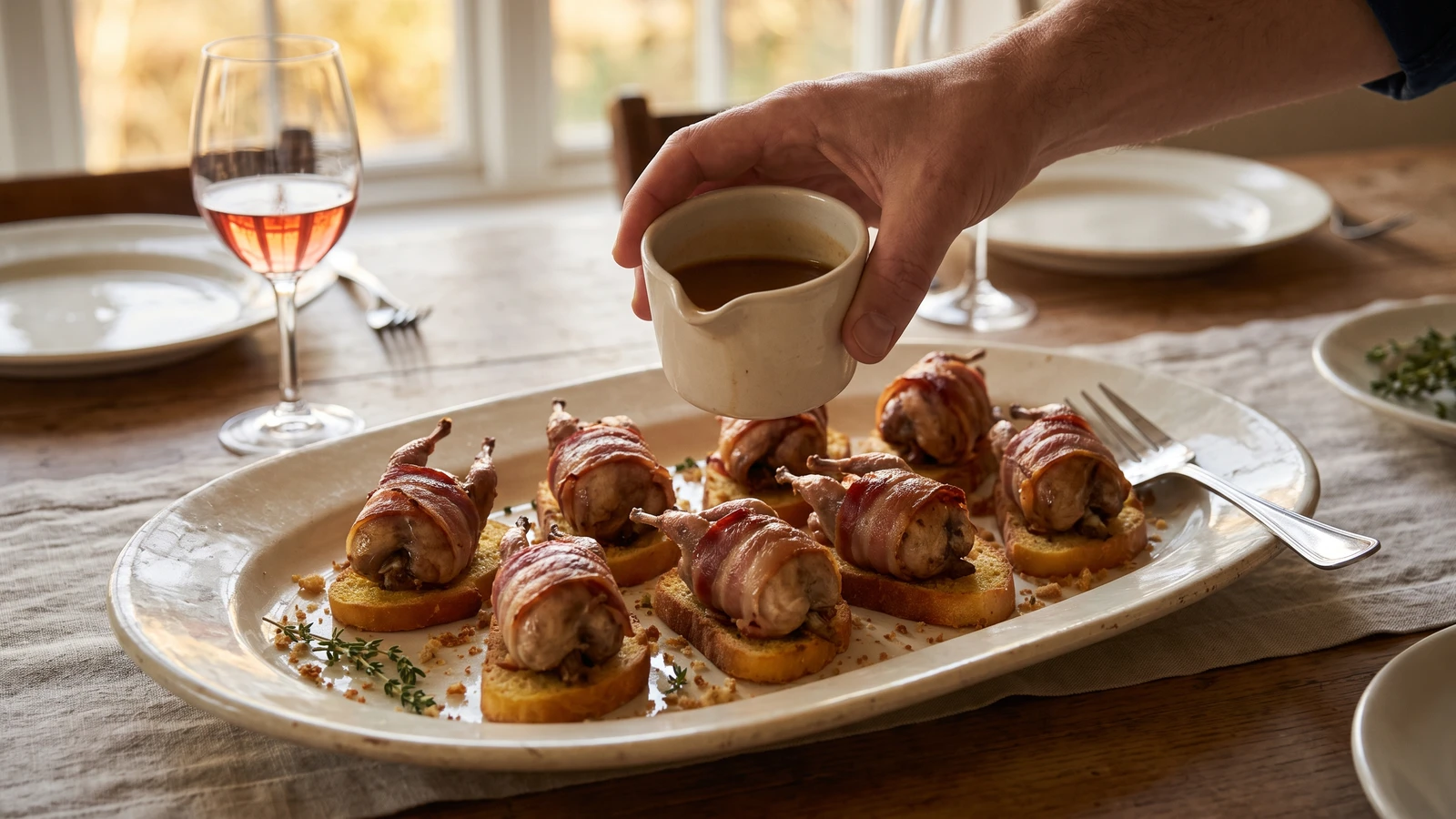
The lesson is restraint: tiny birds protected by bacon, thrushes marked with one juniper berry, roasted fiercely for minutes, then settled on butter-fried bread while a spoonful of glossy jus waits alongside.
Grives et Merles de Corse (Corsican thrushes and blackbirds) teaches restraint before it teaches roasting. These maquis-fed birds were prized because their flesh already carried the berry-rich character of Corsica, so the entry gives each thrush one juniper berry, no spice chest, and lets bacon, fierce heat, and the bird do the rest. The one true thing is this: juniper must whisper. Use one berry where the source directs it, never a handful.
The source assumed a rotisserie before a moderately fierce fire, a saucier within reach, and stock never off the fire. Your equivalents are a rack in a very hot oven, butter-fried bread prepared ahead, and a small metal roasting pan deglazed with light poultry stock. The spit and extra hands are brigade scaffolding; the barding, disciplined juniper, brief roast, fried bread, and jus très court (a scant, quickly reduced roasting gravy) are the dish. A salamander contributes nothing here. It would merely dry the birds. One cook, one stove, one evening.
Wild thrushes and blackbirds are protected or tightly regulated in many jurisdictions. Use only documented lawful game from an approved dealer; otherwise, farmed quail is the honest home equivalent. Eight quail replace twelve smaller birds, and four receive a berry so the platter retains the entry's distinction between thrush and blackbird. This is the necessary change, made for lawful sourcing and size, not a new flavor scheme.
Roast fast and begin checking at ten minutes. Tiny birds possess almost no margin between succulent and dry, so the source's short timing remains the step that decides the dish.
Grives et Merles de Corse belongs to Corsica's hunting table, where thrushes and blackbirds feed among the aromatic shrubs and berries of the maquis. The preparation passed from island hearths and roasting spits into the classical repertoire with remarkably little ornament: bacon protects the tiny birds, one juniper berry echoes the thrush's forage, and fried bread catches the juices. Juniper is not a general game seasoning here; the entry assigns it to the thrushes and not the blackbirds, a small distinction that expresses the dish's restraint.
Quantity
12 small game birds (about 2½ to 4 oz / 70 to 115 g each), or 8 quail (about 3½ to 4½ oz / 100 to 125 g each)
professionally dressed and oven-ready
Quantity
1 per thrush, or 4 berries for 8 quail
Quantity
12 slices (about 7 oz / 200 g), or 8 slices (about 5 oz / 140 g) for quail
Quantity
12 cushions (about 10 oz / 280 g total), or 8 cushions (about 7 oz / 200 g total) for quail
cut 2½ inches / 6 cm wide and ¾ inch / 2 cm thick
Quantity
4 to 6 tablespoons (60 to 90 ml / 56 to 85 g)
Quantity
¾ cup (180 ml / 180 g)
Quantity
Up to ¼ cup (60 ml / 60 g)
for correcting an overly salty jus
| Ingredient | Quantity |
|---|---|
| legally sourced thrushes and/or blackbirds, or small farmed quailprofessionally dressed and oven-ready | 12 small game birds (about 2½ to 4 oz / 70 to 115 g each), or 8 quail (about 3½ to 4½ oz / 100 to 125 g each) |
| whole juniper berries | 1 per thrush, or 4 berries for 8 quail |
| very thin unsmoked streaky bacon | 12 slices (about 7 oz / 200 g), or 8 slices (about 5 oz / 140 g) for quail |
| day-old country breadcut 2½ inches / 6 cm wide and ¾ inch / 2 cm thick | 12 cushions (about 10 oz / 280 g total), or 8 cushions (about 7 oz / 200 g total) for quail |
| unsalted butter | 4 to 6 tablespoons (60 to 90 ml / 56 to 85 g) |
| light unsalted poultry stock | ¾ cup (180 ml / 180 g) |
| water (optional)for correcting an overly salty jus | Up to ¼ cup (60 ml / 60 g) |
Set a wire rack inside the smallest heavy metal roasting pan that will hold the birds without crowding. Heat the oven to 475°F / 245°C. A compact pan keeps the scant drippings from scorching across a broad, empty surface and gives you enough fond for the jus.
Pat every bird completely dry inside and out. If using lawful shot game, inspect the flesh and cavities carefully for stray shot, quills, and damaged tissue. Tuck one juniper berry inside each thrush and none inside the blackbirds, exactly as the entry directs. For the quail adaptation, put one berry into four birds and leave four plain. Add no salt or pepper; the bacon seasons the exterior, and the juniper is seasoning enough. Fold in the wing tips, draw the legs together, and truss each bird compactly.
Wrap one thin bacon slice around each bird, covering the breast and overlapping the ends beneath the back. Secure it with kitchen twine or a wooden pick. This is barder, wrapping lean meat in fat for protection, and it must stay: these birds are too small and lean to face fierce heat bare. If the bacon is thick, press it thinner between two sheets of parchment before wrapping; heavy rashers will remain rubbery during such a brief roast.
Melt 4 tablespoons (60 ml / 56 g) butter in a wide skillet over medium heat until its foam settles. Fry the bread in batches until deeply golden on both sides, adding the remaining butter as the pan dries. Hold the cushions uncovered on a rack so their undersides remain crisp. If the butter blackens, wipe out the pan and begin the next batch with fresh butter. Ça se rattrape.
Arrange the birds breast-side up on the roasting rack, leaving a little air between them. Roast without opening the oven for 10 minutes, then check the deepest part of a thigh with an instant-read thermometer, avoiding bone. Tiny game birds generally reach 165°F / 74°C within the source's 10 to 12 minutes; farmed quail may require 12 to 15 minutes. If they are not ready, continue in 2-minute intervals. If the bacon colors too quickly first, shield only the bacon with small pieces of foil. The thermometer decides, because a dry bird cannot be returned to succulence.
Transfer the birds to a board, remove the twine or picks, and cover them loosely while you make the jus très court. Pour off the fat from the roasting pan, leaving about 1 tablespoon (15 ml / 14 g) with the browned deposits. Set the pan over medium heat, add the poultry stock, and scrape up every trace of fond. Boil briskly until reduced to about ⅓ cup (80 ml / 80 g), glossy but still fluid. If the bacon has made it too salty, add up to ¼ cup (60 ml / 60 g) water and stop reducing as soon as balance returns. Ça se rattrape. Strain into a warm sauceboat.
Arrange the fried bread cushions on a warm oval platter and set one bird on each, letting the bread catch the resting juices. Allow three tiny game birds or two quail per person. Serve the jus separately, as the source requires, so each guest can spoon on only enough to moisten the bread. No garnish is needed. Bacon, bronze, buttered bread, and a little glossy jus are the whole appearance. À table!
1 serving (about 275g)
Culinary guides, cultural storytelling, and the editorial depth that makes cooking meaningful.
Discover Culinary ExplorerChef Juliette
John Dory has the delicacy of sole and the firmness of turbot. A light flouring, a quick butter sauté, and nut-brown beurre noisette show exactly why looks never mattered.

Chef Juliette
Fresh haddock proves its delicacy in the meunière pan: a fine flour crust, moist pearly flakes, and beurre noisette sharpened with lemon and parsley, ready from one skillet in half an hour.

Chef Juliette
Éperlans à l’Anglaise turns small fish into a lesson in disciplined coating: boned smelts under a close, crisp crumb, pan-fried in clarified butter and finished with bright, half-melted maître d’hôtel butter.

Chef Juliette
Tiny smelts, shallot, mushrooms, white wine, gratin sauce, and fine bread raspings meet a fierce oven, where the fish must turn tender in the same breath the buttered crust bronzes.