Culinary Explorer

A cooking platform built around craft, culture, and the stories behind what we eat.
Discover Culinary Explorer
Ortolans au suc d’Ananas

Ortolans au suc d’Ananas

Created by Chef Juliette

Based on No. 1976, Ortolans au suc d’Ananas, from Le Guide Culinaire (1907) by Auguste Escoffier

Hot butter, tiny quail breasts, and ice-cold pineapple juice meet in a covered cocotte. Three minutes of roasting, one decisive splash, and the dish must travel straight to the table.

Main Dishes
French
Special Occasion
Dinner Party
20 min
Active Time
3 min cook23 min total
Yield4 servings

Ortolans au suc d’Ananas (ortolans with pineapple juice) teaches one severe, beautiful principle: temperature is an ingredient. The bird rolls through hot butter for three minutes, very cold pineapple juice strikes the cocotte, and the lid closes at once. That collision makes the dish. Hesitate, and its bright immediacy disappears.

The grand-kitchen entry assumed dressed ortolans arriving by the tray, a fiercely hot oven, a shallow earthenware cocotte fitted precisely to them, and a runner waiting at the pass. It calls on no saucier, perpetual stockpot, or salamander, so none is invented here. Protected ortolans cannot be lawfully sourced, and whole quail are too large for the prescribed three-minute roasting. Sixteen skin-on farmed quail breast lobes provide the honest equivalent: each is close to the original bird's cooking size, and each receives the source's quarter-ounce measure of fresh butter. The brigade's sourcing chain and waiting runner are scaffolding; the butter ratio, three-minute roast, cold juice, tight lid, and instant service are the dish itself.

One cook, one stove, one evening, but have the table ready before the quail enters the oven. The one step that matters most is the last one: the pineapple juice must be truly cold and within your reach when the hot cocotte comes out.

Ortolans belonged most strongly to the tables of Gascony and the Landes, where migratory buntings were trapped and fattened before the grand kitchens of Paris absorbed them into their repertory of tiny game birds. Pineapple in this preparation is not a Provençal accent; its sharp sweetness is a grand-kitchen counterweight to a rich bird served in abundant fresh butter. The ortolan bunting is protected in France and throughout the European Union and cannot be lawfully sourced for this dish, so farmed quail breast carries the method without reviving the trade.

The technique, the tradition, and the story behind every dish.

Discover Culinary Explorer

Ingredients

skin-on, boneless farmed quail breast lobes

Quantity

16 (about 1 lb / 450 g total)

fully thawed, patted dry, and no thicker than 1/2 inch (1.25 cm)

fine sea salt

Quantity

3/4 teaspoon (3.75 ml / 4.5 g)

fresh unsalted butter

Quantity

1/2 cup (120 ml / 113 g; 1/4 oz / 7 g per breast lobe)

unsweetened pineapple juice

Quantity

4 tablespoons (1/4 cup / 60 ml / 65 g)

finely strained and chilled to 35 to 40°F (2 to 4°C)

Equipment Needed

  • Shallow 10-inch (25 cm) ovenproof cocotte or enameled braiser with a tight lid
  • Instant-read thermometer
  • Small chilled measuring jug
  • Fine-mesh sieve
  • Heatproof trivet

Instructions

  1. 1

    Ready the final splash

    Heat the oven to 500°F (260°C) with a rack in the upper third. Put the strained pineapple juice in the coldest part of the refrigerator or nest its measuring jug in an ice bath until it reaches 35 to 40°F (2 to 4°C). Set a trivet on the table, warm four plates, and put the cocotte lid beside the stove. Once the butter is hot, this recipe permits no search for equipment and no pause for conversation.

  2. 2

    Prepare the quail

    Inspect the quail breast lobes and trim away loose fragments without removing the skin. If any piece is thicker than 1/2 inch (1.25 cm), place it between sheets of parchment and press it gently with the flat base of a pan until even. Dry every surface again, then season both sides with the salt. Equal thickness is what allows the source's three-minute cooking time to remain safe and honest.

  3. 3

    Roll in hot butter

    Melt the butter in a shallow 10-inch (25 cm) ovenproof cocotte over medium-high heat. Let it foam briskly while the milk solids remain pale gold, then roll each quail breast through the butter and arrange the pieces snugly in one layer, skin side up. A pan that is too broad exposes the butter and encourages it to burn. If the milk solids turn chestnut, pull the cocotte from the heat for a few seconds and lower the burner; ça se rattrape. If they blacken and smell bitter, fresh butter is the only honest restart.

  4. 4

    Roast three minutes

    Transfer the uncovered cocotte immediately to the very hot oven and roast for exactly three minutes. Check the thickest lobe with an instant-read thermometer as soon as the cocotte comes out; it must reach 165°F (74°C). If it falls short, remove any pieces already at temperature and return the others to the oven in 30-second intervals. Keep the pineapple juice cold until every piece is safely cooked. The prescribed clock governs the method, but temperature has the final word.

    Do not judge these small breasts by colour alone. Pineapple juice enters only after cooking, so there is no later simmer to correct an underdone centre.
  5. 5

    Shock, cover, serve

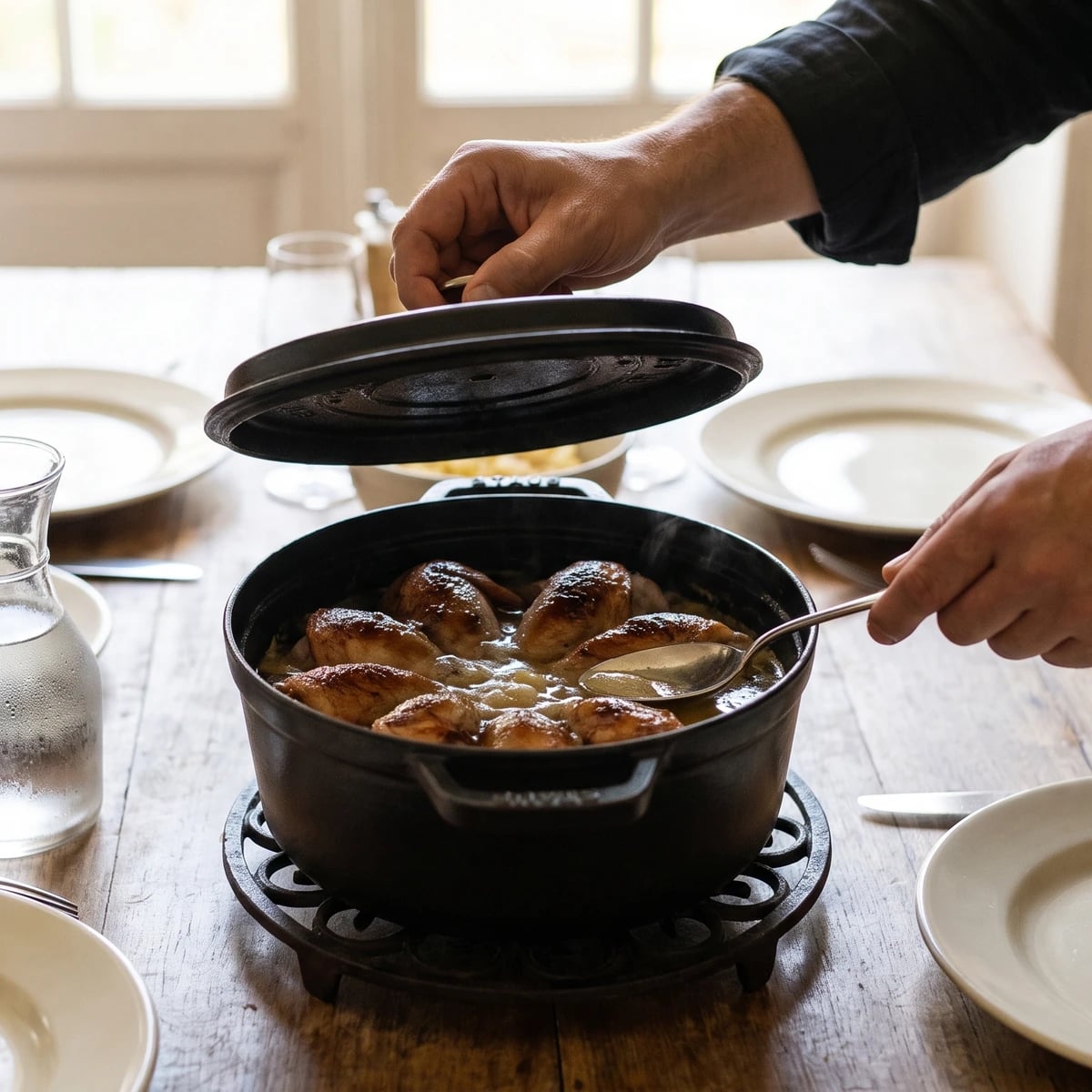
    Set the hot cocotte on its trivet. Keeping the chilled jug low to control splashing, immediately sprinkle the very cold pineapple juice over and around the quail, then cover tightly. Expect a sharp hiss as the juice meets the butter. If the juices gather in separate beads, hold the lid firmly and give the cocotte one decisive circular swirl; ça se rattrape, and the butter will form a loose, gleaming dressing. Do not return it to the burner and do not let it wait. Carry the covered cocotte straight to the table and open it there. À table!

Chef Tips

  • Do not seek actual ortolans. The bunting is protected, and its capture and sale are unlawful. Skin-on breast lobes from legally farmed quail preserve the tiny scale, richness, and quick cooking that the method requires.
  • Use fresh unsalted butter, not margarine and not a butter substitute. The measured quarter ounce for each breast lobe is the source's proportion, and it supplies both the cooking medium and the finished dressing. We don't apologize for butter.
  • A flat cocotte just large enough for one snug layer matters. Use an enameled cast-iron braiser or high-heat-rated flameproof ceramic; ordinary decorative earthenware can crack when cold juice meets a fiercely heated vessel.
  • Fresh pineapple juice should be sharp, strained, and unsweetened. If the fruit at the market is tired, use good unsweetened canned juice and chill it thoroughly. The classical pantry solved poor seasons long before we did.
  • Never marinate the quail in pineapple juice. Fresh pineapple softens meat rapidly, and early contact would turn the delicate surface pasty. Its place is at the finish, cold against hot butter.

Advance Preparation

  • Strain and refrigerate the pineapple juice up to one day ahead. Chill the measuring jug as well, since a warm vessel steals the temperature contrast the dish depends upon.
  • The quail breasts can be trimmed and arranged uncovered in the refrigerator for up to four hours. This dries their surfaces so the butter clings cleanly; take them out only ten minutes before cooking.
  • This dish cannot be cooked ahead, held warm, or reheated without losing its point. Seat the guests, warm the plates, and complete every other part of dinner before the butter enters the cocotte.

Frequently Asked Questions

Nutrition Information

1 serving (about 130g)

Calories
410 calories
Total Fat
35 g
Saturated Fat
18 g
Trans Fat
1 g
Unsaturated Fat
14 g
Cholesterol
145 mg
Sodium
510 mg
Total Carbohydrates
2 g
Dietary Fiber
0 g
Sugars
2 g
Protein
22 g

Note: Chef personas and recipes are created with AI assistance. Cook with care: follow safe food-handling practices, check doneness with a thermometer when needed, and adapt for allergies and your kitchen.

Where cooking meets culture.

Culinary guides, cultural storytelling, and the editorial depth that makes cooking meaningful.

Discover Culinary Explorer

More from Roasts and Salads

Browse the full collection