
Chef Juliette
Accompaniment of Roasts
The roast keeps its sauce and gains its proper escort: lofty Yorkshire pudding for beef, sage and onion dressing for birds, or veal stuffing for pork and veal, each scaled for four.
A cooking platform built around craft, culture, and the stories behind what we eat.
Created by Chef Juliette
Based on No. 1975, Ortolans aux Questches, from Le Guide Culinaire (1907) by Auguste Escoffier
A protected bird becomes a lawful home dish through tiny farmed quail breasts, set on buttered quetsche halves, wrapped in vine leaves, roasted fiercely for four minutes, then salted and brushed with sharp verjuice.
Ortolans aux Quetsches (tiny birds on buttered prune-plum supports) teaches restraint at its most severe: the plum is a piece of fragrant cookware, not a side dish, and the four-minute roast is the dish. The quetsche halves are not eaten. They hold butter, steady each parcel, and lend a brief dark-fruit perfume before the bird is salted and brushed with verjuice.
The book assumed access to wild ortolan, a protected bird that must not be hunted, bought, or served, plus a brigade able to select thumb-sized birds and command a fiercely fired oven. The lawful home translation is one small boneless farmed-quail breast on each support and a thoroughly preheated 500°F (260°C) oven. No saucier, stockpot, salamander, fond, roux, reduction, or emulsion is hiding offstage; this spare formula calls for none. Selecting equal birds and timing them together was brigade scaffolding. Buttered quetsche, vine-leaf wrapping, four fierce minutes, salt after roasting, and verjuice at the finish are the structure and stay intact. One cook, one stove, one evening.
Have the salt and brush ready before the tray goes in, because the true risk is hesitation after the oven. Use breasts of equal size, check their centers at four minutes, and if one is not yet safely cooked, return only that parcel for short bursts. The step that matters most is the preheated oven: less heat forces longer cooking, and longer cooking dries a bird this small.
Ortolan cookery belongs most strongly to Gascony and the Landes, where the small migratory bunting passed from seasonal country ritual into grand-kitchen service. Pairing it with quetsche, the elongated purple plum associated with Alsace and Lorraine, is a codified dining-room construction rather than the expression of one regional pantry: the fruit serves as a buttered aromatic support and is explicitly left uneaten. In France, wild ortolan is protected and its capture, sale, and service are unlawful, so preserving the old method now requires farmed quail rather than a clandestine source.
Quantity
2 large (about 4 1/4 oz / 120 g total)
firm-ripe, halved lengthwise and pitted
Quantity
4 teaspoons (20 ml / 18 g)
softened and divided into four hazelnut-sized knobs
Quantity
4 small fillets (about 3 oz / 85 g total)
evenly sized
Quantity
4 large leaves
fresh or brined, rinsed well
Quantity
1 tablespoon (15 ml / 15 g)
for moistening
Quantity
1/4 teaspoon (1.25 ml / 1.5 g)
Quantity
2 teaspoons (10 ml / 10 g)
| Ingredient | Quantity |
|---|---|
| quetsche plumsfirm-ripe, halved lengthwise and pitted | 2 large (about 4 1/4 oz / 120 g total) |
| unsalted buttersoftened and divided into four hazelnut-sized knobs | 4 teaspoons (20 ml / 18 g) |
| boneless farmed-quail breast filletsevenly sized | 4 small fillets (about 3 oz / 85 g total) |
| tender grape leavesfresh or brined, rinsed well | 4 large leaves |
| cold waterfor moistening | 1 tablespoon (15 ml / 15 g) |
| fine sea salt | 1/4 teaspoon (1.25 ml / 1.5 g) |
| verjuice | 2 teaspoons (10 ml / 10 g) |
Set a rack in the upper third of the oven and heat it to 500°F (260°C), giving it at least twenty minutes after the thermostat first claims it is ready. Use a small heavy-gauge metal tray, not glass or delicate ceramic. The fierce, immediate heat is essential: a cooler oven lengthens the roast and dries the tiny quail breasts before the vine leaves can protect them.
Set the four quetsche halves cut-side up on the tray and place one hazelnut-sized knob of butter in each stone cavity. Roast for 3 to 4 minutes, until the butter bubbles and the plum rims just begin to relax. The fruit should be hot and fragrant but still firm enough to hold a bird. If a half starts to slump, lean it against its neighbor with the cavity facing upward. Remember that the quetsches are supports and are not eaten.
While the plums begin roasting, leave the rinsed grape leaves supple and damp. If fresh leaves are stiff, dip them briefly in boiling water and cool them before using. Moisten each quail breast lightly with wet fingertips, then wrap it in one leaf, folding the sides inward to make a compact parcel. Keep every parcel close to the same thickness so all four cook together. If a leaf tears, turn the split underneath and overlap the edges. Do not season yet; in this preparation, salt belongs after the oven.
Remove the tray just long enough to set one wrapped quail breast on each buttered quetsche half, placing the leaf seam underneath. Return the tray immediately and roast for 4 minutes. Check each breast from the side with an instant-read thermometer; the center must reach 165°F (74°C). If one falls short, lift off the finished parcels and return only the underdone one for 30-second bursts. Ça se rattrape. Do not leave all four in while one catches up.
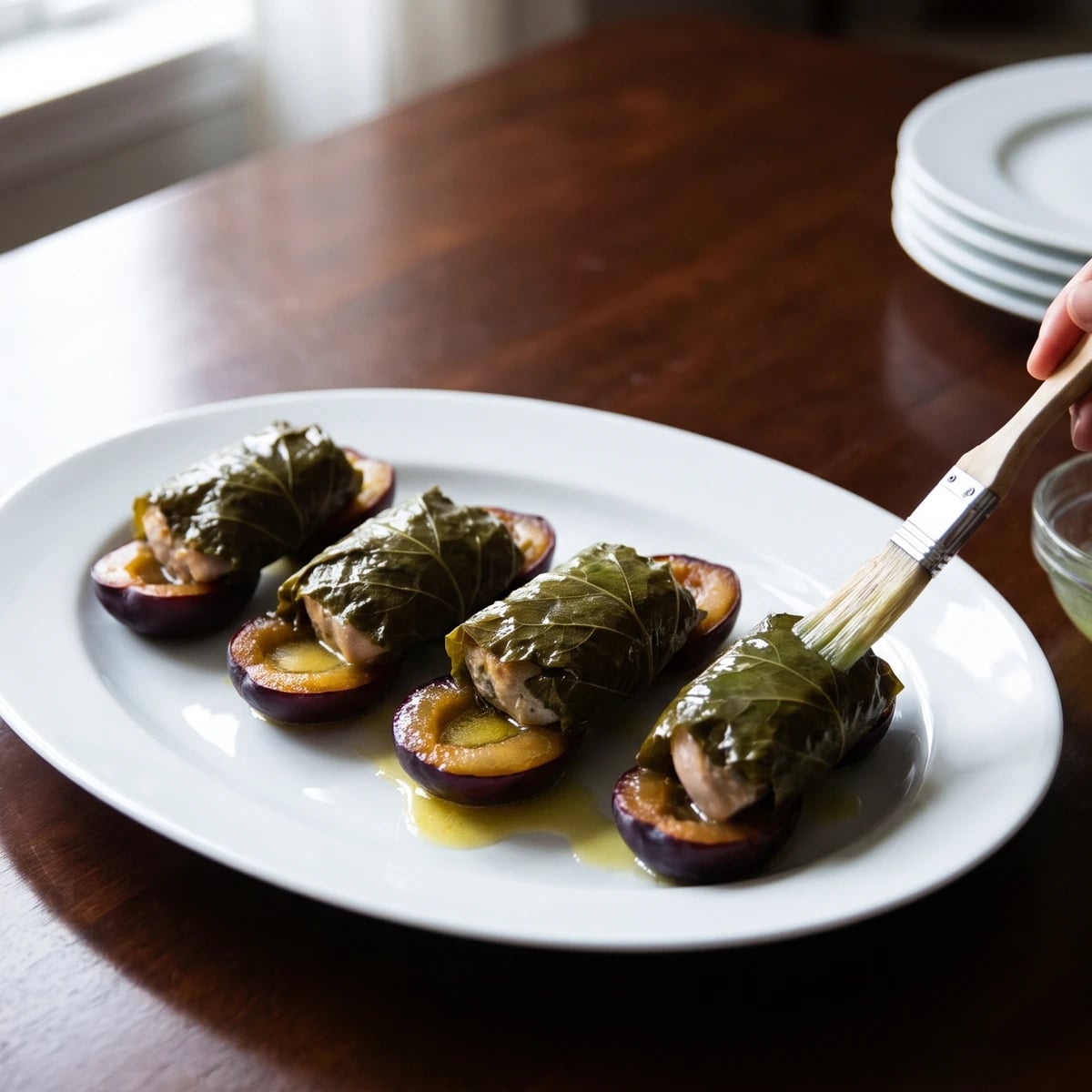
The moment the tray leaves the oven, sprinkle the quail parcels evenly with the fine salt. Dip the pastry brush in verjuice and draw a light coat over each leaf-wrapped breast, then repeat once so the sharp grape acidity reaches every parcel without pooling. Add nothing else. Carry them to the table exactly as they stand, one parcel on each buttered quetsche half; lift away the quail to eat and leave the plum support behind. À table!
1 serving (about 50g)
Culinary guides, cultural storytelling, and the editorial depth that makes cooking meaningful.
Discover Culinary Explorer
Chef Juliette
The roast keeps its sauce and gains its proper escort: lofty Yorkshire pudding for beef, sage and onion dressing for birds, or veal stuffing for pork and veal, each scaled for four.

Chef Juliette
Pouding du Yorkshire teaches the law of hot fat: an egg-rich, nutmeg-scented batter poured into smoking beef dripping, rising bronze and crisp before it catches the roast's savory juices.

Chef Juliette
Whole-baked onions are the lesson: sweet before they meet the pan, never acrid, then joined with butter, dried sage, milk-softened breadcrumbs, and veal fat in the classical 2:2:1 proportion.

Chef Juliette
Equal weights of chopped suet, fine breadcrumbs, and parsley, bound with egg and plenty of nutmeg, make a compact poached farce that slices neatly beside roast veal or pork.