
Chef Juliette
John Dory (St. Pierre)
John Dory has the delicacy of sole and the firmness of turbot. A light flouring, a quick butter sauté, and nut-brown beurre noisette show exactly why looks never mattered.
A cooking platform built around craft, culture, and the stories behind what we eat.
Created by Chef Juliette
Based on No. 1973, Quails, from Le Guide Culinaire (1907) by Auguste Escoffier
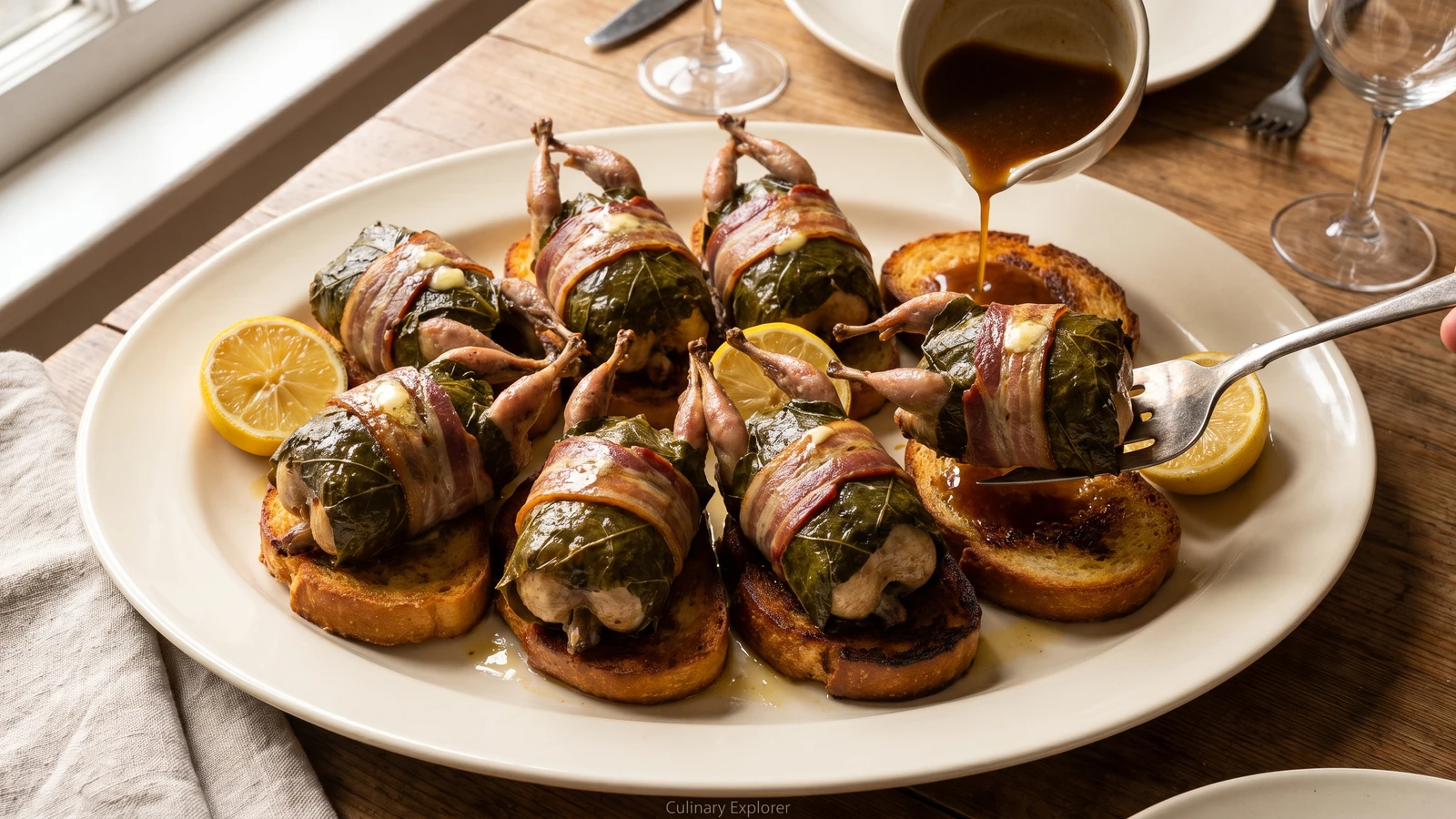
Fierce heat, firm fat, and exact timing turn buttered vine leaves and thin bacon into a protective baste, while crisp croûtons wait beneath to catch every drop of the quails' short gravy.
Cailles rôties sur croûtons (roast quails on butter-fried bread) teach one true thing: a small bird wants fierce heat and very little time. The vine leaf shields the delicate breast, the bacon bastes it, and the quail must leave the oven while its flesh is still succulent. Choose plump birds with pale skin and white, firm fat before you touch a pan. A lean quail cannot give what it doesn't possess.
The original kitchen had an open roasting fire, a turning spit, and another pair of hands frying the croûtons while the birds cooked. Your honest equivalents are a blazing oven, a heavy metal roasting pan heated in advance, and a skillet used while that oven comes to temperature. Eight small quails feed four. I've changed the fire and the scale, not the construction: buttered vine leaf, thin bacon, ten to twelve minutes of roasting, croûtons fried in butter, half-lemons, and a very short gravy. No saucier or stockpot enters this dish, and a salamander would only invite overcooking.
The separate spit and the extra cook were brigade scaffolding, so they can go. The wrapping, fierce heat, croûtons, and concentrated roasting juices are the dish itself, so they stay. Begin checking at ten minutes. That moment, not a complicated sauce, decides the whole plate.
Cailles rôties belong to the Parisian bourgeois and grand-kitchen game-bird table, where small birds from vineyard and field were sent whole to the roasting fire and served on croûtons of fried bread. The vine leaf was practical before it was decorative: it protected the fine skin while the bacon supplied enough fat for fast roasting, a country method carried into city dining rooms. Quail is often called game even when farmed, but the classical test remains the same, a plump body and white, firm fat rather than a romantic label.
Quantity
8 birds, about 4 to 5 ounces (115 to 140 g) each
Quantity
8
use fresh leaves or rinse brined leaves thoroughly
Quantity
8 very thin slices, about 4 ounces (115 g) total
Quantity
6 tablespoons (90 ml / 85 g)
softened and divided
Quantity
8 slices, each ½ inch (1.25 cm) thick, about 10 ounces (280 g) total
crusts removed and trimmed into croûtons
Quantity
1¼ teaspoons (6 ml / 7 g)
Quantity
½ teaspoon (2.5 ml / 1 g)
Quantity
2
halved
Quantity
Up to 2 tablespoons (30 ml / 30 g)
use only as needed to loosen the roasting juices
| Ingredient | Quantity |
|---|---|
| oven-ready quails | 8 birds, about 4 to 5 ounces (115 to 140 g) each |
| large vine leaves (grape leaves)use fresh leaves or rinse brined leaves thoroughly | 8 |
| mild unsmoked streaky bacon | 8 very thin slices, about 4 ounces (115 g) total |
| unsalted buttersoftened and divided | 6 tablespoons (90 ml / 85 g) |
| day-old white country breadcrusts removed and trimmed into croûtons | 8 slices, each ½ inch (1.25 cm) thick, about 10 ounces (280 g) total |
| fine sea salt | 1¼ teaspoons (6 ml / 7 g) |
| freshly ground black pepper | ½ teaspoon (2.5 ml / 1 g) |
| lemonshalved | 2 |
| boiling water (optional)use only as needed to loosen the roasting juices | Up to 2 tablespoons (30 ml / 30 g) |
Set a rack in the upper-middle of the oven and heat it to 500°F (260°C), or 475°F (245°C) in a convection oven. Put a heavy rimmed metal roasting pan inside for at least twenty minutes. The hot metal and strong radiant heat are the home equivalent of roasting before a fierce open fire; a merely warm oven cooks the birds slowly and dries them before their bacon can bronze.
If the vine leaves are fresh, lower them into boiling water for fifteen seconds, then cool and dry them thoroughly. Rinse brined leaves well and dry those too. Pat the quails dry inside and out, then season them evenly with the salt and pepper. Wet leaves or wet birds create trapped moisture, and trapped moisture steams the skin instead of roasting it.
Spread each vine leaf vein-side up and coat it lightly with 2 tablespoons (30 ml / 28 g) of the softened butter. Set a quail breast-side down on the buttered face, fold the leaf around the breast and sides, then wrap one thin bacon slice over the leaf. Tie gently with kitchen twine, using only enough pressure to hold the covering in place. The vine leaf must sit beneath the bacon, where it protects the bird while the melting pork fat bastes through it.
Melt the remaining 4 tablespoons (60 ml / 57 g) butter in a wide skillet over medium heat. Fry the croûtons, pieces of bread browned in butter, in batches until crisp and deep gold on both sides, about two minutes per side. Hold them on a wire rack so their undersides remain crisp. If the butter turns black or smells bitter before the bread is ready, stop and wipe the pan clean. Ça se rattrape: begin again with fresh butter rather than asking scorched fat to behave.
Working carefully, set the wrapped quails breast-side up in the blazing hot roasting pan, leaving space between them. Roast for ten minutes, then check the thickest part of a thigh without touching bone. Continue only until the bacon is bronzed and the birds register 165°F (74°C), usually ten to twelve minutes in all. If the bacon darkens before the meat reaches temperature, cover the breasts loosely with foil and give the birds another minute or two. If they reach temperature early, pull them at once. Small birds do not reward hesitation.
Snip away the twine and place each quail on a warm croûton, then rest them loosely covered for five minutes. Tilt the roasting pan and spoon away the clear surface fat, leaving the dark roasting deposits behind. Add the resting juices and only enough boiling water to loosen the fond, scrape thoroughly, and pour everything into a small saucepan. Boil for a few seconds until the jus de rôti (roasting juices) is glossy and concentrated, yielding only three or four tablespoons. If it tastes too salty, don't reduce it further; whisk in boiling water one teaspoon at a time. Ça se rattrape. No stock, wine, flour, or cream belongs here.
Arrange the quails on their croûtons across a warm platter, with the four lemon halves tucked around them. Pour the short jus into a warmed sauceboat and serve it separately, exactly as the dish requires. Each diner gets two birds and one lemon half. The croûton should be crisp at its edges and soaked with butter and roasting juice at its centre. À table!
1 serving (about 260g)
Culinary guides, cultural storytelling, and the editorial depth that makes cooking meaningful.
Discover Culinary ExplorerChef Juliette
John Dory has the delicacy of sole and the firmness of turbot. A light flouring, a quick butter sauté, and nut-brown beurre noisette show exactly why looks never mattered.

Chef Juliette
Fresh haddock proves its delicacy in the meunière pan: a fine flour crust, moist pearly flakes, and beurre noisette sharpened with lemon and parsley, ready from one skillet in half an hour.

Chef Juliette
Éperlans à l’Anglaise turns small fish into a lesson in disciplined coating: boned smelts under a close, crisp crumb, pan-fried in clarified butter and finished with bright, half-melted maître d’hôtel butter.

Chef Juliette
Tiny smelts, shallot, mushrooms, white wine, gratin sauce, and fine bread raspings meet a fierce oven, where the fish must turn tender in the same breath the buttered crust bronzes.