
Chef Juliette
John Dory (St. Pierre)
John Dory has the delicacy of sole and the firmness of turbot. A light flouring, a quick butter sauté, and nut-brown beurre noisette show exactly why looks never mattered.
A cooking platform built around craft, culture, and the stories behind what we eat.
Created by Chef Juliette
Based on No. 1972, Partridges, from Le Guide Culinaire (1907) by Auguste Escoffier
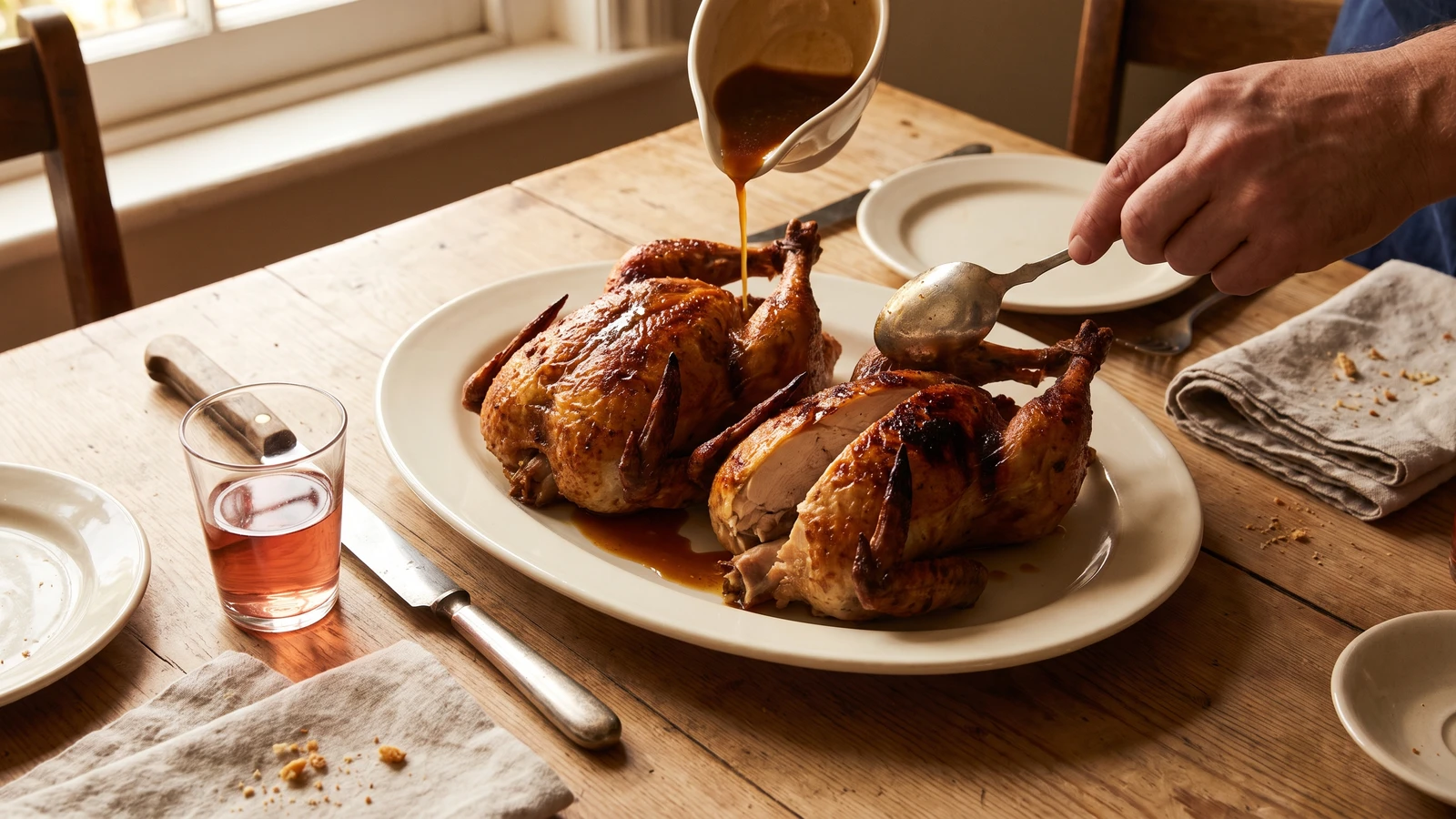
Perdreaux rôtis turn lean young game into a generous roast through three disciplined moves: butter within, fatback over the breast, and fierce heat stopped the instant the birds are done.
Perdreaux rôtis (roast young partridges) teach the first rule of game cookery: age chooses the method. A young bird wants fierce heat and a short roast; an older partridge will dry before it tenderizes and belongs in a covered pot. Know which bird is on your board before touching a pan, because no sauce can rescue the wrong method.
The book sends the pheasant treatment across unchanged: a lump of fat inside, a barde of pork fat over the breast, then a short roast. Its kitchen assumed a turning spit, a cook free to baste, and fatback ready by the sheet. Your honest equivalent is a hot oven, a small roasting pan, and a thermometer. Two birds give four generous half portions. The spit and its attendant were brigade scaffolding; the inner butter, barding, and quick roasting are the dish itself, so all three stay. One cook, one stove, one evening.
The finished birds should be deeply bronzed where the barde comes away, succulent beneath, and surrounded by just enough glossy pan jus to catch the fond without softening the skin. Timing decides everything. Remove the barde early enough to color the breasts, then stop cooking the moment the birds reach temperature.
Perdreaux rôtis belong to the French table de chasse, particularly the grain country of Beauce and Champagne where grey partridge has long been familiar quarry. French cooks preserved a practical distinction in the bird's name: perdreau means a young partridge fit for the spit, while an older perdrix is better served by slow cooking in a covered pot. Barding carried fat into this naturally lean game as the preparation traveled from hunting households into bourgeois dining rooms and the classical repertoire.
Quantity
2 birds, 12 to 14 ounces (340 to 400 g) each
giblets removed
Quantity
1 teaspoon (5 ml / 6 g)
Quantity
½ teaspoon (2.5 ml / 1 g)
Quantity
6 tablespoons (90 ml / 85 g)
2 tablespoons softened, 2 tablespoons melted, and 2 tablespoons cold
Quantity
8 very thin slices (4 ounces / 115 g)
blanch bacon briefly and dry it if substituting
Quantity
½ cup (120 ml / 120 g)
| Ingredient | Quantity |
|---|---|
| young, oven-ready partridgesgiblets removed | 2 birds, 12 to 14 ounces (340 to 400 g) each |
| fine sea salt | 1 teaspoon (5 ml / 6 g) |
| freshly ground black pepper | ½ teaspoon (2.5 ml / 1 g) |
| unsalted butter2 tablespoons softened, 2 tablespoons melted, and 2 tablespoons cold | 6 tablespoons (90 ml / 85 g) |
| pork fatback, or unsmoked streaky baconblanch bacon briefly and dry it if substituting | 8 very thin slices (4 ounces / 115 g) |
| hot water | ½ cup (120 ml / 120 g) |
Use young partridges with plump breasts, smooth legs, and a breastbone that still has a little flexibility. If the birds are wild, run your fingertips carefully over the flesh and remove any remaining shot or feather stubs with tweezers. Pat them thoroughly dry inside and out. Moisture prevents browning, and these small birds have no cooking time to waste.
Heat the oven to 450°F (230°C) with a rack in the center. Season each cavity and the outside of each bird with the salt and pepper. Put 1 tablespoon of softened butter inside each cavity, pressing it against the breast side so it melts through the leanest meat as the birds roast.
Lay 4 slices of fatback across the breast of each bird, overlapping them into a barde, the protective sheet of pork fat that shields lean game from the oven's first fierce heat. Tie each bird around the breast with kitchen twine so the barde stays flat, then brush the exposed legs and sides with the melted butter. Set the birds breast-side up in a small roasting pan, leaving room between them.
Roast for 12 minutes, then baste the birds with the butter and rendered fat in the pan. Cut away the twine and remove the barde, rotate the pan, and roast for another 6 to 10 minutes. The skin should turn a deep butter-gold, and an instant-read thermometer inserted into the thickest part without touching bone must register 165°F (74°C). Check early because a small bird can pass from succulent to dry in minutes. If the skin colors too quickly before the meat is ready, lay the barde loosely back over the breast. Ça se rattrape.
Transfer the partridges to a warm platter and rest them for 10 minutes, covered only very loosely so the skin remains crisp. Do not carve immediately. The juices need this pause to settle back through the meat, and cutting too soon sends the butter and juice onto the board instead of keeping them in the bird.
While the birds rest, pour off the loose fat from the roasting pan, leaving the brown roasting fond behind. Set the pan over medium-high heat, add the hot water, and scrape firmly until every caramelized speck dissolves. Reduce to about ¼ cup (60 ml), then take the pan off the heat and whisk in the 2 tablespoons of cold butter, a little at a time, until the jus turns glossy and lightly coats a spoon. Do not boil it after the butter goes in. If it separates into greasy beads, whisk in 1 teaspoon of cold water off the heat. Ça se rattrape.
Taste the jus and correct the salt only if needed, since the fatback may already have seasoned it. Split each partridge lengthwise into two portions with poultry shears or a heavy knife. Arrange the halves cut-side down, spoon the jus around them rather than over the crisp skin, and serve at once. À table!
1 serving (about 180g)
Culinary guides, cultural storytelling, and the editorial depth that makes cooking meaningful.
Discover Culinary ExplorerChef Juliette
John Dory has the delicacy of sole and the firmness of turbot. A light flouring, a quick butter sauté, and nut-brown beurre noisette show exactly why looks never mattered.

Chef Juliette
Fresh haddock proves its delicacy in the meunière pan: a fine flour crust, moist pearly flakes, and beurre noisette sharpened with lemon and parsley, ready from one skillet in half an hour.

Chef Juliette
Éperlans à l’Anglaise turns small fish into a lesson in disciplined coating: boned smelts under a close, crisp crumb, pan-fried in clarified butter and finished with bright, half-melted maître d’hôtel butter.

Chef Juliette
Tiny smelts, shallot, mushrooms, white wine, gratin sauce, and fine bread raspings meet a fierce oven, where the fish must turn tender in the same breath the buttered crust bronzes.