
Chef Juliette
John Dory (St. Pierre)
John Dory has the delicacy of sole and the firmness of turbot. A light flouring, a quick butter sauté, and nut-brown beurre noisette show exactly why looks never mattered.
A cooking platform built around craft, culture, and the stories behind what we eat.
Created by Chef Juliette
Based on No. 1968, Young Rabbit, from Le Guide Culinaire (1907) by Auguste Escoffier
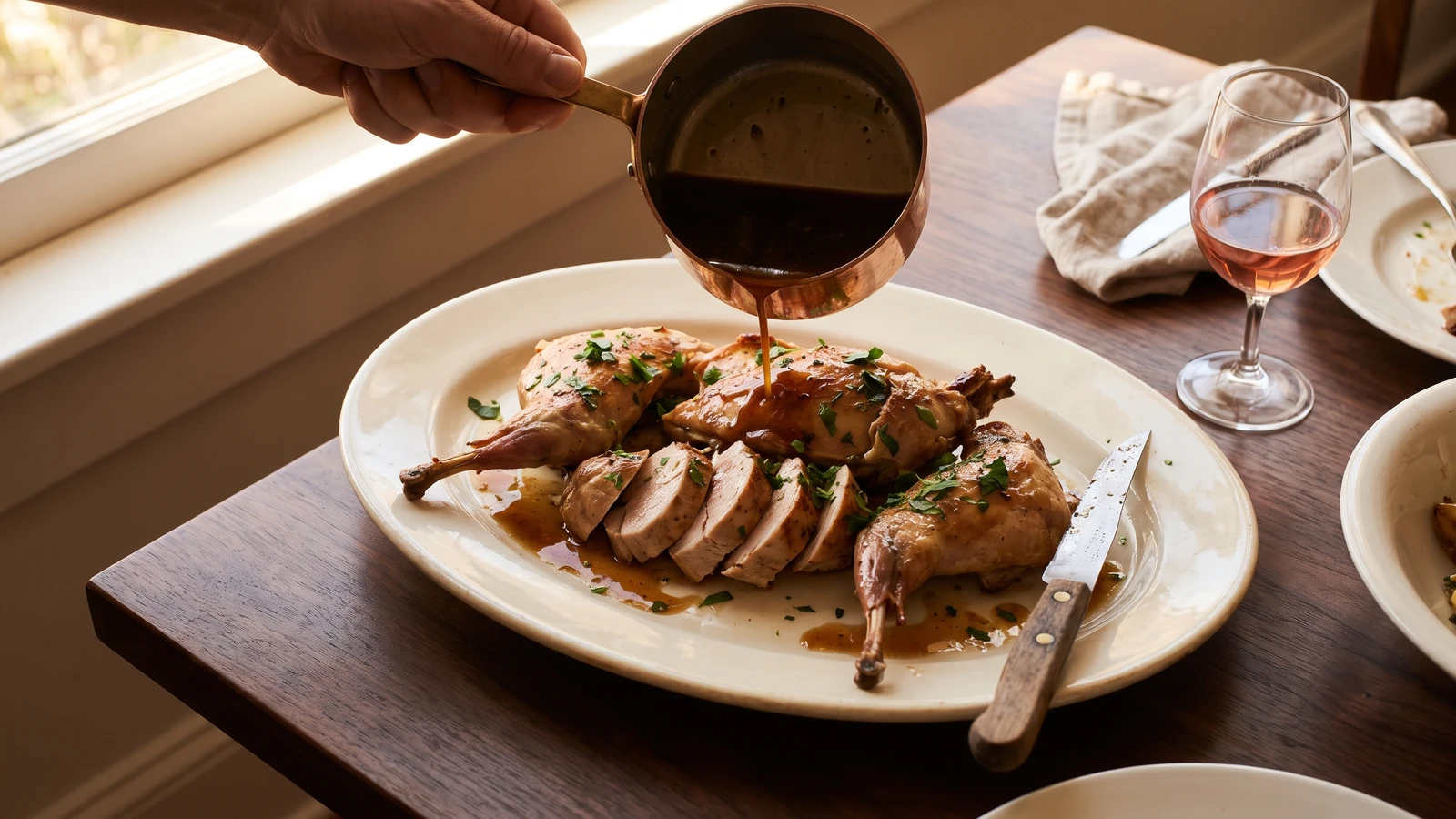
Young wild rabbit treated as the canon treats young hare: the râble protected with pork fat, the pieces roasted over fierce heat, and a quick pan jus built while the meat rests.
Lapereau de garenne rôti (roasted young wild rabbit) teaches one hard rule: age chooses the method. A genuinely young rabbit has fine-grained, tender flesh that can take the hare treatment, fierce heat and brief cooking, while an older animal subjected to the same fire turns stubborn. Settle the age before you touch the pan.
The source entry is a rule of substitution, not a fixed garnish: every hare preparation may be applied unchanged to a young wild rabbit. Its roast treatment assumed a larding needle, an intense roasting range, a saucier at hand, stock never off the fire, and a salamander ready to correct a pale surface. For one cook, thin unsmoked fatback tied over the râble, the saddle and loin section, replaces internal larding; a heavy skillet and hot oven provide the fierce heat, the skillet's fond and unsalted chicken stock make the jus, and the broiler stands in for the salamander. Barding instead of threading fat is the material change, made because it protects the same lean muscle without specialist equipment.
The separate sauce and browning stations are brigade scaffolding and can go. Protecting the râble, roasting quickly, and stopping the instant every cut is safely cooked must stay, because those steps are the dish. Confirm the rabbit's youth before cooking; no quantity of butter can persuade an old rabbit to behave like a young one.
Lapereau de garenne belongs to the table de chasse of French game country, especially Sologne, rather than to one fixed regional garnish. In the classical classification, youth could outweigh species: tender wild rabbit entered the hare repertoire unchanged, while an older rabbit required the moist patience of a braise. As these preparations passed from game larders into grand kitchens and bourgeois homes, the chosen garnish varied, but the judgment of the animal's age remained fundamental.
Quantity
1, 2½ to 3 pounds (1.1 to 1.4 kg)
skinned, cleaned, and jointed into 2 hind legs, 2 forelegs, and 1 bone-in râble
Quantity
6 very thin slices (about 3½ ounces / 100 g)
well chilled
Quantity
3 tablespoons (45 ml / 42 g)
divided
Quantity
1¾ teaspoons (9 ml / 10 g)
Quantity
¾ teaspoon (4 ml / 2 g)
Quantity
4 sprigs
Quantity
1
Quantity
1 (about ¼ cup / 35 g)
finely minced
Quantity
1 cup (240 ml / 240 g)
divided
Quantity
2 tablespoons (30 ml / 8 g)
finely chopped
| Ingredient | Quantity |
|---|---|
| young wild rabbitskinned, cleaned, and jointed into 2 hind legs, 2 forelegs, and 1 bone-in râble | 1, 2½ to 3 pounds (1.1 to 1.4 kg) |
| unsmoked pork fatbackwell chilled | 6 very thin slices (about 3½ ounces / 100 g) |
| unsalted butterdivided | 3 tablespoons (45 ml / 42 g) |
| fine sea salt | 1¾ teaspoons (9 ml / 10 g) |
| freshly ground black pepper | ¾ teaspoon (4 ml / 2 g) |
| thyme | 4 sprigs |
| bay leaf | 1 |
| small shallotfinely minced | 1 (about ¼ cup / 35 g) |
| unsalted chicken stockdivided | 1 cup (240 ml / 240 g) |
| flat-leaf parsleyfinely chopped | 2 tablespoons (30 ml / 8 g) |
Ask the butcher or game supplier to confirm that the rabbit is young; weight alone isn't proof. The joints should be supple and the flesh fine-grained, not dark, heavy, or sinewy. If its age is uncertain, stop and choose a braise instead. Pat the pieces completely dry, then heat the oven to 475°F (245°C) with a rack in the middle.
Season every piece evenly with the salt and pepper. Lay the chilled fatback slices across the râble, overlapping them slightly so the loins are covered, then secure them with kitchen twine. This bardage, or external covering of fat, replaces the larding needle. Tie firmly enough to hold the fat in place, but not so tightly that it cuts into the flesh.
Gently melt 2 tablespoons (30 ml / 28 g) of the butter, skim away the foam, and pour the clear butterfat into a 12-inch ovenproof skillet, leaving the milky sediment behind. Heat the skillet over medium-high heat until the butterfat glistens. Brown the hind legs for 2 to 3 minutes on each broad side, then brown the forelegs for about 1 minute per side and set those smaller pieces aside. Put the skillet containing the hind legs into the oven for 7 minutes.
Add the forelegs and the barded râble to the skillet, bone-side down, with the thyme and bay leaf. Turn the hindquarters toward the back of the oven and roast for 9 minutes. Remove the fatback and twine, baste every piece with the pan fat, then roast for another 4 to 7 minutes. Check each cut separately with an instant-read thermometer; wild rabbit must reach 160°F (71°C) in its thickest flesh, and barely done here means stopping at that safe line, never serving it pink. If the râble reaches temperature before the legs, lift it out and let the legs continue. Ça se rattrape. If the surface is pale once the meat is cooked, give it 30 to 60 seconds under the broiler, watching constantly.
Transfer each finished piece to a warm platter and cover it loosely. Rest the rabbit for 8 to 10 minutes while you make the jus. A tight covering traps moisture against the browned surface, so leave room for the heat to escape. Discard the thyme and bay leaf, but keep every brown trace of fond in the skillet.
Reserve 2 tablespoons (30 ml / 30 g) of the stock. Set the skillet over medium heat, add the shallot, and cook for 1 minute without letting it burn. Pour in the remaining stock and scrape the skillet thoroughly, dissolving the fond into the liquid. Boil until reduced to about ½ cup (120 ml / 120 g), glossy and lightly syrupy, then take the pan off the heat and whisk in the remaining 1 tablespoon (15 ml / 14 g) cold butter. If the jus turns greasy, whisk in a teaspoon of the reserved cold stock and add any remaining butter more slowly. Ça se rattrape. Stir in the parsley, taste, and spoon the jus around the rabbit rather than drowning its browned surface. À table!
1 serving (about 215g)
Culinary guides, cultural storytelling, and the editorial depth that makes cooking meaningful.
Discover Culinary ExplorerChef Juliette
John Dory has the delicacy of sole and the firmness of turbot. A light flouring, a quick butter sauté, and nut-brown beurre noisette show exactly why looks never mattered.

Chef Juliette
Fresh haddock proves its delicacy in the meunière pan: a fine flour crust, moist pearly flakes, and beurre noisette sharpened with lemon and parsley, ready from one skillet in half an hour.

Chef Juliette
Éperlans à l’Anglaise turns small fish into a lesson in disciplined coating: boned smelts under a close, crisp crumb, pan-fried in clarified butter and finished with bright, half-melted maître d’hôtel butter.

Chef Juliette
Tiny smelts, shallot, mushrooms, white wine, gratin sauce, and fine bread raspings meet a fierce oven, where the fish must turn tender in the same breath the buttered crust bronzes.