Chef Juliette
Accompaniment of Roasts
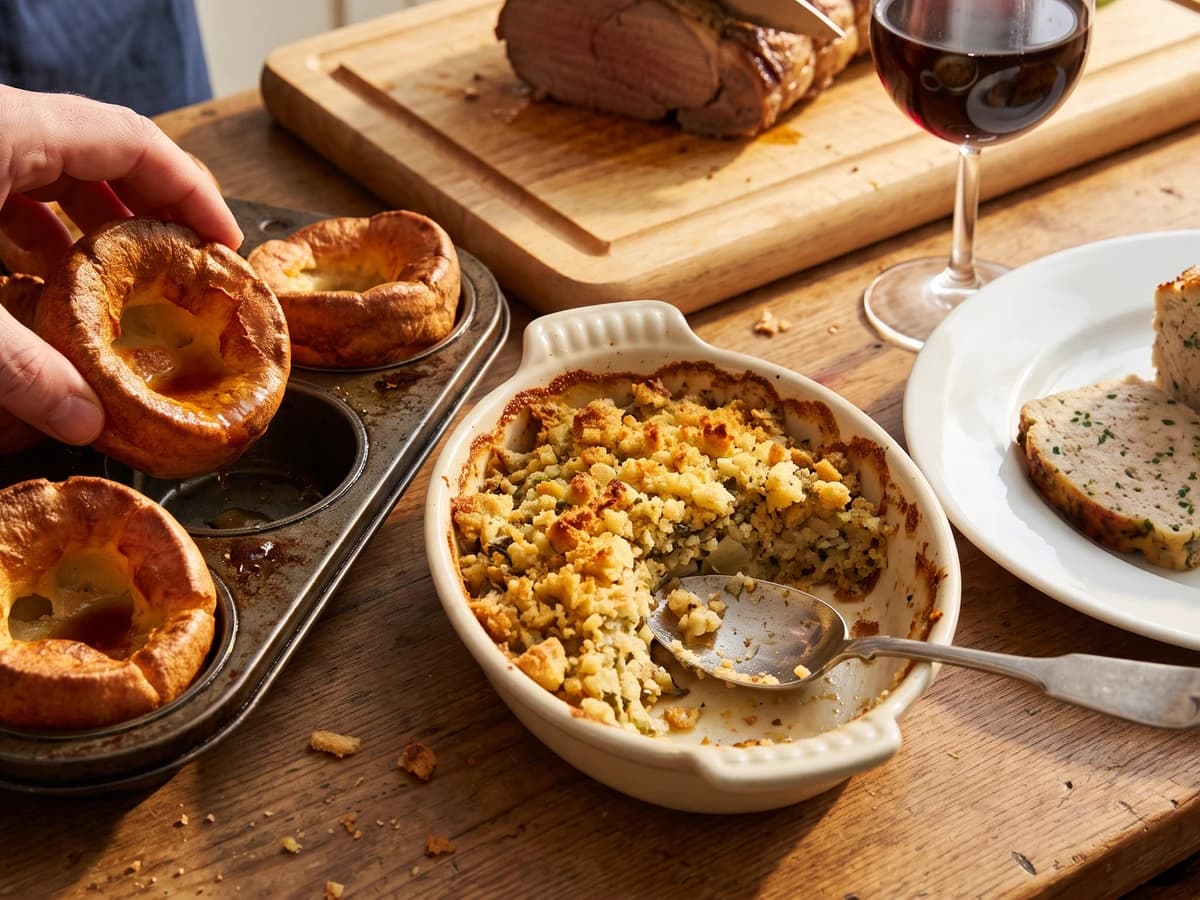
The roast keeps its sauce and gains its proper escort: lofty Yorkshire pudding for beef, sage and onion dressing for birds, or veal stuffing for pork and veal, each scaled for four.
A cooking platform built around craft, culture, and the stories behind what we eat.
Created by Chef Juliette
Based on No. 1964, Caneton Rouennais, from Le Guide Culinaire (1907) by Auguste Escoffier
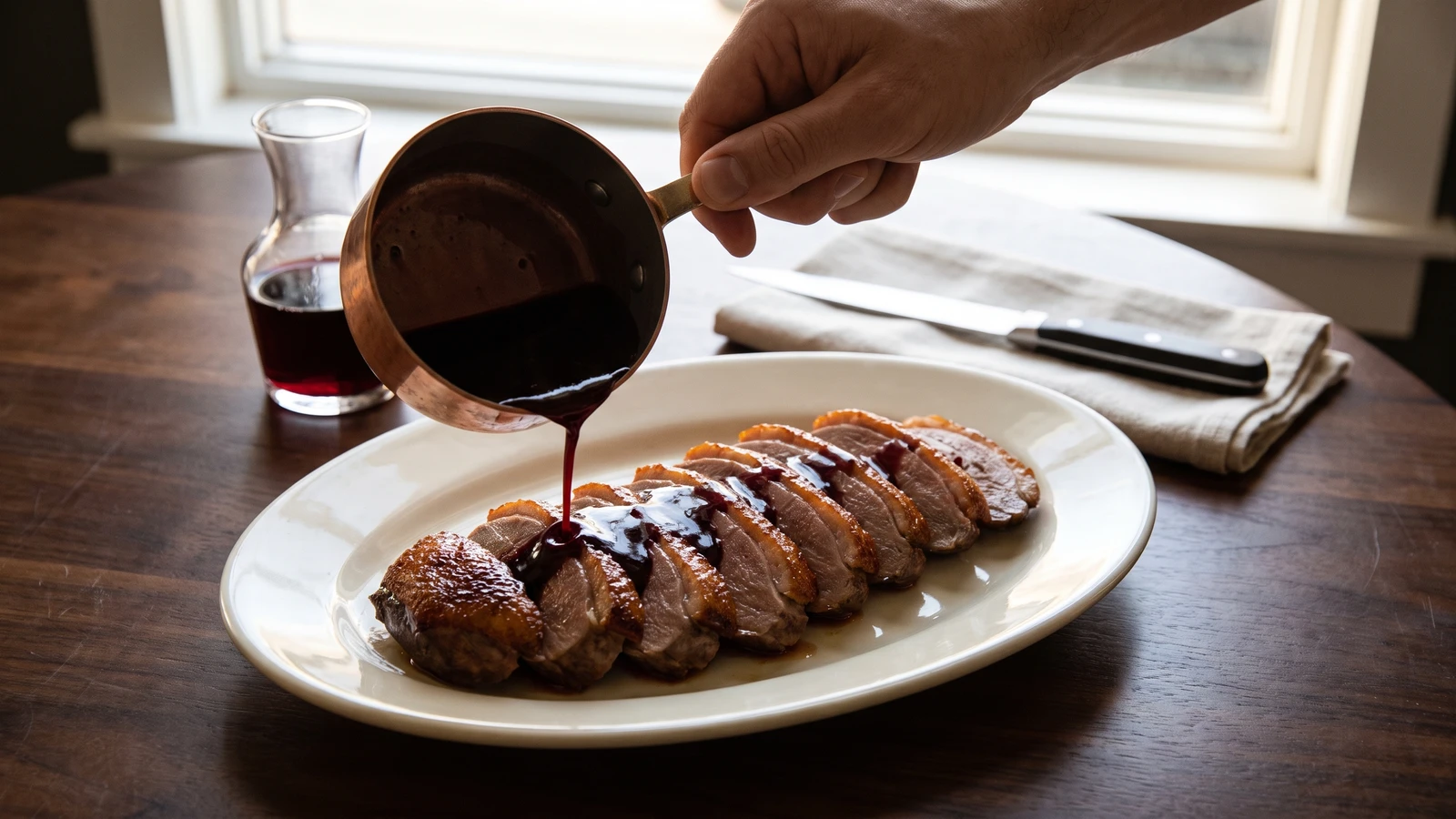
Rouen's duckling, roasted fiercely for twenty minutes, carved at once, and dressed with wine-pressed carcass juices: the lesson is speed at the board and restraint at the heat.
Caneton Rouennais à la Presse (Rouen-style pressed duckling) teaches one hard, useful truth: the sauce is made by extraction, then protected by restraint. Roast fiercely, carve immediately, press the warm carcass with red wine, and heat the liquor until it clings softly. Let it boil and the proteins seize into grey grains. The true thing to know before touching a pan is this: speed makes the sauce, but gentle heat keeps it.
The old service assumed a dedicated carver, a heavy duck press, and a chafer waiting beside the table. It needed neither a stockpot nor a saucier because the duck itself supplied the sauce. Your kitchen needs poultry shears, a chinois (a conical fine-mesh strainer), a sturdy mortar, and a warm ovenproof platter. The tableside ceremony is brigade scaffolding and can go. The fierce twenty-minute roast, immediate carving, wine-washed pressing, drops of brandy, and no-boil finish are the dish and stay exactly where the book put them.
A commercially dressed duckling is bled, unlike the traditional Rouen bird, so its liquor will be lighter and less naturally thick. This home version also uses a thermometer and brings both the pressed liquor and sliced breast to 165°F (74°C), still far below boiling; that turns the book's instruction to heat thoroughly into a safe, visible mark, not a different sauce. One cook, one stove, one evening. The step that decides everything is the final heating: hot enough to cook through, never hot enough to boil.
Caneton Rouennais belongs to Rouen and the Seine valley in Normandy, where a plump young duck was prized for abundant juices and traditionally dispatched without bleeding so those juices could bind the sauce. The preparation traveled from Rouennais tables into grand dining rooms, where the duck press turned extraction into tableside ceremony, but the ceremony is scaffolding: the wine-washed carcass juices are the dish. Paris became famous for pressed duck, yet the name and method point back to Rouen, not to a generic northern roast.
Quantity
1 bird, 4 to 4½ pounds (1.8 to 2 kg)
neck and giblets removed
Quantity
1½ teaspoons (7.5 ml / 9 g)
divided
Quantity
½ teaspoon (2.5 ml / 1 g)
divided
Quantity
⅔ cup (160 ml / 160 g)
divided
Quantity
¼ teaspoon (1.25 ml / 1 g)
Quantity
1 finished preparation, Caneton Rouennais à la Presse (No. 1761)
Quantity
1 separate finished preparation, Caneton Farci à la Rouennaise (No. 1762)
| Ingredient | Quantity |
|---|---|
| small young ducklingneck and giblets removed | 1 bird, 4 to 4½ pounds (1.8 to 2 kg) |
| fine sea saltdivided | 1½ teaspoons (7.5 ml / 9 g) |
| finely ground black pepperdivided | ½ teaspoon (2.5 ml / 1 g) |
| good dry red winedivided | ⅔ cup (160 ml / 160 g) |
| brandy | ¼ teaspoon (1.25 ml / 1 g) |
| Caneton Rouennais à la Presse | 1 finished preparation, Caneton Rouennais à la Presse (No. 1761) |
| Caneton Farci à la Rouennaise (optional) | 1 separate finished preparation, Caneton Farci à la Rouennaise (No. 1762) |
The parent Caneton Rouennais entry names two complete preparations: Caneton Rouennais à la Presse (No. 1761) and Caneton Farci à la Rouennaise (No. 1762). The wine-and-brandy method requested here follows Caneton Rouennais à la Presse (No. 1761); Caneton Farci à la Rouennaise (No. 1762) remains a separate stuffed preparation, and none of its stuffing, accompanying sauce, lemon, or larger brandy treatment enters this dish.
Take the duckling from the refrigerator thirty minutes before roasting and pat it completely dry, inside and out. Heat the oven to 500°F (260°C) with a rack in the middle. Set out the carving knife, poultry shears, mortar, chinois, saucepan, thermometer, and ovenproof serving platter now; once the duck leaves the oven, the method must move without a pause. Reserve 1 tablespoon (15 ml / 15 g) of the wine for correcting the sauce, and fill the platter with hot water so it will be lukewarm when the breast slices arrive.
Season the cavity and skin with 1 teaspoon (5 ml / 6 g) of the salt and half the pepper. Set the duckling breast-side up on a rack in a shallow roasting pan and roast for exactly twenty minutes. The skin should be deeply burnished and the fat running freely, while the breast remains deliberately underdone at this stage. Do not extend the roast to finish the legs; the sliced breast completes its cooking under the sauce, and chasing full leg doneness now would dry the meat the dish is built around.
Empty and dry the warm platter. Move the duck immediately to a carving board and detach both legs at the joints; they are not served in this preparation. Remove each breast lobe closely along the breastbone, keeping its burnished skin attached, then slice it across the grain about ⅛ inch (3 mm) thick. Arrange the slices overlapping on the platter and season them with the remaining salt and pepper. Pour every carving-board juice into the waiting saucepan.
While the carcass is still hot, chop the ribs, back, and breast frame into pieces about 2 inches (5 cm) wide with poultry shears. Crush the pieces in the mortar in batches, adding the wine little by little as you work, then scrape everything into the chinois set over the saucepan. Press fiercely with the pestle or the back of a strong ladle until the bones look nearly dry. Spoon the clear fat from the roasting pan, rinse its browned fond with a little collected wine liquor, and scrape those juices into the saucepan. Strain the liquor once more through a clean fine-mesh sieve so no bone fragment remains. Never use a food processor here; pulverized bone has no place in a sauce.
Add the brandy to the strained liquor and set the saucepan over the lowest heat. Whisk constantly until the sauce reaches 165°F (74°C), keeping it below 180°F (82°C) and nowhere near a simmer. It should taste concentrated and may thicken slightly. If grey flecks appear, strain it; if it suddenly grains or separates, lift it from the heat at once. Ça se rattrape: whisk in the reserved cool wine, strain, and resume over gentler heat. A commercially bled duck may give a thinner jus, and that is honest. Do not add flour or cream, and do not boil it down. Pour the hot sauce over the breast slices and place the platter in a 250°F (120°C) oven for 4 to 8 minutes, just until several slices register 165°F (74°C). Watch the rim closely. If the sauce begins bubbling, remove the platter immediately and strain the sauce once more.
Spoon the gleaming sauce over every slice and carry the platter directly to the table, with no garnish and no waiting. The removed legs do not belong on this platter; once the breast has left the kitchen, roast them separately at 400°F (200°C) until they reach 165°F (74°C), then save them for another meal. The pressed duck is ready now. À table!
1 serving (about 205g)
Culinary guides, cultural storytelling, and the editorial depth that makes cooking meaningful.
Discover Culinary ExplorerChef Juliette
The roast keeps its sauce and gains its proper escort: lofty Yorkshire pudding for beef, sage and onion dressing for birds, or veal stuffing for pork and veal, each scaled for four.
Chef Juliette
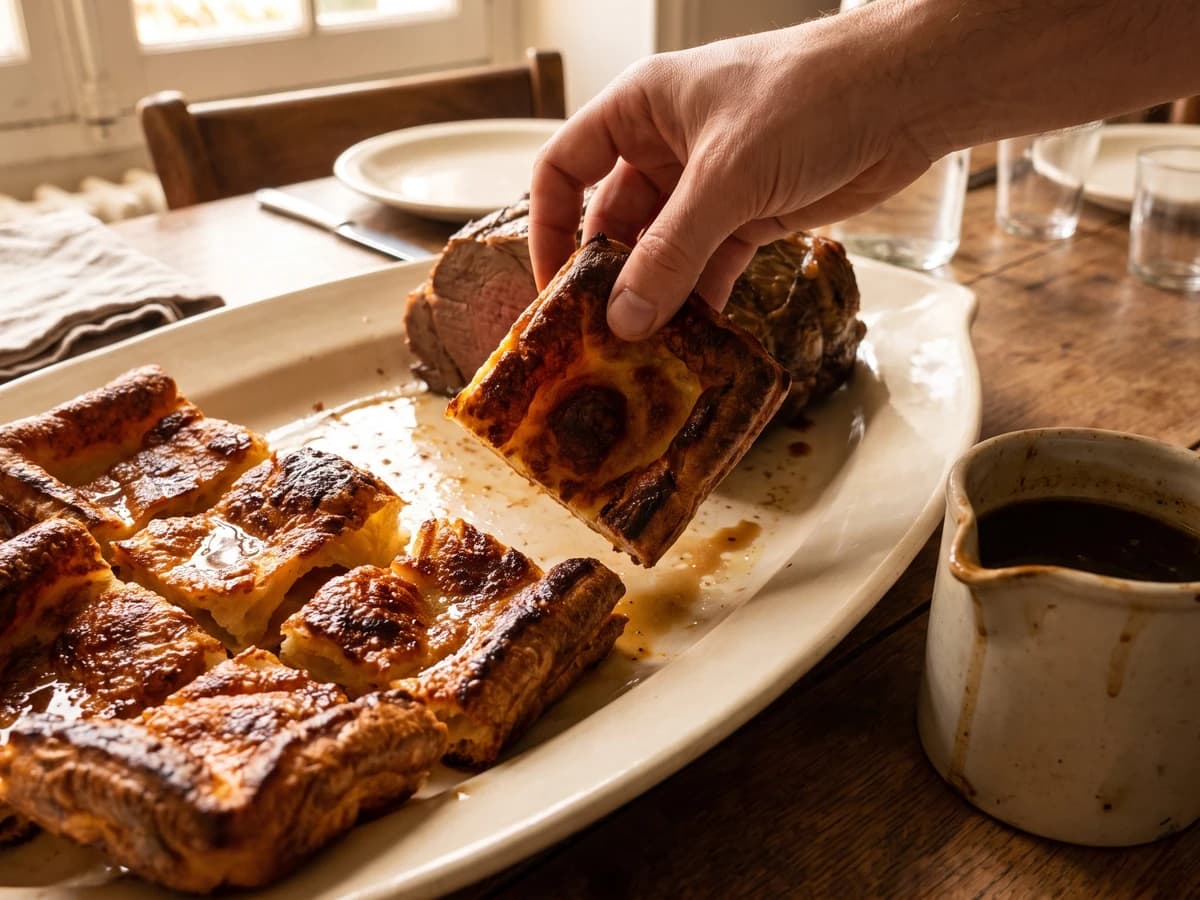
Pouding du Yorkshire teaches the law of hot fat: an egg-rich, nutmeg-scented batter poured into smoking beef dripping, rising bronze and crisp before it catches the roast's savory juices.

Chef Juliette
Whole-baked onions are the lesson: sweet before they meet the pan, never acrid, then joined with butter, dried sage, milk-softened breadcrumbs, and veal fat in the classical 2:2:1 proportion.

Chef Juliette
Equal weights of chopped suet, fine breadcrumbs, and parsley, bound with egg and plenty of nutmeg, make a compact poached farce that slices neatly beside roast veal or pork.