
Chef Juliette
John Dory (St. Pierre)
John Dory has the delicacy of sole and the firmness of turbot. A light flouring, a quick butter sauté, and nut-brown beurre noisette show exactly why looks never mattered.
A cooking platform built around craft, culture, and the stories behind what we eat.
Created by Chef Juliette
Based on No. 1963, Caneton Rôti (Roast Duckling), from Le Guide Culinaire (1907) by Auguste Escoffier
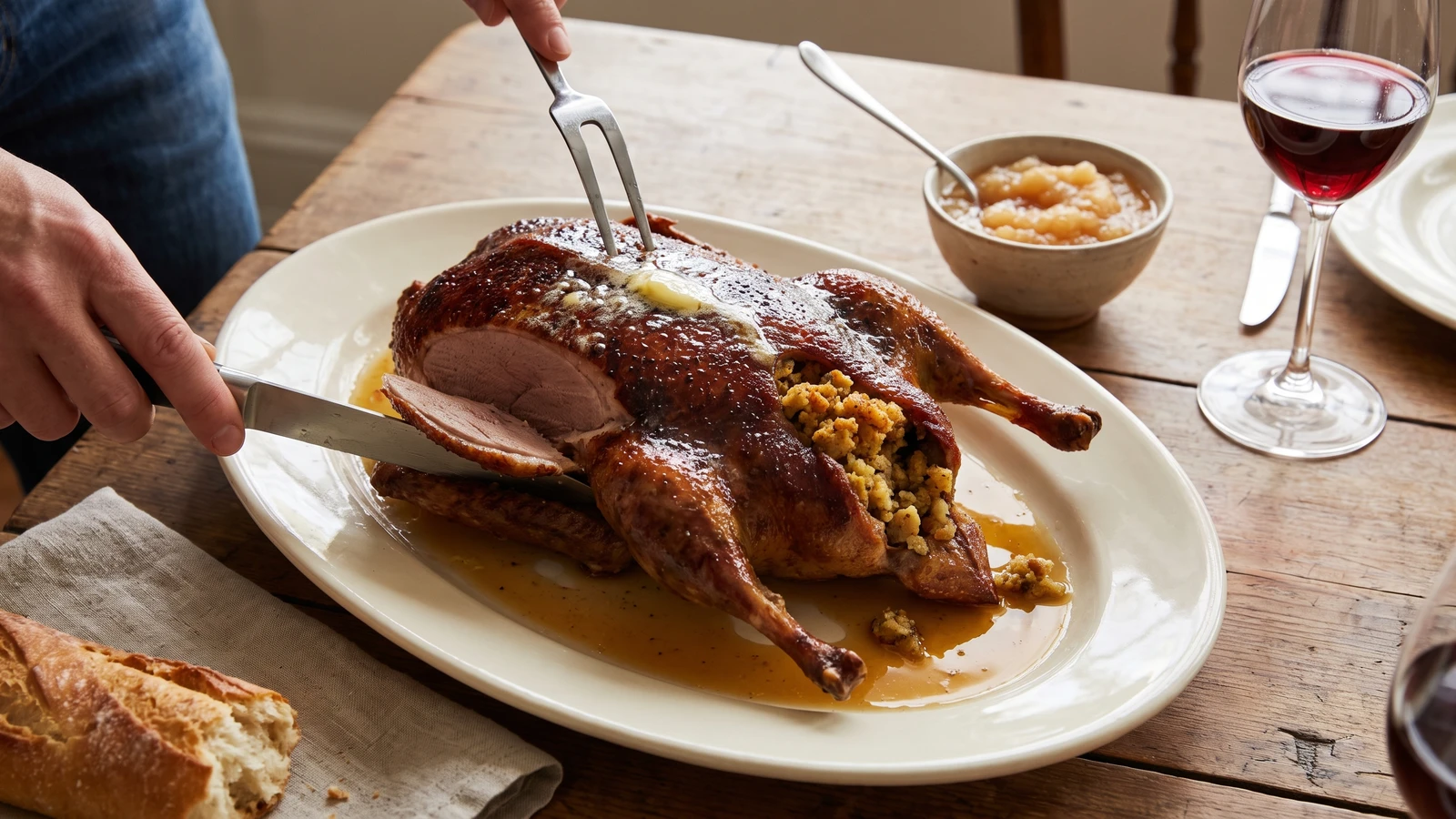
Caneton rôti teaches the central truth of roast duck: let the fat escape without piercing the meat, then bring burnished skin, sage-onion stuffing, and sharp apple sauce to one generous table.
Caneton rôti (roast duckling) teaches the central truth of roasting duck: the bird carries all the fat it needs, and your work is to let that fat escape without opening a path for the juices. Prick only the skin over the breast, thighs, and back, never the flesh, then roast until the bronze skin is crisp and the sage-onion stuffing is fully hot. That small distinction decides the bird before it touches the oven.
The book's kitchen expected a Nantes or Aylesbury duckling, a roasting spit, hands free to turn and baste, a saucier on staff with stock never off the fire, and a salamander ready to correct a pale breast. At home, a rack over a shallow pan renders evenly, a thermometer tells the truth, unsalted chicken stock lifts the roasting fond into a small jus de rôti (roasting juice), and the broiler takes the salamander's last task only if needed. The bird and stuffing are scaled to four, while sage, onions, roasting, and apple sauce remain exactly where the entry puts them. Constant tending was brigade scaffolding; rendering, safe doneness, and tart fruit served apart are the dish.
The apple sauce isn't decoration. Its clean acidity cuts through rich duck fat and makes the next bite welcome; when apples are gone, melted red-currant jelly or cranberry sauce performs the same work, exactly as the source allows. One cook, one stove, one evening. Before you touch the pan, dry the duck thoroughly and prick the skin without piercing the flesh. That is the one step that matters most.
Caneton nantais belongs to the Loire country around Nantes, where tender young ducks were prized for the roasting spit and served with a light jus rather than hidden beneath a braise. The source's comparison with Aylesbury is revealing: French professional kitchens accepted the English white duckling as the Nantes bird's equal, then kept the English habit of sage-onion stuffing and apple sauce beside the French roast. Red-currant jelly and cranberry sauce took the same place at table because their tartness performs the apple's work against rich duck fat.
Quantity
1, about 4½ to 5 lb (2 to 2.3 kg)
giblets removed
Quantity
1 large, about 1½ cups (360 ml / 250 g)
finely chopped
Quantity
4 tablespoons (60 ml / 56 g)
divided
Quantity
2 tablespoons (30 ml / 6 g)
finely chopped
Quantity
1 cup (240 ml / 60 g)
Quantity
1
lightly beaten
Quantity
1¼ cups (300 ml / 300 g)
divided
Quantity
2½ teaspoons (12.5 ml / 15 g)
divided
Quantity
1 teaspoon (5 ml / 2 g)
divided
Quantity
4 medium, about 6 cups sliced (1.4 L / 700 g)
peeled, cored, and sliced
Quantity
¾ cup (180 ml / 180 g)
divided
Quantity
1 tablespoon (15 ml / 12 g)
Quantity
½ cup (120 ml / 160 g)
for serving melted in place of apple sauce
Quantity
¾ cup (180 ml / 180 g)
for serving in place of apple sauce
| Ingredient | Quantity |
|---|---|
| whole young ducklinggiblets removed | 1, about 4½ to 5 lb (2 to 2.3 kg) |
| yellow onionfinely chopped | 1 large, about 1½ cups (360 ml / 250 g) |
| unsalted butterdivided | 4 tablespoons (60 ml / 56 g) |
| fresh sage leavesfinely chopped | 2 tablespoons (30 ml / 6 g) |
| fresh plain breadcrumbs | 1 cup (240 ml / 60 g) |
| large egglightly beaten | 1 |
| unsalted chicken stockdivided | 1¼ cups (300 ml / 300 g) |
| fine sea saltdivided | 2½ teaspoons (12.5 ml / 15 g) |
| freshly ground black pepperdivided | 1 teaspoon (5 ml / 2 g) |
| tart cooking applespeeled, cored, and sliced | 4 medium, about 6 cups sliced (1.4 L / 700 g) |
| waterdivided | ¾ cup (180 ml / 180 g) |
| granulated sugar (optional) | 1 tablespoon (15 ml / 12 g) |
| red-currant jelly (optional)for serving melted in place of apple sauce | ½ cup (120 ml / 160 g) |
| cranberry sauce (optional)for serving in place of apple sauce | ¾ cup (180 ml / 180 g) |
Set an oven rack in the lower third and heat the oven to 425°F (220°C). Remove the giblets and any loose lumps of fat from the cavities, but don't rinse the bird. Pat the duckling thoroughly dry inside and out. With a metal skewer, prick the skin at close intervals over the fatty breast, thighs, and back, holding the point almost parallel to the surface so it enters the skin and fat but never the flesh. Season the bird inside and out with 2 teaspoons of the salt and ½ teaspoon of the pepper.
Melt 2 tablespoons of the butter in a skillet over medium-low heat. Add the onion and cook for 10 to 12 minutes, stirring often, until completely tender and translucent without taking brown colour. Stir in the sage for 1 minute, then transfer everything to a bowl and cool for 5 minutes. Mix in the breadcrumbs, egg, 2 tablespoons of the stock, the remaining ½ teaspoon salt, and the remaining ½ teaspoon pepper. The farce à la sauge et aux oignons (sage-onion stuffing) should hold together softly without becoming paste. If it looks wet and shiny, hold back a little of the stuffing while the crumbs swell; if it crumbles, add stock a teaspoon at a time.
Spoon the farce loosely into the duckling's body cavity while it is still slightly warm. Never compress it, because tightly packed stuffing cooks slowly and forces the breast to wait. Close the opening with a small skewer or kitchen twine, tie the legs together without pulling them hard against the body, and tuck the wing tips beneath the back. Set the duckling breast-side up on a rack in a shallow roasting pan. Once stuffed, it goes directly into the oven; don't hold a stuffed raw bird for later.
Roast at 425°F (220°C) for 20 minutes, then reduce the oven to 375°F (190°C). After another 30 minutes, rotate the pan and carefully spoon the rendered fat into a heatproof vessel. Repeat every 25 to 30 minutes, keeping the pan nearly free of liquid fat so the skin roasts rather than fries. If the fond (the browned roasting deposits) begins turning black at the edges, add 1 tablespoon of water to that spot at once. Begin checking after 1 hour 25 minutes total. The duckling is ready when the centre of the stuffing and the innermost thigh both reach at least 165°F (74°C), the leg joint moves freely, and the juices run clear. Expect 1 hour 30 minutes to 1 hour 50 minutes in all. If the breast darkens too soon, cover that area loosely with foil. If the temperatures are correct but the skin remains pale, place it beneath a fully heated broiler for 60 to 90 seconds, watching without looking away. Ça se rattrape.
While the duckling roasts, put the apples in a covered saucepan with ¼ cup of the water and 1 tablespoon of the butter. Cook over low heat for 15 to 20 minutes, stirring occasionally, until the slices collapse under the spoon. Beat with a wooden spoon or fork for a coarse sauce, then taste before adding any sugar; tartness is needed beside the duck. If the sauce is loose, cook it uncovered for a few minutes. If it stands too stiffly, add water a spoonful at a time. Keep it warm or serve it at room temperature, always in a separate bowl. If apples aren't available, warm the red-currant jelly gently with 1 tablespoon of water until just pourable, or serve the cranberry sauce as it is. Use one fruit accompaniment, never all three.
Transfer the duckling to a warm platter and let it rest for 20 minutes. Cover it very loosely around the sides with foil, leaving the breast exposed so the skin stays crisp. Resting lets the juices settle back into the meat and gives the hot stuffing time to finish evening out. A tight foil tent traps moisture and softens the skin you have worked for.
Pour all remaining fat from the roasting pan into a heatproof vessel, leaving the brown fond behind. Set the pan over medium heat only if it is stovetop-safe; otherwise transfer the fond and drippings to a skillet. Add the remaining stock and scrape firmly with a wooden spoon, lifting every bronze deposit while leaving any truly black patch untouched. Boil until reduced to about ¾ cup (180 ml), then strain. Off the heat, whisk in the final tablespoon of cold butter to give the jus de rôti a light gloss. If it looks greasy, let it stand for a minute and skim the surface rather than thickening it with flour. If it reduces too far, loosen it with hot water.
Remove the twine and lift the farce into a warm serving bowl. Take off the legs, divide them at the joint, then carve each breast into generous slices. Arrange the meat on the warm platter and spoon a little jus around it, not over the crisp skin. Pass the remaining jus, the sage-onion farce, and the apple sauce separately. If using melted red-currant jelly or cranberry sauce, give it the apple sauce's place at the table. À table!
1 serving (about 530g)
Culinary guides, cultural storytelling, and the editorial depth that makes cooking meaningful.
Discover Culinary ExplorerChef Juliette
John Dory has the delicacy of sole and the firmness of turbot. A light flouring, a quick butter sauté, and nut-brown beurre noisette show exactly why looks never mattered.

Chef Juliette
Fresh haddock proves its delicacy in the meunière pan: a fine flour crust, moist pearly flakes, and beurre noisette sharpened with lemon and parsley, ready from one skillet in half an hour.

Chef Juliette
Éperlans à l’Anglaise turns small fish into a lesson in disciplined coating: boned smelts under a close, crisp crumb, pan-fried in clarified butter and finished with bright, half-melted maître d’hôtel butter.

Chef Juliette
Tiny smelts, shallot, mushrooms, white wine, gratin sauce, and fine bread raspings meet a fierce oven, where the fish must turn tender in the same breath the buttered crust bronzes.