
Chef Juliette
John Dory (St. Pierre)
John Dory has the delicacy of sole and the firmness of turbot. A light flouring, a quick butter sauté, and nut-brown beurre noisette show exactly why looks never mattered.
A cooking platform built around craft, culture, and the stories behind what we eat.
Created by Chef Juliette
Based on No. 1956, Truffled Pullet, from Le Guide Culinaire (1907) by Auguste Escoffier
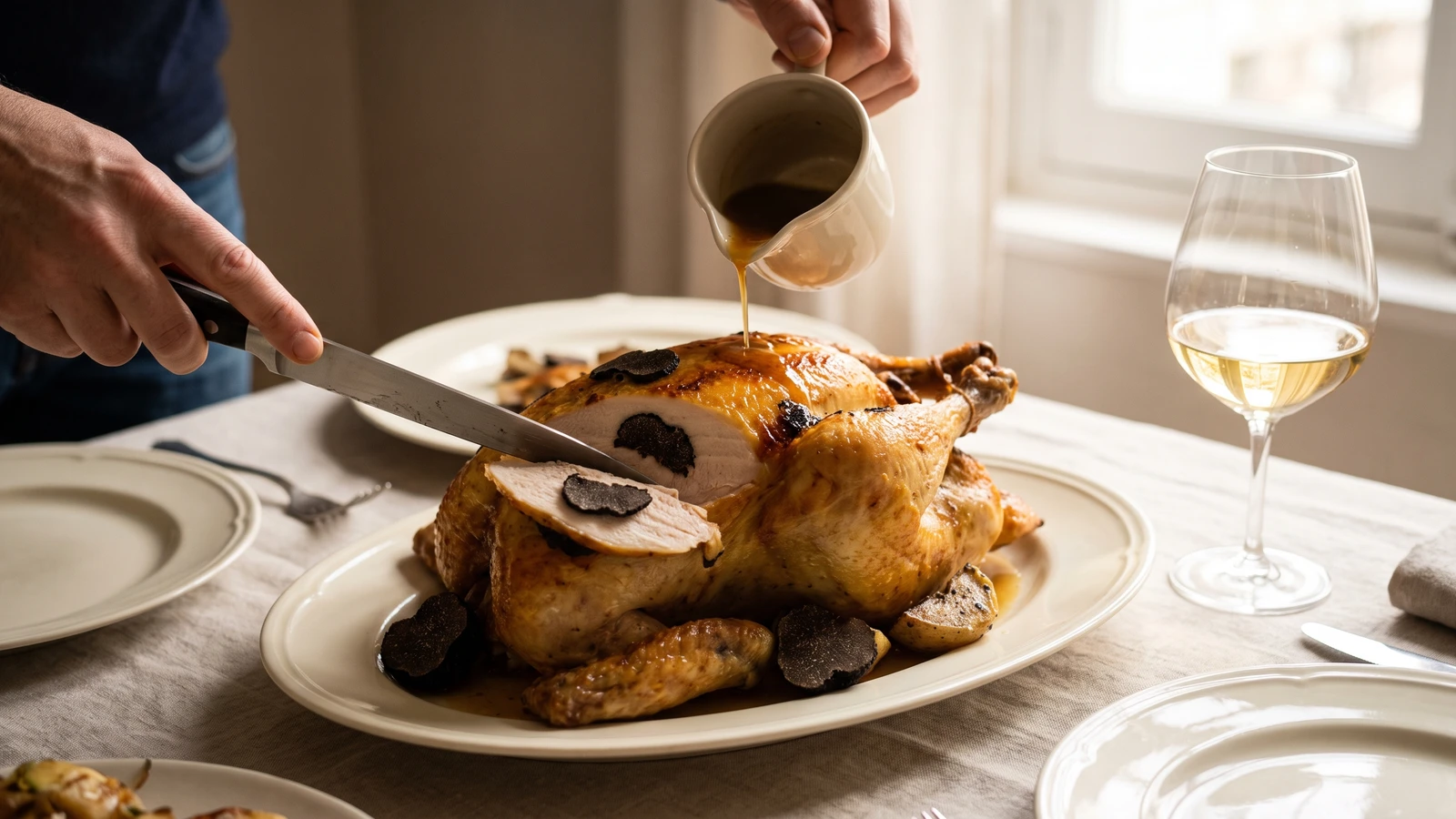
A young hen perfumed from within: black truffle peel worked into fresh pork fat, generous quarters in the cavity, and thin slices under the breast skin before a burnished final roast.
Poularde truffée teaches one true thing: truffle perfume needs fat to carry it through flesh. The peelings are not scraps. Pounded into fresh pork fat, they scent the bird from within, while generous quarters fill the cavity and fine slices mark the breast beneath its skin. Truffle remains the perfume, not the whole conversation; underneath it must still taste unmistakably of well-roasted poultry.
The source assumes a fine whole pullet drawn through a little side opening, its neck skin kept intact, a mortar and sieve, needle sewing, and a spit facing concentrated fire. It needs neither a saucier nor a stockpot, because the gravy is the bird's own roasting juice. This home version uses an already-dressed four-serving pullet, a food processor, skewers, buttered parchment, an oven rack, and a brief broiler finish. It reduces the book's one and one-half pounds of truffles and two pounds of pork fat to one quarter, six ounces and eight ounces, preserving the exact three-to-four proportion while making the filling fit a home-sized bird.
The side-hole evisceration, hand pounding, sewing, and spit are brigade scaffolding, so they can go. The peel worked into fresh pork fat, the quartered truffles inside, the bacon and truffle slices beneath the breast skin, and the paper removed a quarter-hour before serving are the dish itself, so they stay. Cool the cooked truffles and fat almost completely before stuffing. If that mixture goes into the bird warm and liquid, it runs into the pan before it can perfume the flesh. One cook, one stove, one evening.
Poularde truffée belongs to the festive tables of Périgord and Paris, where black truffles from the Dordogne traveled from market baskets into the classical repertoire of whole roasted birds. A poularde is not simply any chicken, but a young hen fattened before laying, prized for tender flesh that readily takes on perfume. Working the peelings into pork fat reveals the canon's thrift beneath its luxury: every aromatic shaving scents the meat while the handsome pieces remain visible.
Quantity
1 bird, 4 to 4½ lb (1.8 to 2 kg)
giblets removed and neck skin intact if possible
Quantity
about ¾ cup whole (180 ml / 170 g)
brushed clean and dried
Quantity
about 1½ cups diced (360 ml / 225 g)
thoroughly chilled
Quantity
4 very thin slices (about 2 oz / 60 g)
rind removed and long enough to span the breasts
Quantity
2 tablespoons (30 ml / 28 g)
softened
Quantity
2¼ teaspoons (11 ml / 13 g)
divided
Quantity
¾ teaspoon (4 ml / 1.5 g)
divided
Quantity
1 small leaf
Quantity
½ cup (120 ml / 120 g), plus more as needed
| Ingredient | Quantity |
|---|---|
| whole pullet or small poulardegiblets removed and neck skin intact if possible | 1 bird, 4 to 4½ lb (1.8 to 2 kg) |
| fresh black winter trufflesbrushed clean and dried | about ¾ cup whole (180 ml / 170 g) |
| very fresh unsalted pork back fatthoroughly chilled | about 1½ cups diced (360 ml / 225 g) |
| fresh streaky baconrind removed and long enough to span the breasts | 4 very thin slices (about 2 oz / 60 g) |
| unsalted buttersoftened | 2 tablespoons (30 ml / 28 g) |
| fine sea saltdivided | 2¼ teaspoons (11 ml / 13 g) |
| freshly ground black pepperdivided | ¾ teaspoon (4 ml / 1.5 g) |
| bay leaf | 1 small leaf |
| hot water | ½ cup (120 ml / 120 g), plus more as needed |
Heat the oven to 400°F (200°C), with a rack in the lower-middle position. Pat the pullet completely dry. At the neck opening, feel for the V-shaped wishbone; cut closely along both arms with a small knife, scrape them free, and pull out the bone, or ask the butcher to do this. Slide your fingers beneath the skin and gently detach it across the whole breast without tearing it. Season the cavity and exterior with 1½ teaspoons of the salt and ½ teaspoon of the pepper. If the skin develops a small tear, don't widen it; a piece of bacon placed beneath it will support the weak spot during roasting.
Brush the truffles under a thin stream of cold water, paying attention to the crevices, then dry them thoroughly. Peel them as thinly as you can, keeping every fragment of peel. Choose the largest truffle and cut it into fine slices; reserve these under cover. Cut the remaining truffles into pieces of about ¾ oz (20 g) each. These substantial quarters belong inside the bird, where they perfume the cavity without disappearing into a mince.
Pulse all the truffle peelings with the cold pork back fat in a food processor until they form a fine, evenly speckled paste, scraping the bowl as needed. Press the paste through a fine-mesh sieve. Melt one quarter of it, about ¼ cup (60 ml / 55 g), over the lowest heat with the bay leaf. Season the truffle pieces with the remaining ¾ teaspoon salt and ¼ teaspoon pepper, add them to the liquid fat, and cook for 10 minutes at the faintest sizzle, never letting them brown. Remove the bay leaf, cover the pan, and cool until the fat is barely fluid, then fold in the remaining truffled fat. If it becomes runny, stop. Ça se rattrape: set the covered bowl over ice and stir until the mixture thickens to a soft, spreadable paste.
Spoon all the cooled truffle-fat mixture and its quartered truffles into the cavity without crushing the pieces. Slide two bacon slices over each breast, directly against the flesh. Arrange the reserved truffle slices on top of the bacon, immediately beneath the skin, and leave the ends of the bacon accessible near the neck opening so they can be withdrawn later. Smooth the skin back into place. Pin the cavity and neck skin closed with skewers, lace them with kitchen twine, then tie the legs and tuck the wing tips beneath the bird.
Spread the softened butter over two overlapping sheets of baking parchment. Set the pullet on top and wrap it closely, buttered side inward, with the seam beneath the bird. Tie the parcel in three places so the paper cannot lift. Place it breast-side up on a rack in a shallow metal roasting pan and pour ¼ cup (60 ml / 60 g) of the hot water beneath the rack. The parchment protects the breast while the dense filling heats through, doing the work once managed by careful turning before the fire.
Roast for 65 to 80 minutes, rotating the pan once, until the centre of the stuffing and the thickest part of the thigh both register about 160°F (71°C), with the thermometer touching neither bone nor the empty cavity wall. Add a little more hot water if the pan dries, but never pour it over the bird. The parchment will turn golden and the breast beneath it will remain pale. That is correct; its colour comes at the end.
Fifteen minutes before serving, remove the pan and switch the broiler to high. Cut away every scrap of parchment and twine. Reach through the neck opening with slim tongs and gently draw out the bacon strips, leaving the truffle slices beneath the skin. If a strip clings, ease it from side to side rather than pulling hard; the skin matters more than speed. Broil the pullet about 6 inches (15 cm) from the heat for 3 to 5 minutes, rotating the pan, until the breast turns deep butter-gold and the skin tightens. Confirm that both thigh and stuffing have reached at least 165°F (74°C). If the colour arrives first, turn off the broiler and finish at 400°F (200°C) until the temperature is safe. Rest the bird uncovered for the remaining 10 minutes.
While the pullet rests, pour the pan juices into a small saucepan. Add the remaining hot water to the roasting pan, scrape up every bronze patch of fond, and pour that into the saucepan with any juices collected beneath the resting bird. Bring it to a brief bubble, then strain it into a warmed gravy boat. Do not skim it lean; the source is quite deliberate that this gravy remains rather fat. If it tastes watery, reduce it for a minute. If it tastes too concentrated, loosen it with a spoonful of hot water.
Carry the whole burnished pullet to the table on a heated platter. Remove the skewers, open the cavity carefully, and spoon one or two truffle quarters beside each serving. Carve the breasts so the dark slices beneath the skin remain visible, then separate the legs at their joints. Pass the hot, glossy gravy separately and let each person take as much of its truffled fat as they please. À table!
1 serving (about 335g)
Culinary guides, cultural storytelling, and the editorial depth that makes cooking meaningful.
Discover Culinary ExplorerChef Juliette
John Dory has the delicacy of sole and the firmness of turbot. A light flouring, a quick butter sauté, and nut-brown beurre noisette show exactly why looks never mattered.

Chef Juliette
Fresh haddock proves its delicacy in the meunière pan: a fine flour crust, moist pearly flakes, and beurre noisette sharpened with lemon and parsley, ready from one skillet in half an hour.

Chef Juliette
Éperlans à l’Anglaise turns small fish into a lesson in disciplined coating: boned smelts under a close, crisp crumb, pan-fried in clarified butter and finished with bright, half-melted maître d’hôtel butter.

Chef Juliette
Tiny smelts, shallot, mushrooms, white wine, gratin sauce, and fine bread raspings meet a fierce oven, where the fish must turn tender in the same breath the buttered crust bronzes.