
Chef Juliette
John Dory (St. Pierre)
John Dory has the delicacy of sole and the firmness of turbot. A light flouring, a quick butter sauté, and nut-brown beurre noisette show exactly why looks never mattered.
A cooking platform built around craft, culture, and the stories behind what we eat.
Created by Chef Juliette
Based on No. 1947, Roast Ribs of Beef, from Le Guide Culinaire (1907) by Auguste Escoffier
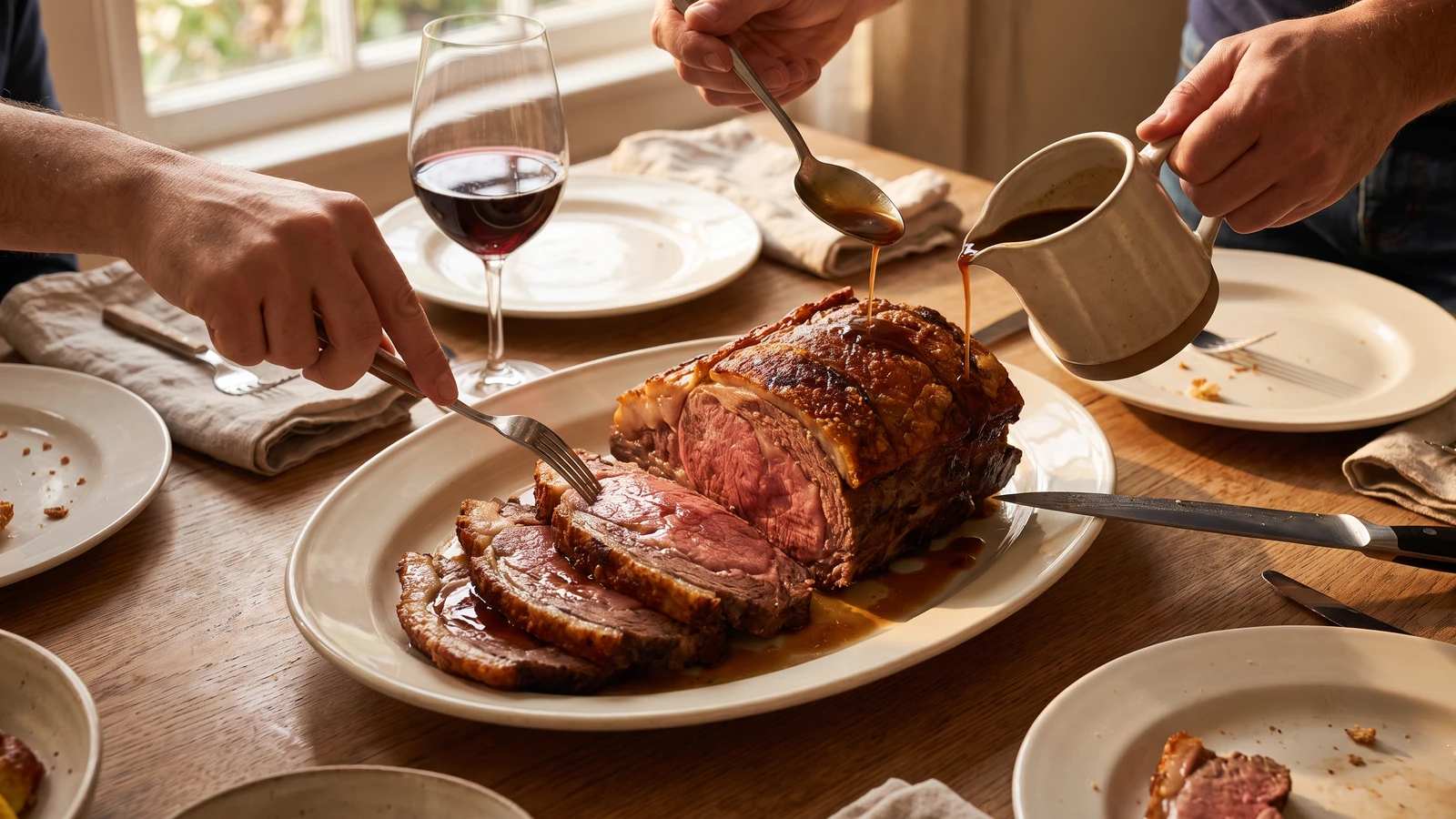
Train de Côtes de Bœuf Rôti teaches the discipline of moderate heat: chined ribs, an exposed fat cap, and an open pan whose sides protect the meat until the center is rosy and the crust deeply browned.
Train de Côtes de Bœuf Rôti (roast ribs of beef) teaches one true thing: the heat must reach the center without punishing the outside. Roast moderately from beginning to end. A fierce start only hardens the exposed meat while the heart remains cold, which is precisely the failure this old instruction warns against.
The source assumed a kitchen butcher to clear the chine bones and tough yellow ligament, plus a turning fire that could roast steadily without scorching. It did not assume a saucier, a stockpot, or a salamander, and neither will we invent them. At home, your butcher does the dangerous saw work, a 350°F (180°C) oven replaces the fire, and an uncovered high-sided roasting pan gives the same protection. The brigade joint becomes a two-rib roast for four. Clearing the bones is scaffolding you may hand off; moderate roasting, a full rest, and careful carving are the dish. One cook, one stove, one evening.
Done properly, the fat cap is deep bronze, the cut face runs from browned edge to rosy center, and the pan fond becomes a small jus naturel (natural pan juices), not an invented sauce. Hold the moderate heat and judge the center with a thermometer. That is the step that decides the roast.
Train de côtes de bœuf rôti belongs to the rôt, the roast course, at bourgeois Sunday tables and grand tables throughout France rather than to one particular region. The professional rôtisseur cooked the joint before an open fire and set it in an uncovered braising pan, not to braise it, but to shield the lower meat while the exposed surface browned. Chining was practical butcher’s work: removing the vertebral bones and tough yellow ligament made a generous joint easier and cleaner to carve at the table.
Quantity
1 roast, 5½ to 6 lb (2.5 to 2.7 kg)
chine bones and yellow ligament removed, rib bones left attached, tied
Quantity
1 tablespoon plus 1 teaspoon (20 ml / 24 g)
Quantity
2 teaspoons (10 ml / 4 g)
Quantity
1 cup (240 ml / 240 g)
divided
| Ingredient | Quantity |
|---|---|
| two-rib bone-in beef rib roastchine bones and yellow ligament removed, rib bones left attached, tied | 1 roast, 5½ to 6 lb (2.5 to 2.7 kg) |
| fine sea salt | 1 tablespoon plus 1 teaspoon (20 ml / 24 g) |
| freshly ground black pepper | 2 teaspoons (10 ml / 4 g) |
| hot waterdivided | 1 cup (240 ml / 240 g) |
Check the spinal edge of the joint. The chine, meaning the vertebral bones attached across the ends of the ribs, should be sawn away without removing the rib bones themselves; the long, tough yellow ligament beside it should also be gone. If either remains, let a butcher finish the work. A cook’s knife is not a bone saw. Pat the beef completely dry, tie it firmly between the ribs if needed, then rub the salt and pepper over every exposed meat surface. Leave the fat cap intact.
Heat the oven to 350°F (180°C), or 325°F (160°C) with a fan, with a rack in the lower-middle position. Set the roast rib-side down and fat-cap up in a snug, heavy, uncovered roasting pan whose sides rise alongside the lower third or half of the meat without hiding the top. The rib bones provide their own roasting rack. Do not cover the pan and do not begin with a fierce blast of heat; the source’s open fire becomes steady oven heat, while the pan sides still shield the joint.
Roast for 1 hour, then rotate the pan from front to back and spoon a little rendered beef fat over the exposed surface. Begin checking the center after 1 hour 30 minutes, inserting the thermometer sideways into the thickest meat without touching bone. For a rosy medium-rare center, remove the roast at 125 to 128°F (52 to 53°C); it should rise to roughly 135°F (57°C) while resting. Expect about 1 hour 35 minutes to 1 hour 55 minutes, but trust the thermometer, not the clock. If the cut faces darken hard before the center reaches 118°F (48°C), shield only those faces loosely with foil and lower the oven to 325°F (165°C). If the pan fond threatens to turn black, add 2 tablespoons (30 ml / 30 g) of the hot water around the edge. Ça se rattrape.
Transfer the roast to a grooved carving board and cover it very loosely with foil. Rest for 25 to 30 minutes. The center continues cooking, the muscle fibers relax, and the juices settle back through the meat instead of flooding the board. Tight wrapping softens the browned surface, so give the roast room to breathe. If the center has already passed your target, rest it uncovered to limit further carryover, then carve it a little thinner.
While the beef rests, pour the pan drippings into a heatproof jug and let the fat rise. Spoon off most of it, leaving the browned film in the roasting pan. Set the pan over medium heat, add ¾ cup (180 ml / 180 g) of the hot water, and scrape up every brown, savory trace, leaving behind anything truly black. Simmer for 4 to 6 minutes, until reduced by about one-third, then add the defatted meat juices and any liquid from the resting board. Taste before salting. If the jus naturel is too strong or salty, loosen it with the remaining hot water; if it tastes weak, reduce it another minute. C’est la même grammaire: fond, liquid, reduction, attention.
Snip away the strings. Run a long carving knife along the curve of the rib bones to lift the roast meat away in one piece, then slice it across the grain ½ to ¾ inch (1.3 to 2 cm) thick. Because the chine was removed, the knife should travel cleanly without striking vertebral bone. Arrange the slices and ribs on a warm platter, spoon only enough jus naturel around the meat to make it gleam, and serve the rest from a warm jug so the browned surface remains proud. À table!
1 serving (about 420g)
Culinary guides, cultural storytelling, and the editorial depth that makes cooking meaningful.
Discover Culinary ExplorerChef Juliette
John Dory has the delicacy of sole and the firmness of turbot. A light flouring, a quick butter sauté, and nut-brown beurre noisette show exactly why looks never mattered.

Chef Juliette
Fresh haddock proves its delicacy in the meunière pan: a fine flour crust, moist pearly flakes, and beurre noisette sharpened with lemon and parsley, ready from one skillet in half an hour.

Chef Juliette
Éperlans à l’Anglaise turns small fish into a lesson in disciplined coating: boned smelts under a close, crisp crumb, pan-fried in clarified butter and finished with bright, half-melted maître d’hôtel butter.

Chef Juliette
Tiny smelts, shallot, mushrooms, white wine, gratin sauce, and fine bread raspings meet a fierce oven, where the fish must turn tender in the same breath the buttered crust bronzes.