
Chef Juliette
John Dory (St. Pierre)
John Dory has the delicacy of sole and the firmness of turbot. A light flouring, a quick butter sauté, and nut-brown beurre noisette show exactly why looks never mattered.
A cooking platform built around craft, culture, and the stories behind what we eat.
Created by Chef Juliette
Based on No. 1946, Roasts of Butcher’s Meat, from Le Guide Culinaire (1907) by Auguste Escoffier
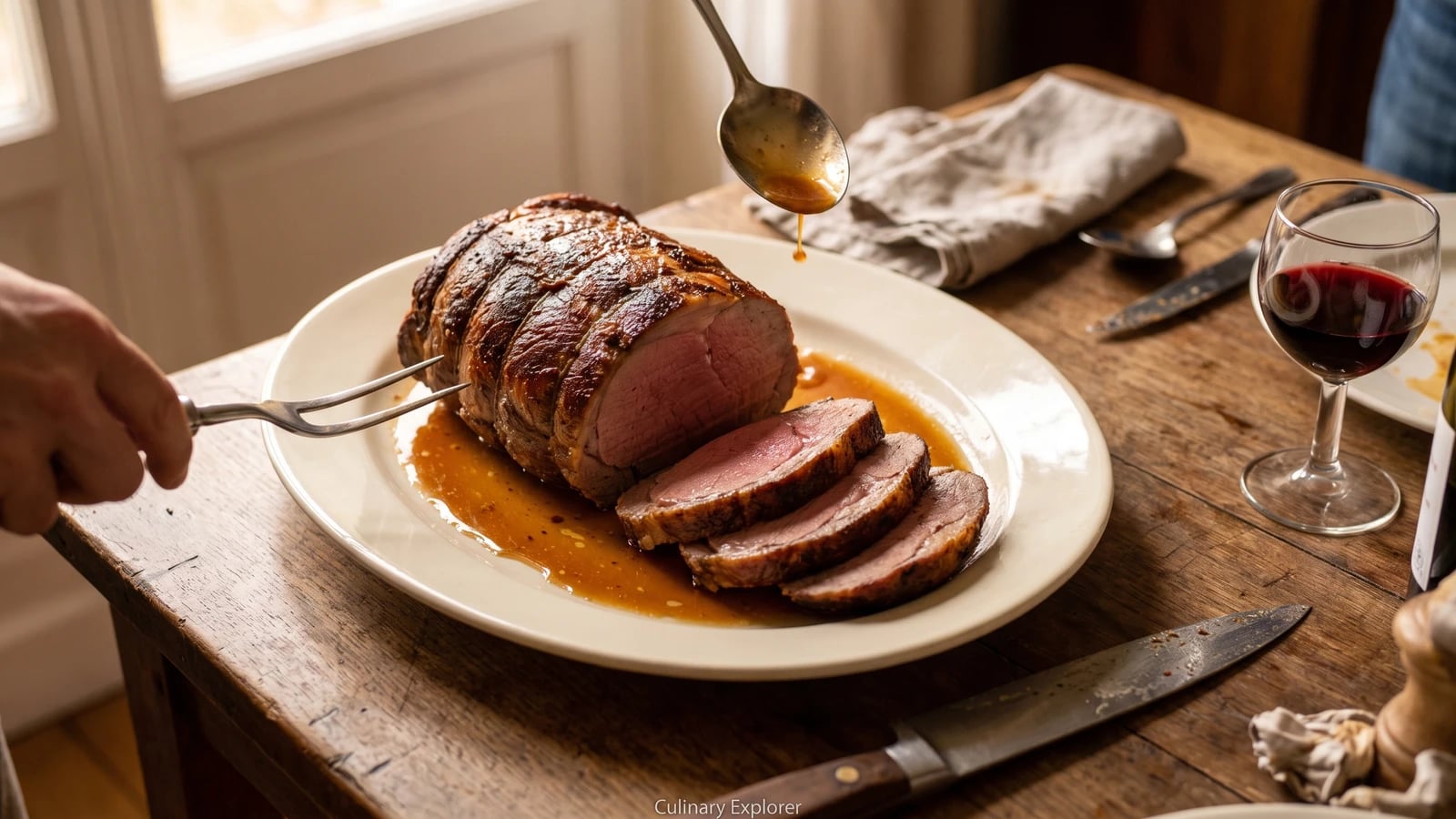
Rôtis de Boucherie puts beef in its proper place: deeply browned, rosy within, and served as the substantial relevé, with a glossy pan jus and no ceremony one cook cannot manage.
Rôtis de boucherie teach a rule of service before they teach roasting: beef and lamb belong at the relevé (the substantial remove course), not in the place called the roast, which the classical menu reserves for fowl and feathered game. At a home table, you preserve that intent by making the butcher’s joint the generous meat course, not by staging a parade of plates.
The source entry gives no seasoning or roasting formula because its subject is placement. It assumes a dining room ready for successive courses, a brigade to coordinate them, a saucier beside the roasting pan, and stock never off the fire. Your honest equivalent is a compact strip loin, one heavy pan, a thermometer, and a quick jus, the natural roasting juices reduced to a light sauce. The parade is brigade scaffolding and can go. Deep browning, controlled doneness, a full rest, and the jus are the dish and must stay.
Expect a deep Maillard bronze crust, an evenly rosy center, and butter-glossed jus gathering around each slice. This is one cook, one stove, one evening, with no imitation dining room required. The one true thing to know before you touch the pan is that carryover heat belongs to the cooking: pull the roast before its final temperature, then give it twenty quiet minutes before the knife goes near it.
Rôtis de boucherie belong to the ordering language of the formal French table rather than to one region: beef and lamb appeared as a relevé, while a single roast course meant fowl or feathered game. When two roasts were announced, the second place could be held by lobster, spiny lobster, or crayfish Mousses, by foie gras as a pâté, Terrine, mousse, or parfait, or by an excellent ham. Calling every oven-browned joint “the roast” hides a distinction of menu architecture, not a ban on roasting beef; at the home table, the joint keeps the relevé’s intent when it stands as the substantial meat course.
Quantity
1 roast, 2 lb (900 g)
tied at 1½-inch (4 cm) intervals
Quantity
2 teaspoons (10 ml / 12 g)
Quantity
1 teaspoon (5 ml / 2 g)
Quantity
1 tablespoon (15 ml / 14 g)
Quantity
¾ cup plus 1 teaspoon (185 ml / 185 g)
¾ cup hot for deglazing, 1 teaspoon cold for the sauce rescue
Quantity
2 tablespoons (30 ml / 28 g)
cut into 4 pieces and kept cold
| Ingredient | Quantity |
|---|---|
| center-cut boneless beef strip loin roasttied at 1½-inch (4 cm) intervals | 1 roast, 2 lb (900 g) |
| fine sea salt | 2 teaspoons (10 ml / 12 g) |
| freshly ground black pepper | 1 teaspoon (5 ml / 2 g) |
| neutral oil | 1 tablespoon (15 ml / 14 g) |
| water¾ cup hot for deglazing, 1 teaspoon cold for the sauce rescue | ¾ cup plus 1 teaspoon (185 ml / 185 g) |
| cold unsalted buttercut into 4 pieces and kept cold | 2 tablespoons (30 ml / 28 g) |
Set a rack in the middle of the oven and heat it to 400°F (200°C). Blot the roast until every surface is dry, tie it if the butcher has not, then season all over with the salt and pepper. Leave it uncovered while the oven heats. A wet surface delays browning because the water must disappear before the meat can color; if the salt draws out fresh moisture, blot once more just before searing.
Heat the oil in a 12-inch (30 cm) heavy ovenproof skillet over medium-high heat until it ripples. Lay in the roast and brown every broad surface for 2 to 3 minutes, then hold the ends against the pan, about 8 to 10 minutes altogether. Let the meat release on its own; tugging early tears away the crust. This fond, the chestnut-brown glaze stuck to the pan, will become the jus. If it turns black and smells bitter, move the roast to a clean ovenproof dish and wipe out the scorched pan. The resting juices will still give you a lighter but sound jus.
Set the roast fat-side up and transfer the skillet to the oven. Roast for 25 to 35 minutes, beginning to check at 22 minutes. Pull it at 125 to 128°F (52 to 53°C) for medium-rare or 135°F (57°C) for medium; carryover heat will raise the center several degrees as it rests. Minutes are only a guide. If the crust darkens before the center is ready, cover the top loosely with foil and continue checking every 4 minutes.
Transfer the roast to a warm platter and cover it very loosely with foil. Rest for 20 minutes. This is part of the cooking, not idle time: the temperature evens out and the juices settle into the meat instead of flooding the board. A tight foil parcel softens the crust, so give it shelter, not swaddling. Pour every resting juice into a cup for the jus.
While the beef rests, pour excess fat from the skillet but leave the fond. Set the pan over medium-high heat, add the ¾ cup (180 ml / 180 g) hot water, and scrape until every sound brown speck dissolves. Boil for 5 to 7 minutes, until reduced to about ½ cup (120 ml) and strong enough to taste distinctly of roasted beef, then add the resting juices. Remove the pan from the heat and monter au beurre (whisk in cold butter for gloss and body), one piece at a time. Never boil the jus after the butter goes in. If yellow beads float on the surface, the pan was too hot. Ça se rattrape: whisk in the reserved 1 teaspoon (5 ml / 5 g) cold water off the heat until the jus comes together again.
Remove the string and identify the direction of the grain, then carve across it into generous ¼-inch (6 mm) slices. Arrange the slices against the remaining joint on the warm platter and spoon the jus around them rather than drowning the browned crust. Bring the whole platter to the table as the substantial meat course. That is the relevé’s intent, alive and useful. À table!
1 serving (about 185g)
Culinary guides, cultural storytelling, and the editorial depth that makes cooking meaningful.
Discover Culinary ExplorerChef Juliette
John Dory has the delicacy of sole and the firmness of turbot. A light flouring, a quick butter sauté, and nut-brown beurre noisette show exactly why looks never mattered.

Chef Juliette
Fresh haddock proves its delicacy in the meunière pan: a fine flour crust, moist pearly flakes, and beurre noisette sharpened with lemon and parsley, ready from one skillet in half an hour.

Chef Juliette
Éperlans à l’Anglaise turns small fish into a lesson in disciplined coating: boned smelts under a close, crisp crumb, pan-fried in clarified butter and finished with bright, half-melted maître d’hôtel butter.

Chef Juliette
Tiny smelts, shallot, mushrooms, white wine, gratin sauce, and fine bread raspings meet a fierce oven, where the fish must turn tender in the same breath the buttered crust bronzes.