
Chef Juliette
John Dory (St. Pierre)
John Dory has the delicacy of sole and the firmness of turbot. A light flouring, a quick butter sauté, and nut-brown beurre noisette show exactly why looks never mattered.
A cooking platform built around craft, culture, and the stories behind what we eat.
Created by Chef Juliette
Based on No. 1941, Chevaliers Divers (Various Sandpipers), from Le Guide Culinaire (1907) by Auguste Escoffier
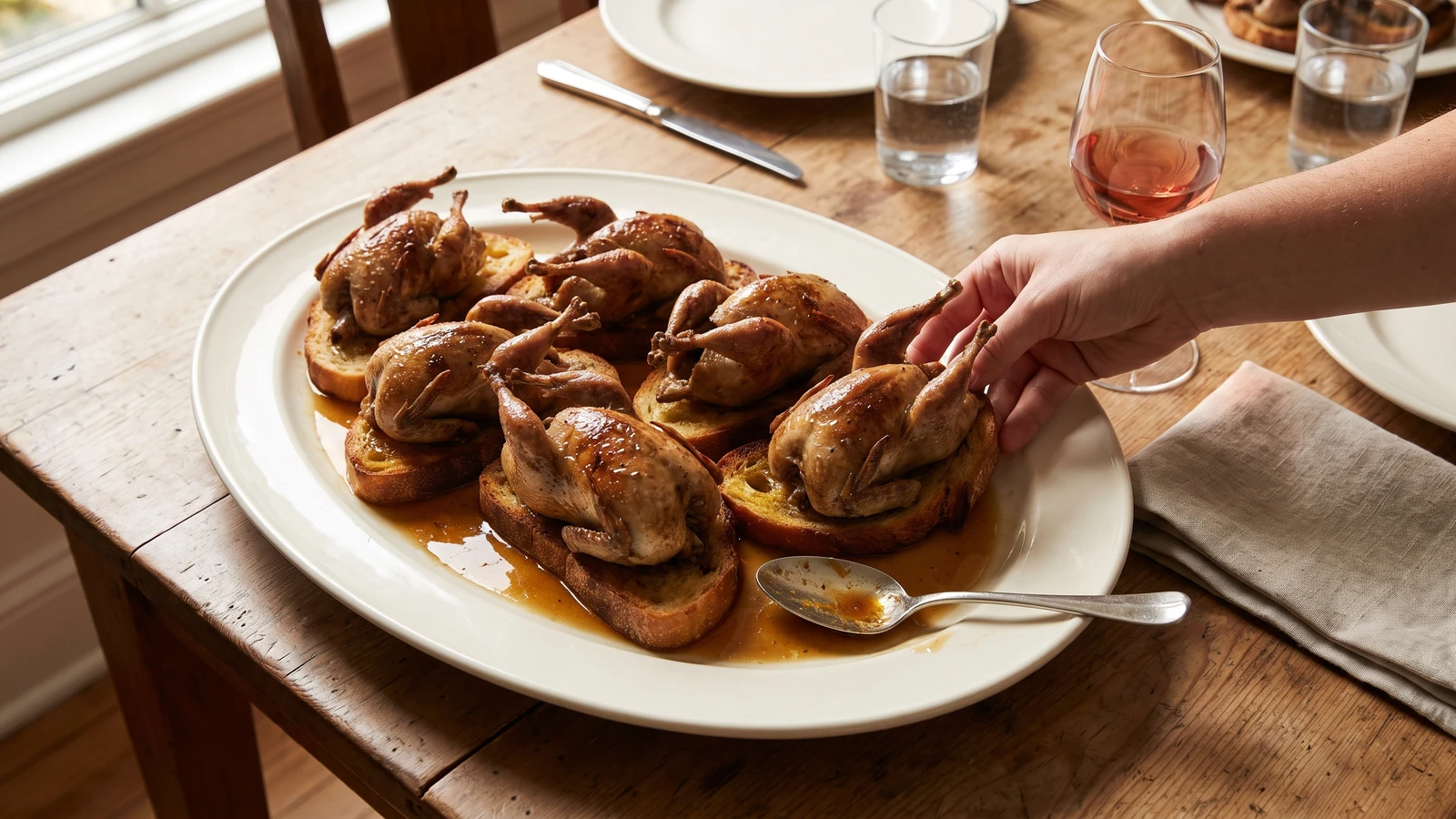
Tiny game birds teach exact roasting: dry skin, fierce heat, and individual timing, with each Chevalier lifted when done and its butter-rich fond gathered into a plain, glossy jus.
Chevaliers divers rôtis (various sandpipers, roasted) teach exact roasting because a small, lean bird gives you almost no margin: dry it thoroughly, expose it to fierce heat, and judge each bird on its own rather than trusting one clock for the whole pan. The promise is burnished skin, just-cooked flesh, and a spoonful of glossy jus caught by crisp toast beneath.
The source gives no proportion because its professional kitchen expected roast game to be sized and judged by eye. Here it becomes eight small, fully eviscerated, lawfully obtained birds for four, checked with a thermometer because a home cook has no game larder inspecting the day's bag. A classical kitchen could manage a turning spit and a hand with a basting spoon; your honest equivalents are a hot oven, a heavy pan, and one careful basting. The spit and constant hand are brigade scaffolding and may go. The fierce roast and individual timing are the dish and must stay. There is no saucier on staff to call, no stock kept permanently at the tremble, and no salamander to imitate. One cook, one stove, one evening.
Sort the birds by size before they meet the oven and lift them one by one as each reaches safe doneness; the smallest may be resting while the largest finishes. That individual timing is the step that matters most.
Chevaliers divers is a collective name from the French game table for several wading birds in the chevalier group, not one species or one regional specialty. The source places them on ordinary menus and makes roasting the rule; salmis, a sauce-bound preparation of previously roasted game, was also permitted, but the skin had to be excluded from the carcasses pounded for the cullis so the sauce remained clean rather than oily. That menu ranking records a hierarchy of formal service, not a defect in the birds, but most sandpipers are now protected or tightly regulated and may be cooked only when the exact species and provenance are lawful.
Quantity
8 birds, about 3 to 4 ounces / 85 to 115 g each; 24 to 32 ounces / 680 to 920 g total
legally sourced, fully eviscerated, and inspected for shot
Quantity
6 tablespoons (90 ml / 85 g)
divided, with 2 tablespoons kept cold
Quantity
1½ teaspoons (7.5 ml / 9 g)
Quantity
1 teaspoon (5 ml / 2 g)
Quantity
8 slices, about 10 ounces / 280 g total
cut about ½ inch / 1.25 cm thick
Quantity
½ cup (120 ml / 120 g)
| Ingredient | Quantity |
|---|---|
| whole oven-ready sandpiperslegally sourced, fully eviscerated, and inspected for shot | 8 birds, about 3 to 4 ounces / 85 to 115 g each; 24 to 32 ounces / 680 to 920 g total |
| unsalted butterdivided, with 2 tablespoons kept cold | 6 tablespoons (90 ml / 85 g) |
| fine sea salt | 1½ teaspoons (7.5 ml / 9 g) |
| freshly ground black pepper | 1 teaspoon (5 ml / 2 g) |
| country breadcut about ½ inch / 1.25 cm thick | 8 slices, about 10 ounces / 280 g total |
| water | ½ cup (120 ml / 120 g) |
Before opening the package, confirm that its records identify the species and lawful provenance. If they do not, stop. Examine the fully eviscerated birds one at a time, pluck away any pinfeathers, remove visible shot with tweezers, and trim bloodshot tissue. Do not rinse them; water spreads raw-game juices and leaves the skin wet. Pat the cavities and skin completely dry, then keep the birds chilled while you prepare the butter.
Melt 4 tablespoons (60 ml / 57 g) of the butter over the gentlest heat. Skim away the white foam, then pour the clear golden fat into a small bowl, leaving the milky sediment behind. This is beurre clarifié, clarified butter, and it gives you real butter flavor without scorched milk solids under the fierce roasting heat. Keep it warm and reserve the remaining 2 tablespoons (30 ml / 28 g) of butter cold for the jus.
Set a rack in the upper-middle of the oven and heat it to 475°F / 245°C. Put a heavy 12-inch / 30 cm ovenproof skillet in the oven for the final 5 minutes. Meanwhile, arrange the birds from smallest to largest, season them inside and out with the salt and pepper, and tie the legs loosely together if they splay. Brush each bird with beurre clarifié, saving about 1 tablespoon for the bread.
Brush both sides of the bread lightly with the reserved beurre clarifié and arrange the slices on a baking sheet. Toast them in the hot oven for 3 to 5 minutes, turning once, until crisp at the edges but still able to absorb the roasting juices. Transfer them to a warm platter.
Arrange the birds breast-side up in the hot skillet, placing the largest toward the hotter back of the oven. Roast for 6 minutes, baste them with the butter in the pan, and rotate the skillet. Begin checking the smallest at 9 minutes by inserting an instant-read thermometer sideways into the thickest flesh without touching bone. Remove each bird as it reaches at least 165°F / 74°C; mixed sizes may finish several minutes apart. If the skin becomes deeply bronzed before the center is ready, lower the oven to 400°F / 205°C and shield only the breast with a small piece of foil while the bird finishes.
Set two birds on each pair of toast slices and leave them uncovered for 5 minutes. The rest settles their juices while the bread catches what escapes. Do not wrap the platter tightly, because trapped moisture softens the skin you worked to brown.
Place the roasting skillet over medium heat, add the water, and scrape up every bronze speck of fond from the pan floor. Simmer until reduced to about ¼ cup (60 ml / 60 g) and lightly syrupy. Take the pan off the heat and whisk in the cold butter a few pieces at a time until the jus gleams and lightly coats a spoon. If it turns greasy or separates, add 1 teaspoon of cold water and whisk off the heat. Ça se rattrape. Taste and correct the seasoning.
Spoon the glossy jus over and around the birds without drowning their skin. Serve two Chevaliers per person on the buttered toast, with no herb confetti and no elaborate garnish. Plain birds, plainly served. À table!
1 serving (about 265g)
Culinary guides, cultural storytelling, and the editorial depth that makes cooking meaningful.
Discover Culinary ExplorerChef Juliette
John Dory has the delicacy of sole and the firmness of turbot. A light flouring, a quick butter sauté, and nut-brown beurre noisette show exactly why looks never mattered.

Chef Juliette
Fresh haddock proves its delicacy in the meunière pan: a fine flour crust, moist pearly flakes, and beurre noisette sharpened with lemon and parsley, ready from one skillet in half an hour.

Chef Juliette
Éperlans à l’Anglaise turns small fish into a lesson in disciplined coating: boned smelts under a close, crisp crumb, pan-fried in clarified butter and finished with bright, half-melted maître d’hôtel butter.

Chef Juliette
Tiny smelts, shallot, mushrooms, white wine, gratin sauce, and fine bread raspings meet a fierce oven, where the fish must turn tender in the same breath the buttered crust bronzes.