
Chef Juliette
John Dory (St. Pierre)
John Dory has the delicacy of sole and the firmness of turbot. A light flouring, a quick butter sauté, and nut-brown beurre noisette show exactly why looks never mattered.
A cooking platform built around craft, culture, and the stories behind what we eat.
Created by Chef Juliette
Based on No. 1935, Becs-figues et Beguinettes (Fig Peckers), from Le Guide Culinaire (1907) by Auguste Escoffier
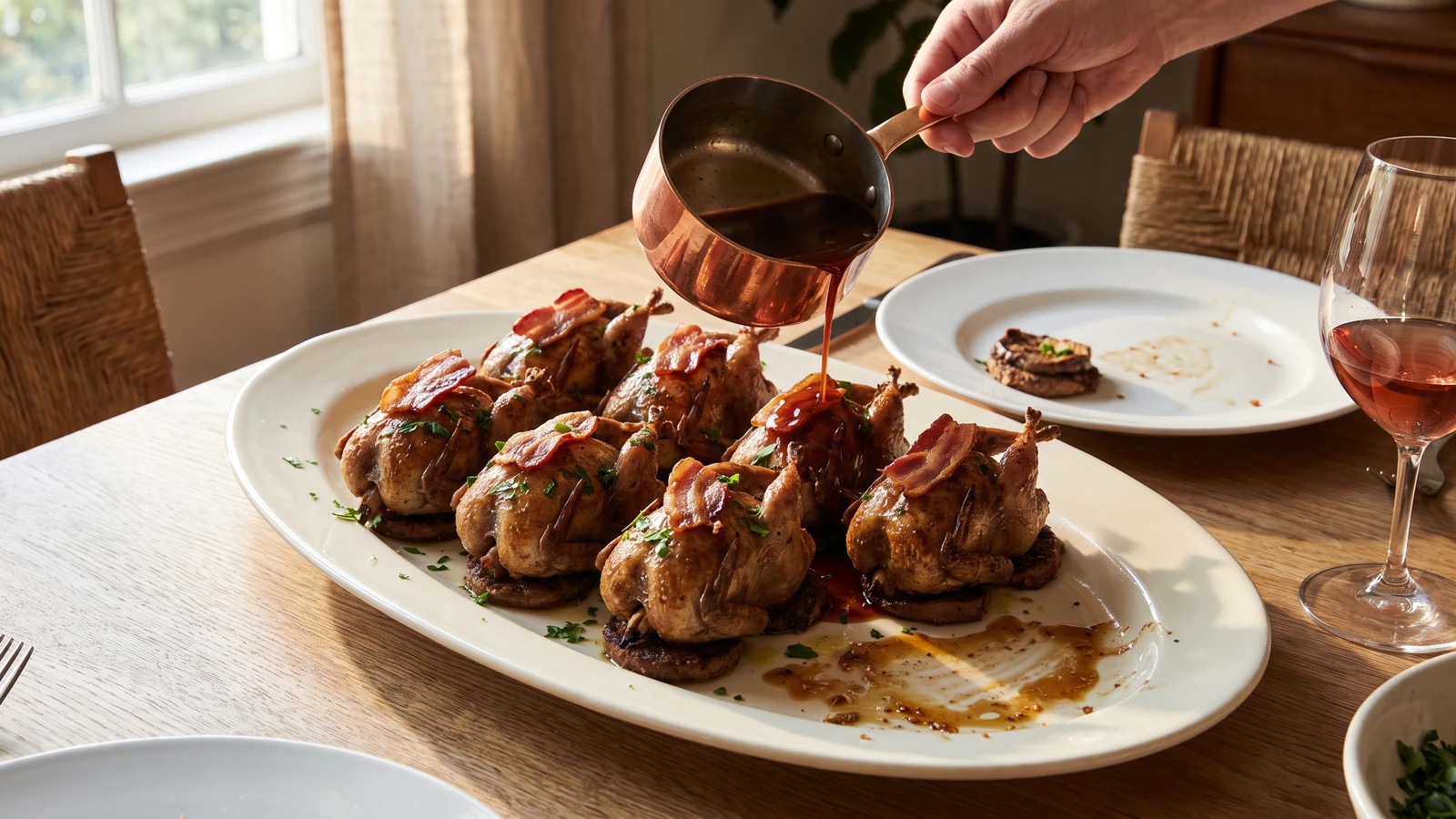
Eight small quail, barded with bacon and roasted hot over liver canapés, carry the book's lark instruction into a generous platter, with Madeira jus gathering every browned drop.
Becs-figues et Beguinettes (fig peckers) teach the discipline of roasting a very small bird. The one true thing is this: a small bird has no forgiving middle. Protect the breast, give it fierce heat, and stop cooking the moment the flesh is done. Catch that moment and eight modest birds arrive bronze, glossy, and generous enough for four.
The entry supplies no separate formula, seasoning list, or brigade ratio. It assumes a French game market and a cook already fluent in the lark repertory, with rows of tiny birds turned before a roast fire and their savory innards traditionally left in place. That scaffolding can go. Farmed quail, cleaned for a modern kitchen, stand in at two per person; a hot oven replaces the spit, and liver spread beneath each bird restores the depth the drawn quail no longer bring. One cook, one stove, one evening.
The barding, quick roast, bread catching the juices, and fond reduced into jus must stay. They are the dish. Match the quail by weight, begin checking them early, and let the thermometer settle the matter before the pan takes one minute too many.
Along Mediterranean France, particularly Provence, bec-figue was a market name for several tiny migratory warblers taken after feeding among late-season figs; beguinette belonged to the same culinary family of small birds. The source records them through omission, directing the cook to treat them exactly like larks rather than granting them a separate method. Wild migratory songbirds are protected across France and absent from lawful trade, so farmed quail preserves the scale and roasting logic without pretending the original quarry can still be bought.
Quantity
8, each 4 to 5 ounces (115 to 140 g), about 2 to 2 1/2 pounds (900 g to 1.1 kg) total
patted dry
Quantity
8 slices, about 4 ounces (115 g)
Quantity
1/2 cup (120 ml / 113 g)
divided
Quantity
8 slices, each 1/2 inch (1.25 cm) thick, about 6 ounces (170 g) total
Quantity
3 ounces (85 g)
trimmed and patted dry
Quantity
1 small, about 1 ounce (30 g)
finely minced and divided
Quantity
2 tablespoons (30 ml / 28 g)
Quantity
1 teaspoon (5 ml / 1 g)
finely chopped
Quantity
1 1/2 teaspoons (7.5 ml / 9 g)
divided
Quantity
1 teaspoon (5 ml / 2 g)
divided
Quantity
1/2 cup (120 ml / 120 g)
Quantity
3/4 cup (180 ml / 180 g)
Quantity
1 tablespoon (15 ml / 15 g)
Quantity
2 tablespoons (30 ml / 8 g)
finely chopped
| Ingredient | Quantity |
|---|---|
| oven-ready farmed quailpatted dry | 8, each 4 to 5 ounces (115 to 140 g), about 2 to 2 1/2 pounds (900 g to 1.1 kg) total |
| thinly sliced unsmoked streaky bacon | 8 slices, about 4 ounces (115 g) |
| unsalted butterdivided | 1/2 cup (120 ml / 113 g) |
| baguette | 8 slices, each 1/2 inch (1.25 cm) thick, about 6 ounces (170 g) total |
| chicken liverstrimmed and patted dry | 3 ounces (85 g) |
| shallotfinely minced and divided | 1 small, about 1 ounce (30 g) |
| Cognac | 2 tablespoons (30 ml / 28 g) |
| fresh thyme leavesfinely chopped | 1 teaspoon (5 ml / 1 g) |
| fine sea saltdivided | 1 1/2 teaspoons (7.5 ml / 9 g) |
| freshly ground black pepperdivided | 1 teaspoon (5 ml / 2 g) |
| dry Madeira | 1/2 cup (120 ml / 120 g) |
| unsalted, gelatin-rich chicken broth | 3/4 cup (180 ml / 180 g) |
| fresh lemon juice | 1 tablespoon (15 ml / 15 g) |
| flat-leaf parsleyfinely chopped | 2 tablespoons (30 ml / 8 g) |
Set a rack in the center of the oven and heat it to 475°F (245°C), leaving a shallow metal roasting pan inside to heat. Season the quail inside and out with 1 teaspoon of the salt and 3/4 teaspoon of the pepper, then leave them for 20 minutes while the oven comes fully to temperature. Tuck the wing tips beneath the bodies, tie the legs together, and lay one bacon slice over each breast, tucking its ends underneath. The heated pan replaces the immediate force of a turning spit; the barde, the protective covering of bacon, stays because it shields the lean breast while the legs cook.
Melt 2 tablespoons of the butter in a wide skillet over medium-high heat. Brown the chicken livers for about 2 minutes on each side, then add half the shallot and the thyme. Cook until the shallot softens and the livers reach 165°F (74°C) at their centers. Take the skillet off the flame before adding the Cognac, return it to gentle heat, and reduce until only a glossy coating remains. Chop the livers finely and mash them into their butter. If the mixture turns crumbly, ça se rattrape: work in a teaspoon of chicken broth until it spreads softly. Melt another 2 tablespoons of butter in the wiped skillet and brown the baguette slices on both sides. Spread each with an equal portion of liver and arrange them on a warm oval platter.
Carefully remove the heated roasting pan and add 2 tablespoons of butter. As soon as it foams, arrange the quail breast-side up with room between them and return the pan to the oven. Roast for 8 minutes, then lift the bacon from the breasts and lay it beside the birds. Brush the exposed skin with the butter in the pan and roast for another 4 to 7 minutes, checking early, until the skin is deep gold and the thickest part of each bird reaches 165°F (74°C). Remove smaller birds as they finish. A dry quail cannot truly be restored with sauce, so trust the thermometer, not the clock.
Set one quail on each liver canapé, top it with its bacon, and cover the platter loosely while the birds rest. Pour off the loose fat from the roasting pan, leaving the browned fond behind, then place the pan over medium heat. Add the reserved shallot and cook for 30 seconds. Pour in the Madeira and scrape up every browned trace, then reduce it to about 2 tablespoons. Add the chicken broth and boil steadily until the jus measures about 1/2 cup and lightly coats a spoon. Take the pan off the heat and whisk in the remaining 2 tablespoons of cold butter, a piece at a time, followed by the lemon juice. If the emulsion separates, ça se rattrape: whisk 1 teaspoon of cold water in a clean bowl, then add the split jus gradually until it returns to a gloss. Taste and add the remaining salt or pepper only if needed, because the bacon and reduction have already spoken.
Let the quail complete a full 8-minute rest on their canapés so the bread catches both liver butter and roasting juices. Spoon enough Madeira jus over each bird to make the skin gleam without softening it, scatter the parsley lightly, and send the remaining jus to the table in a warm sauceboat. Serve two quail per person, with a knife for the first neat cuts and fingers for the last good ones. Cooking well is not cooking fancy. À table!
1 serving (about 280g)
Culinary guides, cultural storytelling, and the editorial depth that makes cooking meaningful.
Discover Culinary ExplorerChef Juliette
John Dory has the delicacy of sole and the firmness of turbot. A light flouring, a quick butter sauté, and nut-brown beurre noisette show exactly why looks never mattered.

Chef Juliette
Fresh haddock proves its delicacy in the meunière pan: a fine flour crust, moist pearly flakes, and beurre noisette sharpened with lemon and parsley, ready from one skillet in half an hour.

Chef Juliette
Éperlans à l’Anglaise turns small fish into a lesson in disciplined coating: boned smelts under a close, crisp crumb, pan-fried in clarified butter and finished with bright, half-melted maître d’hôtel butter.

Chef Juliette
Tiny smelts, shallot, mushrooms, white wine, gratin sauce, and fine bread raspings meet a fierce oven, where the fish must turn tender in the same breath the buttered crust bronzes.