
Chef Juliette
John Dory (St. Pierre)
John Dory has the delicacy of sole and the firmness of turbot. A light flouring, a quick butter sauté, and nut-brown beurre noisette show exactly why looks never mattered.
A cooking platform built around craft, culture, and the stories behind what we eat.
Created by Chef Juliette
Based on No. 1932, Mauviettes Froides, from Le Guide Culinaire (1907) by Auguste Escoffier
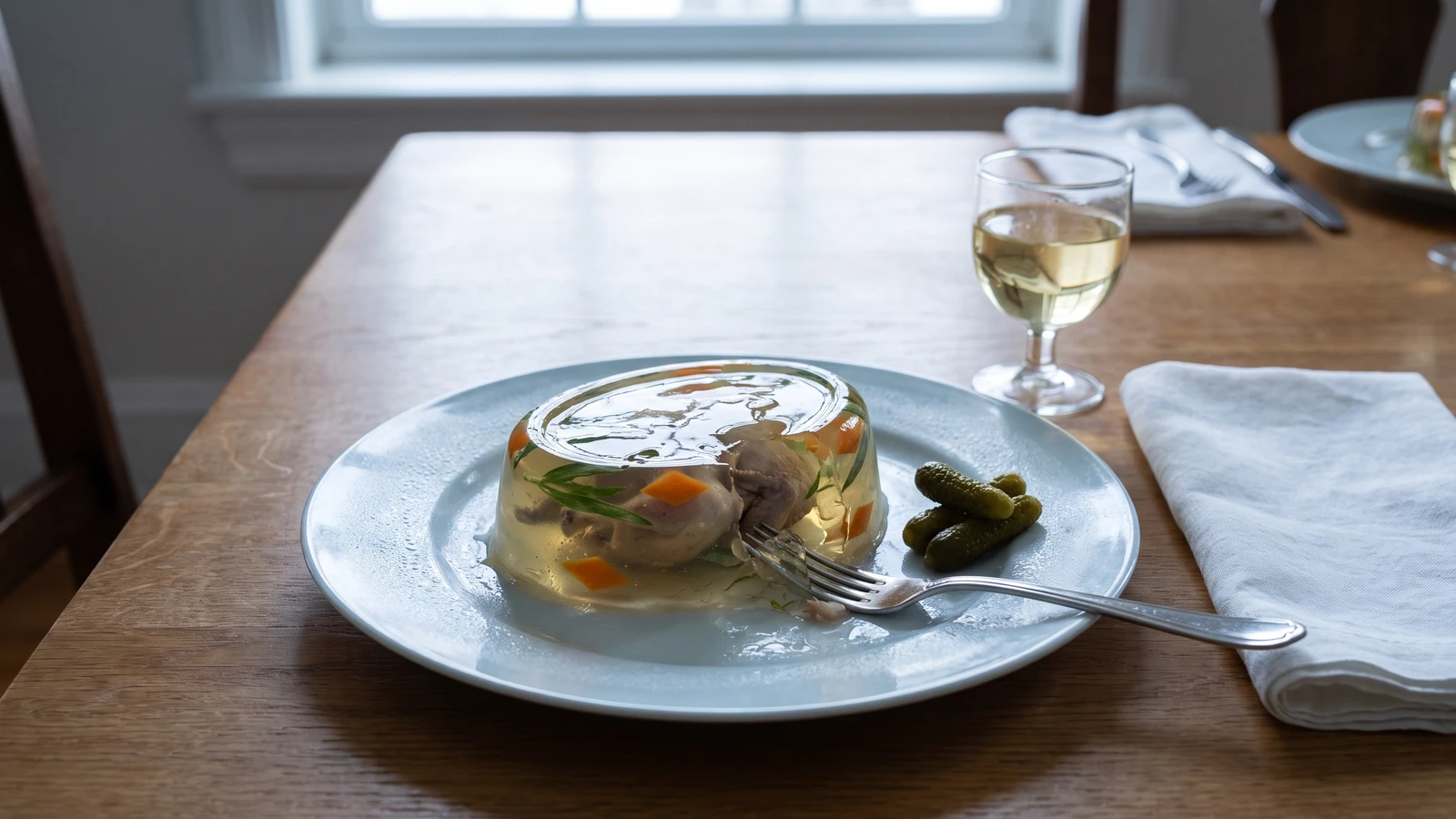
Mauviettes froides turn gently poached small birds into a clear Belle-vue centerpiece: quail cooled in its liquor, arranged with tarragon and carrot, then sealed under tender Madeira aspic.
Mauviettes froides (cold larks) teach the discipline of cold assembly: every layer must be fully set before the next is poured. Rush the work and the decoration drifts, the birds float, and clear aspic becomes a blurred window. Give each layer its proper chill and the result unmolds cleanly, pale gold and gleaming, with the small birds held visibly inside.
The original kitchen assumed legally gathered larks arriving with the game, a saucier keeping clear aspic ready, stock never off the fire, ranks of metal molds, and a cold room. A home kitchen has none of that, nor should it chase protected songbirds. Eight farmed quail provide four generous portions; their flavor is milder than lark, and that change is stated plainly. Good unsalted chicken stock, clarified once with egg white, replaces the permanent stockpot, while four shallow household bowls replace a battery of specialized molds. One cook, one stove, one evening of assembly, then the cold does its work.
The source sends cold larks down several separate roads: plain chaud-froid, cases, Belle-vue, Aspic, or Mousses. These are choices, not successive layers. This version follows Belle-vue because it preserves the entry's cold-poached bird and makes the clarity of the aspic the central skill. Multiple sauces and trays of ornamental garnish were brigade scaffolding and can go; the gentle poach, cooling in the liquor, clarification, and staged pouring are the dish and must stay. Before touching the pan, remember the one true thing: pour only cool liquid aspic onto a layer firm enough to receive it.
Mauviettes belong to the Parisian cold-game repertoire, where market larks passed into the hands of traiteurs and grand-house cold kitchens for buffets and formal suppers. Plain chaud-froid, cases, Belle-vue, Aspic, and Mousses were alternate modes of service rather than parts of one elaborate construction; Belle-vue displayed the bird through clarified jelly and made the cold cook's precision visible. Wild skylarks are protected or tightly controlled across much of their range, so farmed quail preserves the small-bird technique without pretending the flavor is identical.
Quantity
8 (about 4 to 5 oz / 115 to 140 g each)
giblets removed
Quantity
2 teaspoons (10 ml / 12 g), plus more to taste
divided
Quantity
½ teaspoon (2.5 ml / 1 g)
freshly ground
Quantity
6⅓ cups (1.5 L / 1.5 kg)
Quantity
1 (about 5 oz / 140 g)
peeled, with 12 thin diamonds cut from the broad end and the remainder chopped
Quantity
1 (about 4 oz / 115 g)
white and pale green parts sliced and rinsed
Quantity
1 (about 2 oz / 55 g)
chopped
Quantity
1 (about 1½ oz / 40 g)
sliced
Quantity
1
parsley stems, 1 thyme sprig, and 1 bay leaf
Quantity
8
Quantity
2
Quantity
1
for reclarifying if needed
Quantity
2 tablespoons plus 1 teaspoon (35 ml / 21 g)
Quantity
1 teaspoon (5 ml / 3 g)
for a weak set test
Quantity
7 tablespoons (105 ml / 105 g)
for blooming the gelatin
Quantity
1 tablespoon (15 ml / 15 g)
for blooming the additional gelatin
Quantity
¼ cup (60 ml / 60 g)
Quantity
1 tablespoon (15 ml / 15 g)
Quantity
12 small leaves
Quantity
8 cups (1.9 L / about 1.2 kg)
for cooling
Quantity
¾ cup (180 ml / 110 g)
drained, for serving
| Ingredient | Quantity |
|---|---|
| whole farmed quailgiblets removed | 8 (about 4 to 5 oz / 115 to 140 g each) |
| fine sea saltdivided | 2 teaspoons (10 ml / 12 g), plus more to taste |
| white pepperfreshly ground | ½ teaspoon (2.5 ml / 1 g) |
| good unsalted chicken stock | 6⅓ cups (1.5 L / 1.5 kg) |
| large carrotpeeled, with 12 thin diamonds cut from the broad end and the remainder chopped | 1 (about 5 oz / 140 g) |
| small leekwhite and pale green parts sliced and rinsed | 1 (about 4 oz / 115 g) |
| celery stalkchopped | 1 (about 2 oz / 55 g) |
| large shallotsliced | 1 (about 1½ oz / 40 g) |
| bouquet garniparsley stems, 1 thyme sprig, and 1 bay leaf | 1 |
| black peppercorns | 8 |
| large egg whites | 2 |
| additional large egg white (optional)for reclarifying if needed | 1 |
| unflavored powdered gelatin, preferably 200-bloom | 2 tablespoons plus 1 teaspoon (35 ml / 21 g) |
| additional unflavored powdered gelatin (optional)for a weak set test | 1 teaspoon (5 ml / 3 g) |
| cold waterfor blooming the gelatin | 7 tablespoons (105 ml / 105 g) |
| additional cold water (optional)for blooming the additional gelatin | 1 tablespoon (15 ml / 15 g) |
| dry Madeira | ¼ cup (60 ml / 60 g) |
| fresh lemon juice | 1 tablespoon (15 ml / 15 g) |
| fresh tarragon leaves | 12 small leaves |
| ice cubesfor cooling | 8 cups (1.9 L / about 1.2 kg) |
| cornichonsdrained, for serving | ¾ cup (180 ml / 110 g) |
Pat the quail dry. Season them inside and out with 1 teaspoon of the salt and the white pepper, fold the wing tips underneath, and tie the legs together loosely so the birds keep their shape without becoming tight little fists. Keep them cold while you build the poaching liquor.
Combine the chicken stock, chopped carrot, leek, celery, shallot, bouquet garni, peppercorns, and remaining teaspoon of salt in a saucepan wide enough to hold the birds snugly. Bring it to a bare simmer and cook for 20 minutes. Add the 12 carrot diamonds for the final 3 minutes, then lift them out carefully and chill them; they must remain neat enough for the Belle-vue decoration.
Lower the quail into the liquor and cover them with a parchment cartouche so they remain submerged. Hold the liquid between 175 and 185°F (80 and 85°C), with only an occasional lazy bubble, and begin checking after 12 minutes. Continue until the thickest part of each thigh reaches 165°F (74°C), lifting out smaller birds as they finish. Return every bird to the liquor, remove the pan from the heat, and set it in a deep ice bath. Cool the quail in their liquor, stirring the liquid gently around them and replenishing the ice as needed; this keeps the breasts succulent and carries the seasoning through the meat. Once the liquor falls below 70°F (21°C), cover and refrigerate until the birds are completely cold, about 2 hours.
Lift out the cold quail, remove the string, pat them dry, and keep them covered in the refrigerator. Strain the liquor, discard the aromatics, skim away every trace of hardened fat, and boil it down to 5 cups (1.2 L / about 1.2 kg). Cool it until fluid but no warmer than room temperature. Whisk in 2 egg whites, set the pan over medium-low heat, and stir slowly until the whites gather into a raft on the surface. Stop stirring, open a small vent in the raft, and hold the liquor at the barest simmer for 10 minutes. Ladle it through a damp cheesecloth-lined sieve without pressing the raft. Measure 4 cups (950 ml / about 950 g) for the aspic and reserve any extra for adjustment. If a hard boil breaks the raft and the liquor remains cloudy, strain it, cool it, whisk in the additional egg white, and repeat. Ça se rattrape.
Sprinkle the 21 g of gelatin over the 7 tablespoons of cold water and leave it for 10 minutes. Warm 1 cup (240 ml) of the clarified liquor, remove it from the heat, and stir in the bloomed gelatin until completely dissolved. Combine it with the remaining measured liquor, Madeira, and lemon juice. Taste it cool: it should seem slightly brighter and more seasoned than a warm sauce because the cold will soften both. Chill a spoonful on a cold saucer for 10 minutes. The aspic must yield to a spoon but hold a clean edge. If the test slumps, bloom the optional teaspoon of gelatin in the additional tablespoon of water, dissolve it in a little warm aspic, and stir it back through. If the test is rubbery, melt the mixture gently and loosen it with reserved clarified liquor. Never boil aspic after adding gelatin.
Rinse four 2½-cup (600 ml) oval molds or shallow bowls with cold water and shake them dry. Set them level on a tray. Pour a thin layer of liquid aspic into each and refrigerate until completely set, 10 to 15 minutes. Arrange 3 tarragon leaves and 3 carrot diamonds face down on each layer, remembering that the bottom becomes the top. Seal the decoration with another spoonful of aspic and chill again. Pouring onto a soft layer makes the decoration drift and the jelly turn ragged, so test it with a fingertip before proceeding.
Place 2 cold quail breast-side down in each mold. Spoon in enough cool, still-liquid aspic to come one-third of the way up the birds, then refrigerate for about 20 minutes, until the quail are anchored. Fill the molds with the remaining aspic and chill again. If a bird floats or rolls, stop pouring and let the shallow layer set before nudging it back into place. If the aspic begins setting in the saucepan, stand the pan briefly in warm water and stir until fluid; gentle warmth restores it.
Cover the molds once their surfaces are firm and refrigerate for at least 4 hours, preferably overnight. To unmold, dip each mold in warm water for 3 to 5 seconds, wipe it dry, place a chilled plate on top, and invert with confidence. If it clings, wrap the mold briefly in a warm towel rather than submerging it longer. Refrigerate for 10 minutes if the surface softens. Serve cold with cornichons, and tell the table plainly that whole quail still contain small bones. À table!
1 serving (about 450g)
Culinary guides, cultural storytelling, and the editorial depth that makes cooking meaningful.
Discover Culinary ExplorerChef Juliette
John Dory has the delicacy of sole and the firmness of turbot. A light flouring, a quick butter sauté, and nut-brown beurre noisette show exactly why looks never mattered.

Chef Juliette
Fresh haddock proves its delicacy in the meunière pan: a fine flour crust, moist pearly flakes, and beurre noisette sharpened with lemon and parsley, ready from one skillet in half an hour.

Chef Juliette
Éperlans à l’Anglaise turns small fish into a lesson in disciplined coating: boned smelts under a close, crisp crumb, pan-fried in clarified butter and finished with bright, half-melted maître d’hôtel butter.

Chef Juliette
Tiny smelts, shallot, mushrooms, white wine, gratin sauce, and fine bread raspings meet a fierce oven, where the fish must turn tender in the same breath the buttered crust bronzes.