
Chef Juliette
John Dory (St. Pierre)
John Dory has the delicacy of sole and the firmness of turbot. A light flouring, a quick butter sauté, and nut-brown beurre noisette show exactly why looks never mattered.
A cooking platform built around craft, culture, and the stories behind what we eat.
Created by Chef Juliette
Based on No. 1930, Mauviettes à la Mère Marianne, from Le Guide Culinaire (1907) by Auguste Escoffier
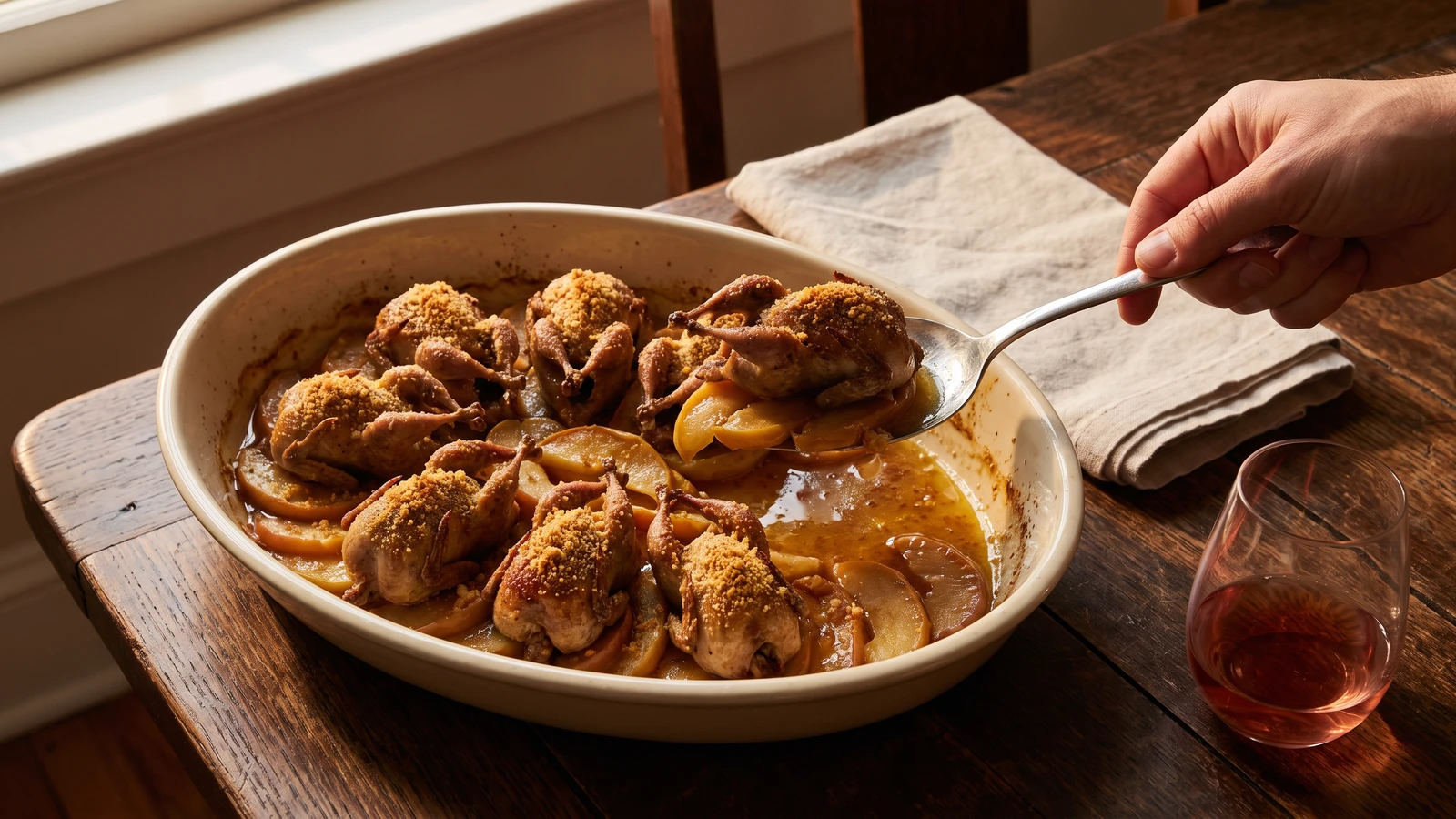
Farmed quail take the place of scarce larks, browned only until firm in beurre noisette, then nestled into russet apples beneath fine buttered crumbs that bronze as the birds finish.
Mauviettes à la Mère Marianne (larks on buttered russet apples) teaches the speed of small-bird cookery. Raidir, to stiffen the flesh in hot fat, does not mean cooking it through. The birds leave the pan while still raw within, because their cooking must finish in the same brief interval that turns the buttered crumbs bronze.
The original entry assumes market-dressed larks, brigade quantities, and a salamander fierce enough to glaze the crumbs before those minute birds dry. It calls on no saucier and no stockpot because there is no sauce hiding underneath the method. For one cook, one stove, one evening, eight legally farmed quail feed four, while a fiercely heated upper oven and a short broiler finish replace the salamander. Quail are larger than larks, so an instant-read thermometer supplies the certainty the old kitchen gained from repetition.
Bird procurement and the separate finishing station were brigade scaffolding, and they can go. The three-quarter cooking of the apples, the beurre noisette, the quick raidir, and the final pressing into the fruit are the dish itself, so every one stays. The one step that matters most is taking the quail out of the butter as soon as their skin firms and colors; cook them through in the pan and the glazed finish can only dry them.
Mauviettes belonged to the French autumn game table and entered the grand-kitchen repertoire as tiny birds cooked rapidly, often with fruit or crumbs to catch their rich butter. À la Mère Marianne sets them on russeted apples as a named table-style preparation, not as a claim from Normandy or another apple-growing region. The word mauviette also became everyday French for a puny person, a reminder of the lark's size; because wild larks are protected or unavailable in many markets, farmed quail now carries the method lawfully.
Quantity
8 (about 3 lb / 1.35 kg total)
oven-ready, giblets removed
Quantity
6 medium (about 2½ lb / 1.1 kg before trimming)
peeled and cored
Quantity
10 tablespoons (150 ml / 142 g)
divided
Quantity
¾ cup (180 ml / 75 g)
Quantity
2 teaspoons (10 ml / 12 g)
Quantity
¾ teaspoon (3.75 ml / 1.5 g)
| Ingredient | Quantity |
|---|---|
| whole farmed quailoven-ready, giblets removed | 8 (about 3 lb / 1.35 kg total) |
| russet apples, such as Golden Russet or Belle de Boskooppeeled and cored | 6 medium (about 2½ lb / 1.1 kg before trimming) |
| unsalted butterdivided | 10 tablespoons (150 ml / 142 g) |
| very fine dry white breadcrumbs | ¾ cup (180 ml / 75 g) |
| fine sea salt | 2 teaspoons (10 ml / 12 g) |
| freshly ground black pepper | ¾ teaspoon (3.75 ml / 1.5 g) |
Set a rack in the upper third of the oven and heat it to 450°F (230°C). Butter a shallow 3-quart (3-liter) gratin dish with 1 tablespoon of the butter. Pat the quail completely dry, tuck their wing tips underneath, and season them inside and out with the salt and pepper. A wet bird cannot color properly, and this brief cooking leaves no time to correct a pale skin later.
Cut the apples into slices about ¼ inch (6 mm) thick. Melt 3 tablespoons of butter in the skillet over medium heat, add the apples, and turn them gently for 8 to 12 minutes. Stop when the edges are translucent and supple but the centers still resist a knife; this is three-quarter cooking, not apple purée. If the slices begin breaking, take them off the heat immediately. Ça se rattrape: spread the broken fruit across the bottom and reserve the sound slices for the upper layers. Arrange all the apples in thick, overlapping layers in the buttered dish and keep them warm.
Wipe the skillet clean and melt 2 tablespoons of butter over medium-high heat. Let the foam subside and the milk solids turn hazelnut brown, making beurre noisette. Add four quail and turn them briskly for 2 to 3 minutes, just until the skin firms and takes light color on every side; their centers must remain raw. Press them slightly into the warm apples, then repeat with the remaining 2 tablespoons of butter and four quail. If the butter turns black or smells acrid, lift out the birds, wipe the pan, and begin that batch with fresh butter. Burnt beurre noisette cannot be disguised, but the birds are unharmed if you move promptly.
Scatter the very fine breadcrumbs evenly over the quail and the exposed apples, making a light, complete coat rather than a heavy casing. Melt the remaining 2 tablespoons of butter and spoon it across the crumbs. Pressing the birds into the fruit matters: the apple cushions their undersides, while the exposed skin and crumbs meet the fierce heat above.
Bake in the upper third of the oven for 8 minutes, then begin checking. The dish is ready when the crumbs are deeply golden, the butter bubbles around the apple layer, and the thickest part of each quail reaches 165°F (74°C), usually after 10 to 14 minutes. If the birds reach temperature while the crumbs remain pale, use the broiler for 30 to 60 seconds and watch without looking away. If the crumbs brown first, shield the surface loosely with foil and move the dish to the middle rack until the birds finish. Ça se rattrape.
Rest the dish for 5 minutes so the quail settle and the apple layers absorb the pooling butter. Bring the gratin dish directly to the table, giving each person two quail with a generous spoonful of the soft russet apples and bronzed crumbs. Cooking well is not cooking fancy. À table!
1 serving (about 410g)
Culinary guides, cultural storytelling, and the editorial depth that makes cooking meaningful.
Discover Culinary ExplorerChef Juliette
John Dory has the delicacy of sole and the firmness of turbot. A light flouring, a quick butter sauté, and nut-brown beurre noisette show exactly why looks never mattered.

Chef Juliette
Fresh haddock proves its delicacy in the meunière pan: a fine flour crust, moist pearly flakes, and beurre noisette sharpened with lemon and parsley, ready from one skillet in half an hour.

Chef Juliette
Éperlans à l’Anglaise turns small fish into a lesson in disciplined coating: boned smelts under a close, crisp crumb, pan-fried in clarified butter and finished with bright, half-melted maître d’hôtel butter.

Chef Juliette
Tiny smelts, shallot, mushrooms, white wine, gratin sauce, and fine bread raspings meet a fierce oven, where the fish must turn tender in the same breath the buttered crust bronzes.