Culinary Explorer

A cooking platform built around craft, culture, and the stories behind what we eat.
Discover Culinary Explorer
Prairie-hens

Prairie-hens

Created by Chef Juliette

Based on No. 1921, Prairie-hens, from Le Guide Culinaire (1907) by Auguste Escoffier

Poules de prairie rôties teach the clean discipline of game roasting: work with a very fresh bird, protect its lean breast with fatback, and stop the heat before delicacy turns dry.

Main Dishes
French
Dinner Party
Special Occasion
Comfort Food
30 min
Active Time
30 min cook1 hr 15 min total
Yield4 servings

Poules de prairie rôties (roast prairie-hens) teach one clean principle: freshness is not a preference here, it is the dish. These are not birds to hang until their flavor grows forceful. Cook them promptly, protect their lean breasts with fat, and let brisk heat produce bronze skin without driving the dark meat dry.

The canonical entry could simply direct the brigade to roast because it assumed cooks fluent in game, a turning spit for the birds, and a saucier with stock never off the fire if service turned toward salmis. A salamander could supply last-minute color. This home version needs none of that scaffolding. An ovenproof skillet replaces the spit, rendered fatback shields the breasts, and water lifts the roasting fond into a proper jus. The mousse, mousseline, and salmis branches are alternative preparations, not missing steps. What remains is the dish itself: two very fresh birds, real butter, decisive heat, and close attention. One cook, one stove, one evening.

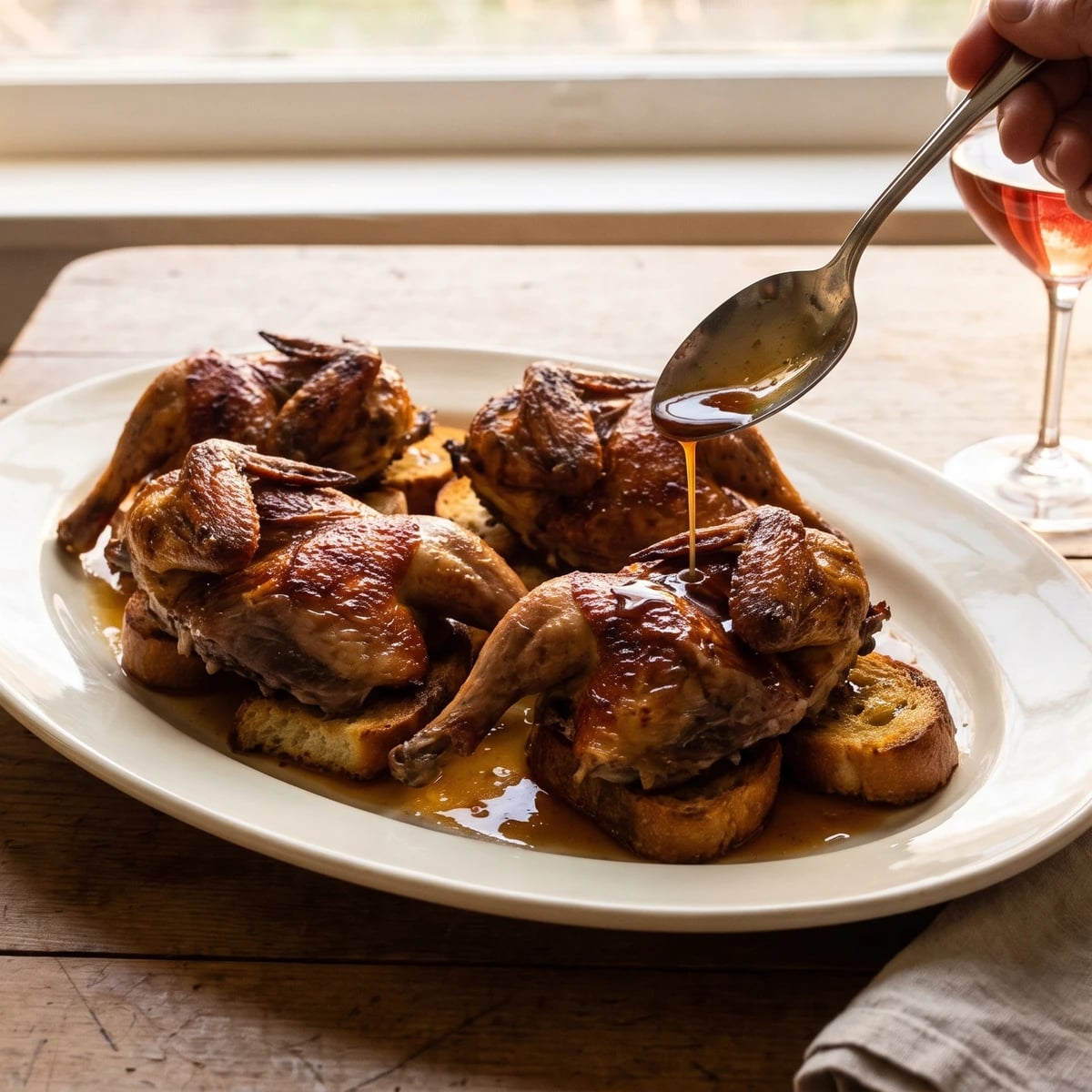
When the roast is right, the birds arrive deeply bronzed, their dark flesh moist beneath the skin, each half resting on a croûton that has caught the buttery drippings. The step that decides everything is the final temperature: begin probing early, protect the breasts if the legs lag behind, and don't trust color alone.

Prairie-hen belongs to the tallgrass and mixed-grass prairies of central North America, not to any French region; the classical French repertory received it through game markets and classified it beside grouse and hazel-hen for its delicate flesh. Its usual place was the roast, while mousse, mousseline, and salmis gave the kitchen other forms. The telling correction is that this bird was not meant to be hung for stronger flavor: it had to be worked very fresh, and for salmis its bitter skin and legs were kept out of the cullis.

The technique, the tradition, and the story behind every dish.

Discover Culinary Explorer

Ingredients

very fresh, oven-ready, legally harvested prairie-hens

Quantity

2 birds (1 to 1¼ lb / 450 to 570 g each)

unsmoked fatback

Quantity

4 thin slices (about 2½ oz / 70 g)

unsalted butter

Quantity

3 tablespoons (45 ml / 42 g)

divided

fine sea salt

Quantity

1½ teaspoons (7.5 ml / 9 g)

freshly ground black pepper

Quantity

½ teaspoon (2.5 ml / 1 g)

firm country bread

Quantity

4 slices (about 4 oz / 115 g)

cut ½ inch (1.25 cm) thick, crusts trimmed

water

Quantity

½ cup (120 ml / 120 g)

Equipment Needed

  • 12-inch (30 cm) ovenproof skillet or shallow roasting pan
  • Instant-read thermometer
  • Kitchen twine
  • Poultry shears or sturdy chef's knife
  • Small whisk

Instructions

  1. 1

    Inspect the birds

    Heat the oven to 450°F (230°C), with a rack in the upper-middle position. Remove the birds from the cold about 20 minutes before cooking. Do not rinse them. Pull away any pinfeathers, locate and remove visible shot, and trim bloodshot or badly bruised flesh without cutting needlessly into the breasts. Pat the cavities and skin thoroughly dry. A sound fresh bird smells clean and faintly mineral; if the surface is sticky or the smell is sour, don't cook it.

    Birds of similar size finish together. If one is noticeably smaller, begin checking it several minutes before the other.
  2. 2

    Render and brown

    Lay the fatback in a cold 12-inch (30 cm) ovenproof skillet and set it over medium heat. Cook for 3 to 4 minutes, just until it releases a clear film of fat and becomes pliable, then lift it out without letting it crisp. Season the birds inside and out with the salt and pepper, rub them with 1 tablespoon (15 ml / 14 g) of the butter, and raise the heat to medium-high. Brown them breast-side down for 2 minutes, then roll them briefly onto each side until the skin takes a definite golden color.

  3. 3

    Apply the barde

    Turn the birds breast-side up. Lay two slices of rendered fatback across each breast and secure them with kitchen twine; this is the barde, the protective layer that replaces constant turning and basting at a roasting spit. Keep the legs exposed so the heat can reach them. Set the skillet in the oven and roast for 10 minutes.

  4. 4

    Finish the roast

    Lower the oven to 425°F (220°C). Spoon the pan fat over the exposed legs and roast for another 6 minutes, then remove the barde and continue cooking for 4 to 8 minutes so the breasts regain their bronze surface. Begin checking early with an instant-read thermometer in the thickest breast and the innermost thigh, avoiding bone. Both places should reach 160°F (71°C) before resting. If the breasts arrive first, put the fatback back over them and turn the legs toward the rear of the oven while they finish in 2-minute intervals. Ça se rattrape.

  5. 5

    Rest and verify

    Transfer the birds to a warm rack or plate and cover them very loosely. Rest for 10 to 15 minutes, then verify that both breast and thigh have reached 165°F (74°C). If either remains below that mark, return the bird to the oven under its barde for 2 to 3 minutes and rest it again. This pause is part of the cooking, not empty time; it lets the heat finish its work and keeps the juices in the meat.

  6. 6

    Toast the croûtons

    While the birds rest, set the skillet over medium heat. Add 1 tablespoon (15 ml / 14 g) of the butter and lay in the bread. Fry until each croûton is crisp and deep gold on both sides, about 2 minutes per side, adding a spoonful of the rendered fat if the pan looks dry. Transfer the croûtons to a warm oval platter.

  7. 7

    Make the jus

    Pour away excess fat from the skillet but leave every brown deposit attached to the pan. Add the water and bring it to a brisk simmer, scraping until the fond dissolves. Reduce to about ⅓ cup (80 ml), then take the skillet off the heat and swirl in the remaining 1 tablespoon (15 ml / 14 g) butter. If the jus looks greasy instead of glossy, whisk in a teaspoon of hot water. Ça se rattrape: the little addition brings the butter and roasting juices together again.

  8. 8

    Carve and serve

    Remove the twine and split each bird lengthwise with poultry shears or a sturdy chef's knife, giving each serving breast and leg. Set one half on each croûton and spoon the jus over the cut flesh, leaving a crisp border of bread exposed. Bring the platter to the table at once. À table!

Chef Tips

  • Prairie-hen populations are closely regulated, and some are protected. Possess and cook only a legally harvested bird from a licensed source. Rarity is not seasoning.
  • Work the bird very fresh, exactly as the canonical entry directs. If it was frozen promptly after dressing, thaw it in the refrigerator and cook it the day it finishes thawing; don't hang it or leave it uncovered for days as you might with stronger game.
  • Use unsmoked fatback rather than smoked bacon. The barde is there to protect the lean breast and contribute clean fat, not to make delicate game taste chiefly of smoke.
  • If prairie-hen cannot be sourced legally, ruffed grouse is the closest practical cousin. Domestic guinea hen also accepts the method, but it is larger and milder, so roast by temperature rather than the timing given here.
  • The source permits salmis but gives a firm warning: discard the prairie-hen's bitter skin and legs before preparing any cullis. This roast keeps the bird whole because no flesh is being worked into that concentrated sauce.
  • Pour a light red Burgundy or another restrained Pinot Noir. Heavy, sweetly oaked wine overwhelms a bird whose virtue is delicacy.

Advance Preparation

  • This is not a make-ahead roast. Have the birds plucked, promptly eviscerated, and kept below 40°F (4°C), then cook them within 24 hours of receiving them.
  • The bread may be trimmed into croûtons and the ingredients measured up to 4 hours ahead. Keep the birds refrigerated until 20 minutes before cooking.
  • Leftovers should be chilled within 2 hours and eaten within 2 days. Remove the meat from the carcasses before storing so it cools quickly.

Frequently Asked Questions

Nutrition Information

1 serving (about 180g)

Calories
420 calories
Total Fat
24 g
Saturated Fat
11 g
Trans Fat
0.3 g
Unsaturated Fat
12 g
Cholesterol
110 mg
Sodium
1100 mg
Total Carbohydrates
14 g
Dietary Fiber
1 g
Sugars
1 g
Protein
37 g

Note: Chef personas and recipes are created with AI assistance. Cook with care: follow safe food-handling practices, check doneness with a thermometer when needed, and adapt for allergies and your kitchen.

Where cooking meets culture.

Culinary guides, cultural storytelling, and the editorial depth that makes cooking meaningful.

Discover Culinary Explorer

More from Poultry (Volaille) - Partridge (Perdrix et Perdreaux)

Browse the full collection