
Chef Juliette
John Dory (St. Pierre)
John Dory has the delicacy of sole and the firmness of turbot. A light flouring, a quick butter sauté, and nut-brown beurre noisette show exactly why looks never mattered.
A cooking platform built around craft, culture, and the stories behind what we eat.
Created by Chef Juliette
Based on No. 1915, Timbale de Cailles Tzarine, from Le Guide Culinaire (1907) by Auguste Escoffier
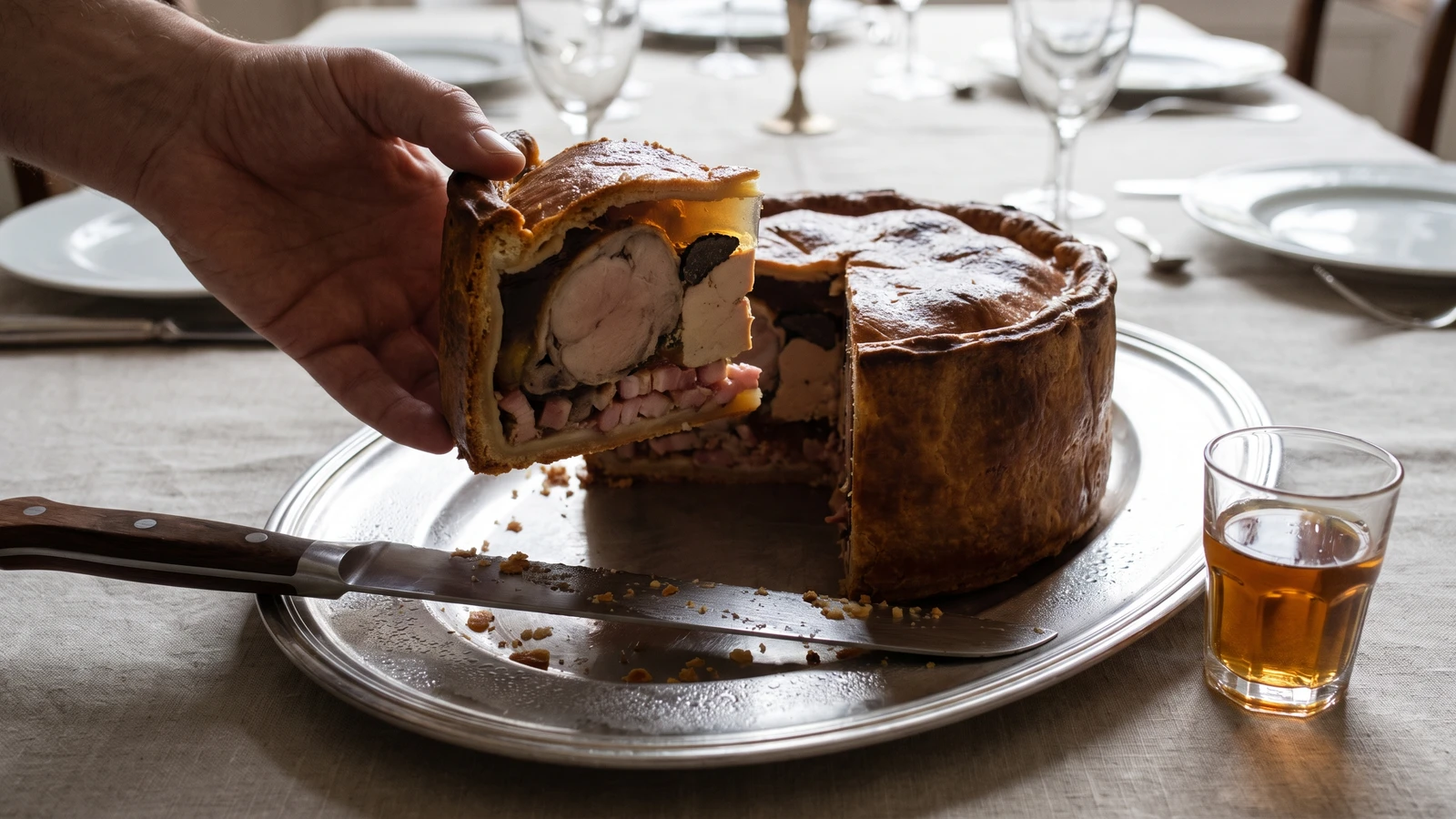
A bronze pastry timbale packed with whole quail, foie gras, bacon, and black truffles, then flooded with Madeira veal jelly and rested cold until every lavish quarter cuts clean.
Timbale de Cailles Tzarine (a molded quail, foie gras, and truffle pie) teaches the architecture of a cold pastry: the bake makes the shell, but the gelée, a savory set jelly, makes the slice. The one true thing to know before touching a pan is that the Madeira veal stock must set firmly enough to hold each bird, each black truffle, and the central foie gras in place. If the gelée is weak, the first cut empties the timbale; if it is tested cold, the quarters stand beautifully.
The original kitchen assumed a deep timbale mould, a pastry cook, a saucier, a pot of gelatinous veal stock never off the fire, and enough diners to justify a fortress of quail and truffles. Your honest equivalents are a deep 20-centimetre springform, four quails arranged one to each future quarter, and reduced veal stock strengthened with measured gelatin. The permanent stockpot and brigade scale are scaffolding, so they can go. The whole birds, whole foie gras, bacon lining, whole truffles, hot fill, and day or two in the cold are the dish, so they stay.
Once cut, the bronze crust frames a mosaic of quail, pale foie gras, black truffle, and amber Madeira jelly. It is extravagant, yes, but every richness also performs a structural job. Save your full attention for the cold-saucer test before you fill the baked timbale. Ça se rattrape if the jelly is weak, and that rescue is written into the method.
Timbale de Cailles Tzarine belongs to the Parisian grand-kitchen repertoire, where molded pastry cases carried game birds, foie gras, truffles, and fortified-wine jelly to formal celebration tables. Its Russian title does not make it a Russian household dish; in the French canon, Tzarine signals courtly abundance, while the actual grammar is pâté en croûte, filling baked inside pastry, charged with gelée through a vent, and matured cold before cutting.
Quantity
2¾ cups (650 ml / 330 g)
Quantity
1 teaspoon (5 ml / 6 g)
Quantity
11 tablespoons (165 ml / 155 g)
10 tablespoons cold and cubed for the pastry; 1 tablespoon softened for the mould
Quantity
6 to 7 tablespoons (90 to 105 ml / 90 to 105 g)
Quantity
16 thin slices (about 12 oz / 340 g)
Quantity
1 small lobe (about 12 oz / 340 g)
chilled
Quantity
4 (about 1½ lb / 680 g total)
giblets removed and patted dry
Quantity
6 small truffles (about 5 oz / 140 g)
peeled; cut 1 into quarters and leave 5 whole
Quantity
½ teaspoon (2.5 ml / 3 g)
Quantity
½ teaspoon (2.5 ml / 1 g)
Quantity
¼ teaspoon (1.25 ml / 0.5 g)
Quantity
3 cups (710 ml / 710 g)
Quantity
⅓ cup (80 ml / 80 g)
Quantity
4½ to 5½ teaspoons (22 to 27 ml / 15 to 18 g)
divided
| Ingredient | Quantity |
|---|---|
| all-purpose flour | 2¾ cups (650 ml / 330 g) |
| fine sea salt, for the pastry | 1 teaspoon (5 ml / 6 g) |
| unsalted butter10 tablespoons cold and cubed for the pastry; 1 tablespoon softened for the mould | 11 tablespoons (165 ml / 155 g) |
| ice water | 6 to 7 tablespoons (90 to 105 ml / 90 to 105 g) |
| unsmoked streaky bacon | 16 thin slices (about 12 oz / 340 g) |
| whole raw foie gras lobechilled | 1 small lobe (about 12 oz / 340 g) |
| oven-ready whole quailsgiblets removed and patted dry | 4 (about 1½ lb / 680 g total) |
| whole raw black trufflespeeled; cut 1 into quarters and leave 5 whole | 6 small truffles (about 5 oz / 140 g) |
| fine sea salt, for the foie gras | ½ teaspoon (2.5 ml / 3 g) |
| finely ground black pepper | ½ teaspoon (2.5 ml / 1 g) |
| ground allspice | ¼ teaspoon (1.25 ml / 0.5 g) |
| unsalted veal stock | 3 cups (710 ml / 710 g) |
| Madeira | ⅓ cup (80 ml / 80 g) |
| unflavored powdered gelatindivided | 4½ to 5½ teaspoons (22 to 27 ml / 15 to 18 g) |
Combine the flour with the pastry salt. Rub in the 10 tablespoons of cold butter until the mixture resembles coarse crumbs with a few lentil-sized pieces remaining. Add 6 tablespoons of ice water and gather the dough without kneading; if dry flour remains, add the final tablespoon a teaspoon at a time. The pâte ordinaire, the firm ordinary paste that supports the timbale, should hold together without becoming sticky. Divide it into two-thirds for the case and one-third for the lid, flatten both pieces, wrap, and chill for 1 hour.
Keep the foie gras whole and cold. Mix the ½ teaspoon salt, pepper, and allspice, then season every surface evenly, pressing the spices on lightly rather than kneading or breaking the lobe. Insert one truffle quarter into the cavity of each dry quail. Do not heavily season the birds; the bacon surrounding their breasts supplies salt as they bake.
Butter a deep 8-inch (20 cm) springform mould and wrap its exterior in two snug layers of foil. Roll the larger pastry piece about ⅛ inch (3 to 4 mm) thick and line the base and sides, leaving ¾ inch (2 cm) above the rim. Repair thin spots now with a pressed-on scrap. Coat the inside with overlapping bacon slices, carrying them across the base and up the walls with no broad gaps, and reserve enough bacon to cover the filling.
Stand the seasoned foie gras in the middle. Arrange the four quails upright around it, cavity openings uppermost and breasts pressed against the bacon, placing them at four equal points so the finished timbale can be cut between the birds. Pack the five whole peeled truffles into the spaces around the quails. Lay the reserved bacon over everything in an overlapping round, enclosing the filling without crushing it.
Roll the remaining pastry into a round slightly wider than the mould. Moisten the exposed pastry rim with a little ice water, set the lid over it, and pinch the two layers together firmly before trimming and crimping. Cut a ½-inch (1 cm) slit in the centre for the Madeira gelée. Reserve the pastry scraps for repairs, then chill the assembled timbale for 20 minutes while the oven heats to 400°F (200°C), or 375°F (190°C) with a fan.
Set the mould on a rimmed baking sheet and bake for about 1 hour 15 minutes. The pastry should be deeply bronze, and a thin thermometer inserted through the central slit into the thickest quail thigh should register 165°F (74°C). If the crust darkens too early, cover it loosely with foil. If a seam splits, press reserved pastry over the crack and continue baking; a crack discovered at the end can be patched and baked for 5 more minutes. Ça se rattrape.
While the timbale bakes, reserve ⅔ cup (150 ml) of the cold veal stock. Sprinkle 4½ teaspoons (15 g) gelatin over ½ cup (120 ml) of that reserve and leave it to swell. Boil the remaining stock until reduced to 1½ cups (360 ml), add the Madeira, and simmer for 2 minutes. Remove from the heat and dissolve the swollen gelatin in the reduction. Chill a teaspoonful on a cold saucer for 5 minutes: it must set firmly enough to cut, not merely wobble. If it slumps, bloom the reserved 1 teaspoon (3 g) gelatin in the remaining 2 tablespoons (30 ml) cold stock, whisk it into the rewarmed gelée, and test again. This is the step that decides the slice.
Let the baked timbale settle in its mould for 5 minutes. The gelée should be hot and entirely fluid but no longer boiling. Set a small funnel in the central slit and pour slowly, about ½ cup (120 ml) at a time, pausing between additions while the stock finds every space. Continue until the gelée remains visible at the opening. If a little seeps into the outer foil, stop for 10 minutes and try again; if it still runs, chill the timbale for 20 minutes, warm the gelée just until fluid, and continue filling.
Cool the filled timbale on a rack for no more than 1 hour, then refrigerate it uncovered until thoroughly cold. Cover once the crust and mould are cold, and leave it for 24 to 48 hours. The gelée firms, the foie gras settles, and the pastry absorbs just enough of the Madeira-scented juices to cut cleanly without becoming sodden. One cook, one stove, one evening of work, then the cold does the rest.
Release the springform while the timbale is fully chilled and transfer it to a serving platter. Follow the four spaces between the quails and cut through the pastry, central foie gras, truffles, and set gelée with long, gentle strokes, giving each serving one whole bird. Wipe the knife between cuts so the amber gelée and black truffle remain distinct. Let the portions stand for 15 minutes before serving. À table!
1 serving (about 500g)
Culinary guides, cultural storytelling, and the editorial depth that makes cooking meaningful.
Discover Culinary ExplorerChef Juliette
John Dory has the delicacy of sole and the firmness of turbot. A light flouring, a quick butter sauté, and nut-brown beurre noisette show exactly why looks never mattered.

Chef Juliette
Fresh haddock proves its delicacy in the meunière pan: a fine flour crust, moist pearly flakes, and beurre noisette sharpened with lemon and parsley, ready from one skillet in half an hour.

Chef Juliette
Éperlans à l’Anglaise turns small fish into a lesson in disciplined coating: boned smelts under a close, crisp crumb, pan-fried in clarified butter and finished with bright, half-melted maître d’hôtel butter.

Chef Juliette
Tiny smelts, shallot, mushrooms, white wine, gratin sauce, and fine bread raspings meet a fierce oven, where the fish must turn tender in the same breath the buttered crust bronzes.