
Chef Juliette
John Dory (St. Pierre)
John Dory has the delicacy of sole and the firmness of turbot. A light flouring, a quick butter sauté, and nut-brown beurre noisette show exactly why looks never mattered.
A cooking platform built around craft, culture, and the stories behind what we eat.
Created by Chef Juliette
Based on No. 1908, Cailles glacées au Romanée, from Le Guide Culinaire (1907) by Auguste Escoffier
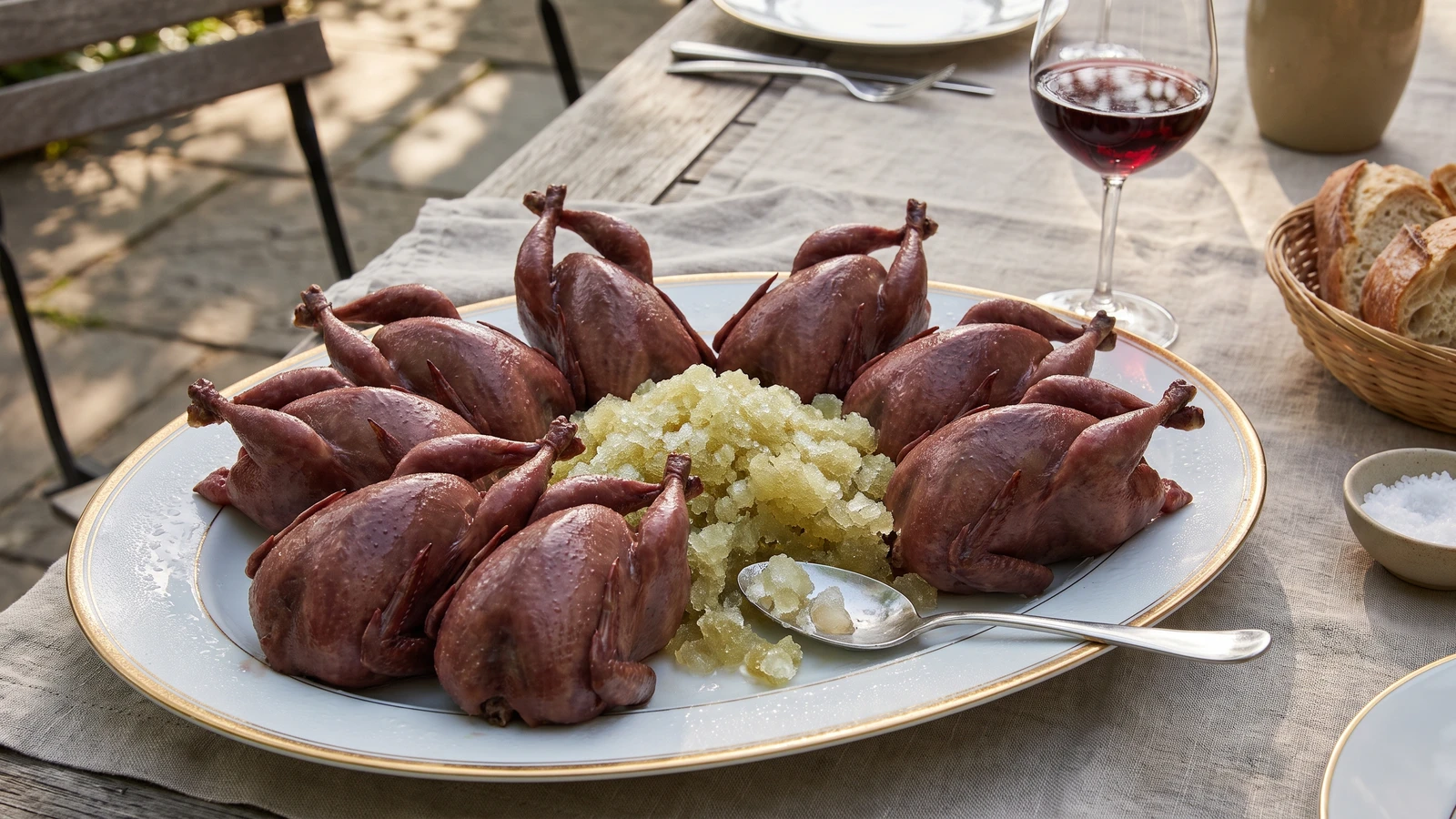
Two chilled quails per guest, wine-scented and tender, gathered around a sharp verjuice granité: a grand-kitchen composition made practical for one home cook without sweetening its vineyard logic.
Cailles glacées au Romanée (chilled quails poached with Romanée wine) teaches a severe and beautiful lesson: cold food must be cooked more gently and seasoned more exactly, because chilling hides no roughness and mutes every quiet flavor. The dish should arrive wine-scented rather than wine-soaked, the little birds tender, the verjuice ice sharp and granular beside them. Sugar has no work here; the granité is savoury, and that clean vineyard acidity is what makes the next bite of quail feel new.
The book's entry assumed a stockpot never off the fire, Romanée close at hand, and enough cooks to poach a service of birds while a saucier tended the liquor and someone else raked the ice. At home, good light poultry stock, a sound red Burgundy from Pinot Noir, one narrow pot, and a shallow freezer pan do the same honest work. True Romanée is too scarce and dear to demand by the half-bottle; using a fine but attainable red Burgundy is the one ingredient change, made to preserve the wine's Burgundian perfume without turning supper into a cellar auction. The brigade volume and extra hands are scaffolding and can go. Gentle wine-stock poaching and a sugarless verjuice granité are the dish, so they stay.
Make the granité first and let the freezer work while the quails cook and chill. One cook, one stove, one evening. Keep the poaching liquor below a simmer: that barely trembling surface is the step that decides the dish.
Cailles glacées au Romanée belongs to the cold grand-kitchen table, while Romanée points precisely to Vosne-Romanée in Burgundy's Côte de Nuits. It is not a farmhouse red-wine braise: the birds are gently poached in wine-enriched stock, chilled, and set around verjuice ice, whose tart grape bite keeps the composition savoury. Here glacées means thoroughly chilled, not lacquered with sugar, and the verjuice joins Burgundy's ripe wine to the unfermented grape juice French cooks have used for generations.
Quantity
8 (about 2¾ pounds / 1.25 kg total)
necks and giblets removed; pinfeathers checked
Quantity
2 teaspoons (10 ml / 12 g)
divided
Quantity
4 cups (960 ml / 960 g)
Quantity
2 cups (480 ml / 475 g)
Quantity
2 cups (480 ml / 500 g)
chilled
| Ingredient | Quantity |
|---|---|
| whole farmed quailsnecks and giblets removed; pinfeathers checked | 8 (about 2¾ pounds / 1.25 kg total) |
| fine sea saltdivided | 2 teaspoons (10 ml / 12 g) |
| light unsalted poultry stock | 4 cups (960 ml / 960 g) |
| Romanée wine or dry red Burgundy made from Pinot Noir | 2 cups (480 ml / 475 g) |
| bottled white verjuicechilled | 2 cups (480 ml / 500 g) |
Stir the chilled verjuice with ¼ teaspoon (1.25 ml / 1.5 g) of the salt until dissolved. Pour it into a shallow metal pan in a layer no deeper than ½ inch (1.25 cm), then freeze for 40 to 50 minutes, until ice gathers around the edges. Rake the frozen edges toward the center with a fork and return the pan to the freezer. Repeat every 25 to 30 minutes until the whole pan holds loose, opaque crystals, about 2½ to 3 hours. If it freezes into a solid slab, don't add sugar or water. Ça se rattrape: leave it at room temperature for five minutes, then rake firmly from one corner until the crystals loosen. Cover and keep frozen.
Check the quails for pinfeathers, then pat them completely dry inside and out. Fold each wing tip behind the back and tie the legs together with kitchen twine so the birds keep their shape. Season them evenly with 1 teaspoon (5 ml / 6 g) of the salt and refrigerate for 15 minutes. Do not brown them. A seared fond belongs to another preparation; this one depends on the clean perfume of wine and stock.
Combine the poultry stock and wine in a narrow 5 to 6-quart (4.7 to 5.7-liter) pot. Bring them just to a boil and hold there for two minutes, skimming any foam, then lower the heat until the liquid registers 180°F to 185°F (82°C to 85°C). Dissolve the remaining ¾ teaspoon (3.75 ml / 4.5 g) salt in the liquor. It should taste fragrant, lightly seasoned, and brisk with wine, not salty enough to resemble soup.
Lower four quails into the liquor in a single layer and lay a parchment circle directly on the surface. Hold the liquid between 175°F and 185°F (79°C and 85°C), with only an occasional tremor at the edge. Turn the birds once if they are not completely covered and poach for 14 to 18 minutes, until the thickest part of each inner thigh reaches 165°F (74°C). Transfer them to a tray and repeat with the remaining quails. If the liquor breaks into a boil and the skins begin to tighten, lift the pot off the heat and uncover it immediately. Ça se rattrape: wait until the temperature falls below 185°F (85°C), then continue gently.
Return the first batch of quails to the pot so all eight rest in the poaching liquor. Set the pot in a large ice-water bath and turn the birds gently with clean tongs while the liquor cools. Replace melting ice as needed and bring the liquor below 70°F (21°C) within 30 minutes. Cover and refrigerate until the quails and liquor reach 40°F (4°C) or colder, at least 2 hours. The quick cooling protects both their texture and the table; don't leave the warm pot on the counter.
Lift the chilled quails from the liquor, let them drain well, and blot their skins carefully without rubbing away the wine color. Remove the twine and arrange the birds on a rack in the refrigerator for 20 minutes while the serving platter chills. Do not rinse or oil them. Their finish should be cool and lightly satin-like, not greasy.
Rake the granité once more, then mound three quarters of it into an irregular rocher, or rock, at the center of the chilled platter. Arrange the eight quails closely around it, breasts facing outward and legs toward the ice. Crown the rocher with the reserved loose crystals and serve two quails to each guest. If its edges begin to slump, spoon away the melted verjuice and replace it with crystals from the freezer. For an outdoor table, assemble only when everyone is seated and set the platter over a second tray of ice. À table!
1 serving (about 295g)
Culinary guides, cultural storytelling, and the editorial depth that makes cooking meaningful.
Discover Culinary ExplorerChef Juliette
John Dory has the delicacy of sole and the firmness of turbot. A light flouring, a quick butter sauté, and nut-brown beurre noisette show exactly why looks never mattered.

Chef Juliette
Fresh haddock proves its delicacy in the meunière pan: a fine flour crust, moist pearly flakes, and beurre noisette sharpened with lemon and parsley, ready from one skillet in half an hour.

Chef Juliette
Éperlans à l’Anglaise turns small fish into a lesson in disciplined coating: boned smelts under a close, crisp crumb, pan-fried in clarified butter and finished with bright, half-melted maître d’hôtel butter.

Chef Juliette
Tiny smelts, shallot, mushrooms, white wine, gratin sauce, and fine bread raspings meet a fierce oven, where the fish must turn tender in the same breath the buttered crust bronzes.