
Chef Juliette
John Dory (St. Pierre)
John Dory has the delicacy of sole and the firmness of turbot. A light flouring, a quick butter sauté, and nut-brown beurre noisette show exactly why looks never mattered.
A cooking platform built around craft, culture, and the stories behind what we eat.
Created by Chef Juliette
Based on No. 1907, Cailles glacées Reine Amelie, from Le Guide Culinaire (1907) by Auguste Escoffier
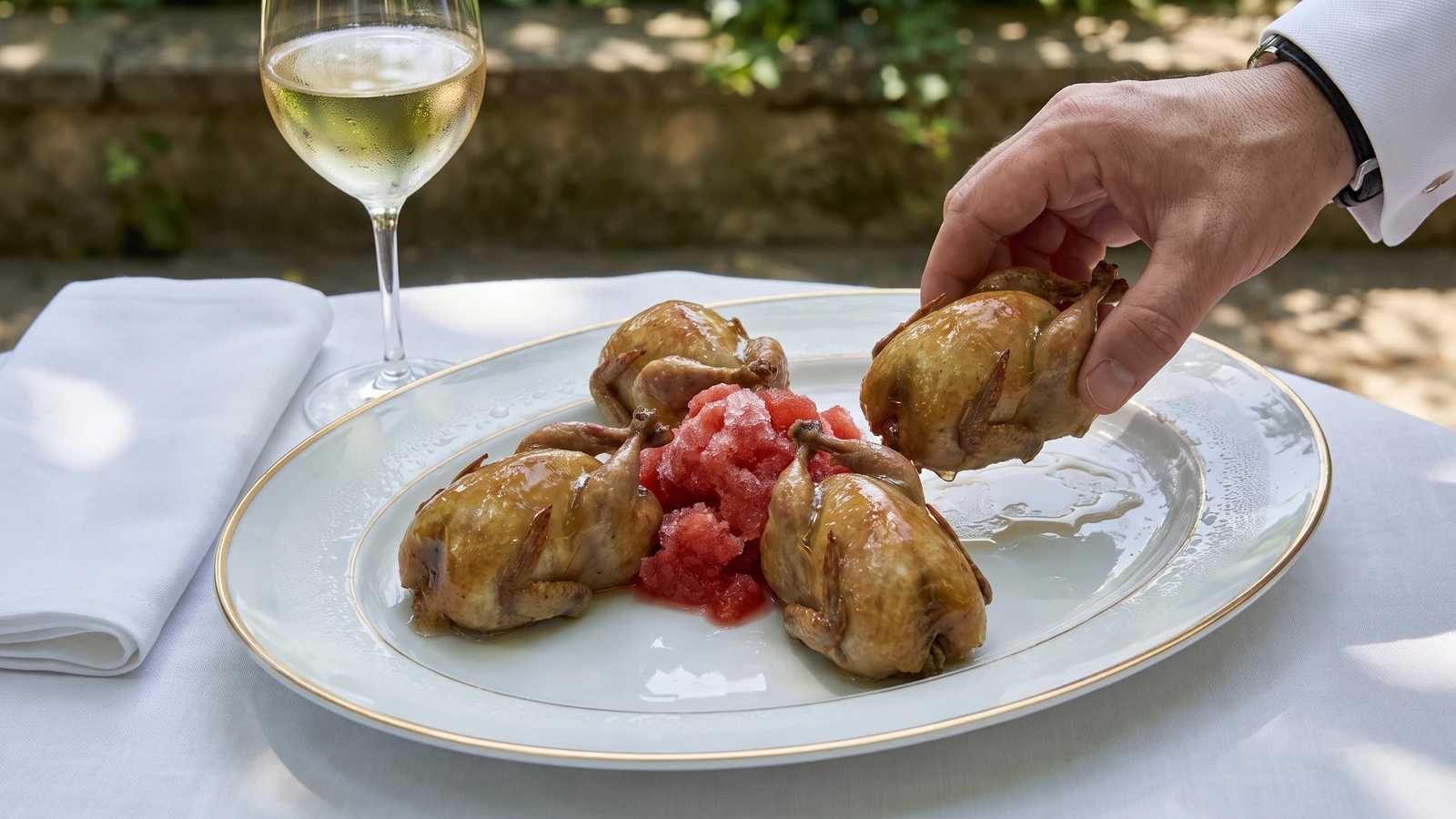
Cold glazed quails encircle a crimson tomato granité, a formal summer composition made practical at home, where exact seasoning and a clear pan gelée do the real work.
Cailles glacées Reine Amélie (Queen Amélie's cold glazed quails) teaches the governing rule of cold cookery: season for the temperature at which the food will be eaten. Tomato juice that tastes perfectly balanced from the counter becomes timid once frozen, while a warm pan reduction loses some of its force when set into gelée. Taste both cold before you commit them. That is the one true thing to know before touching a pan.
The original gives only two lines because it assumed a cook who already knew the “usual way” with quail, a stock never off the fire, a saucier to turn the roasting fond into a glaze, and a cold room with another pair of hands to rake the granité. A salamander has no work in this chilled composition. Here the banquet display becomes four birds, a cup of unsalted stock reduced in their roasting pan, and a little powdered gelatin in place of prepared game gelée. A shallow metal tray and a fork replace the dedicated ice equipment. The separate stockpot and extra hands are brigade scaffolding and can go; the cold gloss on the quails and the rock of savoury tomato granité are the dish, and they stay.
At the table, the quails should look burnished beneath a clear, delicate sheen, gathered around tomato ice as red as crushed garnet. Rich bird, sharp cold tomato, then rich bird again. The contrast is grand without being fussy, one cook, one stove, one afternoon into evening. The decisive step is still the simplest: chill a spoonful of tomato juice, taste it, and finish its seasoning before the freezer takes over.
Cailles glacées Reine Amélie belongs to the Parisian grand-kitchen repertory of cold poultry displays, in which small birds were glazed with gelée and arranged around a frozen centre for formal summer service. Its title points to Amélie of Orléans, queen consort of Portugal, reflecting the classical habit of naming menu pieces for royal and public figures rather than for a place. The tomato granité does not make the dish Provençal; this is a composed Paris cold-service dish, with tomato used for acidity, colour, and a melting contrast to rich quail.
Quantity
6 medium (about 2 lb / 900 g)
cored and roughly chopped
Quantity
1 tablespoon (15 ml / 15 g)
Quantity
1 teaspoon (5 ml / 4 g)
Quantity
2 teaspoons (10 ml / 12 g), divided, plus more to taste
Quantity
1/2 teaspoon (2.5 ml / 1 g), divided
Quantity
4 (about 6 oz / 170 g each)
giblets removed
Quantity
2 tablespoons (30 ml / 28 g)
melted
Quantity
1 cup (240 ml / 240 g)
Quantity
1 1/2 teaspoons (7.5 ml / 4.5 g)
Quantity
2 tablespoons (30 ml / 30 g)
| Ingredient | Quantity |
|---|---|
| ripe tomatoescored and roughly chopped | 6 medium (about 2 lb / 900 g) |
| fresh lemon juice | 1 tablespoon (15 ml / 15 g) |
| granulated sugar | 1 teaspoon (5 ml / 4 g) |
| fine sea salt | 2 teaspoons (10 ml / 12 g), divided, plus more to taste |
| ground white pepper | 1/2 teaspoon (2.5 ml / 1 g), divided |
| oven-ready quailsgiblets removed | 4 (about 6 oz / 170 g each) |
| unsalted buttermelted | 2 tablespoons (30 ml / 28 g) |
| unsalted chicken stock | 1 cup (240 ml / 240 g) |
| unflavored powdered gelatin | 1 1/2 teaspoons (7.5 ml / 4.5 g) |
| cold water | 2 tablespoons (30 ml / 30 g) |
Purée the tomatoes until completely fluid, then pass them through a fine sieve, pressing firmly to extract about 3 cups (710 ml / 710 g) of smooth juice. Stir in the lemon juice, sugar, 1 teaspoon (5 ml / 6 g) of the salt, and 1/4 teaspoon (1.25 ml / 0.5 g) of the white pepper. Chill a spoonful over ice and taste it cold. It should seem bright and slightly more seasoned than ordinary tomato juice, because freezing will mute it. If the cold spoonful tastes flat, correct the base now; once frozen, scattered salt cannot dissolve evenly.
Pour the seasoned tomato juice into a shallow metal tray, making a layer no deeper than 1/2 inch (1.25 cm). Freeze for 45 minutes, then draw a sturdy fork through the frozen edges and mix them into the softer centre. Repeat every 30 minutes until the granité forms loose, distinct crimson crystals, about 2 1/2 to 3 hours altogether. If it freezes into a solid slab, don't attack it with a knife. Ça se rattrape: leave it in the refrigerator for 10 minutes, then scrape firmly with the fork and return the crystals to the freezer.
Heat the oven to 450°F (230°C). Pat the quails completely dry, fold the wing tips beneath them, and tie the legs together if they sit untidily. Season the cavities and skins with the remaining 1 teaspoon (5 ml / 6 g) salt and 1/4 teaspoon (1.25 ml / 0.5 g) white pepper, then brush them all over with the melted butter. Set them breast-side up in a small roasting pan and roast for 12 to 15 minutes, basting once, until deeply bronzed and an instant-read thermometer inserted into the thickest thigh without touching bone registers 165°F (74°C). If the breasts color too quickly, shield them loosely with foil while the thighs finish.
Transfer the quails to a wire rack and let them cool for 20 minutes, then refrigerate them uncovered until thoroughly cold. Meanwhile, set the roasting pan over medium heat, add the chicken stock, and scrape every browned morsel of fond from the pan floor. Simmer until reduced by half to about 1/2 cup (120 ml / 120 g), then strain and skim away the surface fat. Sprinkle the gelatin over the cold water and leave it for 5 minutes, then whisk it into the hot reduction. This is the gelée, a savoury jelly glaze. Taste and season while it is still fluid, remembering again that cold softens salt.
Cool the gelée over a bowl of ice until it becomes lightly syrupy but has not set. Place the cold quails on their rack over a tray and brush each with a very thin, even coat. Refrigerate for 8 to 10 minutes, then repeat twice, letting every layer set before adding the next. Thick gelée looks rubbery, so patience, not quantity. If it runs straight off, either the birds are not cold enough or the gelée is too warm; chill both briefly. If it sets in the bowl, warm it gently over hot water until fluid again. Ça se rattrape.
Chill a large oval platter and a serving spoon. Rake the granité once more, then pile it into an irregular rock at the centre of the platter, working quickly so the crystals remain distinct. Arrange the four glazed quails breast-side up in a close ring around it. Bring the platter straight to the table; for an outdoor meal, nest it over a larger tray of ice and keep it out of direct sun. The gelée should gleam, the tomato should remain crystalline, and the first spoonful should taste more savoury than sweet. À table!
1 serving (about 320g)
Culinary guides, cultural storytelling, and the editorial depth that makes cooking meaningful.
Discover Culinary ExplorerChef Juliette
John Dory has the delicacy of sole and the firmness of turbot. A light flouring, a quick butter sauté, and nut-brown beurre noisette show exactly why looks never mattered.

Chef Juliette
Fresh haddock proves its delicacy in the meunière pan: a fine flour crust, moist pearly flakes, and beurre noisette sharpened with lemon and parsley, ready from one skillet in half an hour.

Chef Juliette
Éperlans à l’Anglaise turns small fish into a lesson in disciplined coating: boned smelts under a close, crisp crumb, pan-fried in clarified butter and finished with bright, half-melted maître d’hôtel butter.

Chef Juliette
Tiny smelts, shallot, mushrooms, white wine, gratin sauce, and fine bread raspings meet a fierce oven, where the fish must turn tender in the same breath the buttered crust bronzes.