
Chef Juliette
John Dory (St. Pierre)
John Dory has the delicacy of sole and the firmness of turbot. A light flouring, a quick butter sauté, and nut-brown beurre noisette show exactly why looks never mattered.
A cooking platform built around craft, culture, and the stories behind what we eat.
Created by Chef Juliette
Based on No. 1905, Cailles glacées Carmen, from Le Guide Culinaire (1907) by Auguste Escoffier
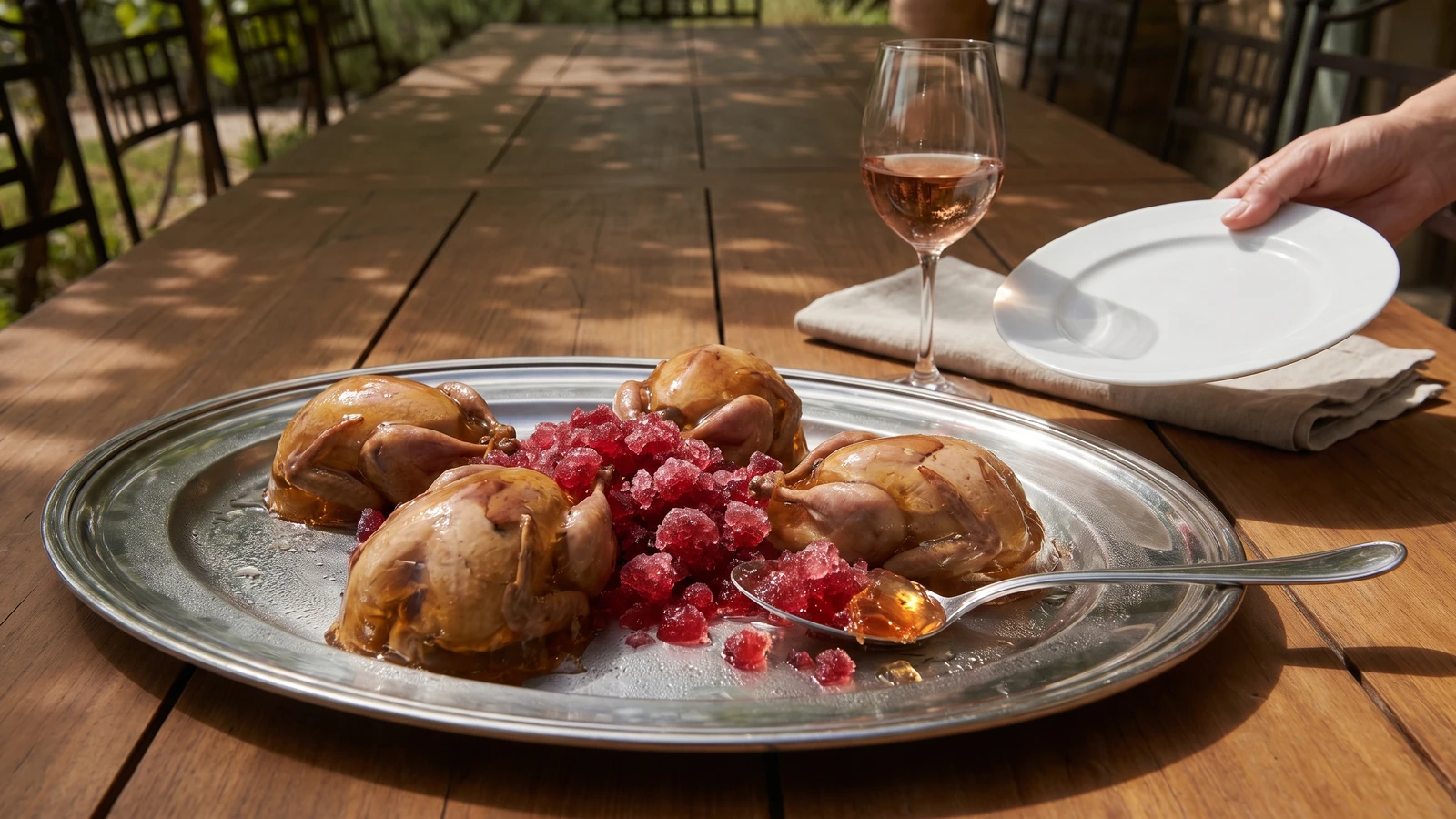
Four tender quail moulds shine under clear aspic around a ruby rock of pomegranate granité, a cold main whose elegance depends on contrast, careful chilling, and one strict rule: freeze the fruit syrup without stirring.
Cailles glacées Carmen (chilled glazed quails with pomegranate granité) teaches the discipline of cold contrast. The savory birds must remain tender and full-flavored beneath their clear aspic, while the crimson fruit ice stays bright and lightly grained. One thing decides the effect before a pan is touched: the granité freezes undisturbed and is scraped only when the platter is ready.
The old entry is one line because the grand kitchen around it supplied what the page did not: moulded birds from the garde-manger, clear stock never off the fire, and a saucier to reduce it. The salamander, so useful elsewhere in the canon, has no place in this cold dish. At home, a saucepan, a fine sieve, measured gelatin, and four small ramekins provide the honest equivalent.
The brigade's separate quail preparation is consolidated here. The birds are browned, gently poached, boned after cooking, and rebuilt one per mould in their own seasoned liquor. That changes the labor, not the composition. The separate aspic stockpot is scaffolding; the individual quails and the unstirred pomegranate rock are the dish. One cook, one stove, one evening, with the work finished before the table fills.
Cailles glacées Carmen belongs to the Parisian grand-kitchen cold table rather than to a provincial French kitchen, where the garde-manger moulded small birds in aspic for buffets and formal suppers. Carmen is a repertory title, not a claim of Spanish provenance; such names often announced a visual association, here the deep crimson pomegranate ice against pale, glossy quail. The entry's brevity reflects a kitchen of standing preparations, but its defining arrangement is precise: the moulded quails encircle a rock of pomegranate granité.
Quantity
2 cups (480 ml / 500 g)
Quantity
½ cup (120 ml / 100 g)
Quantity
½ cup (120 ml / 120 g)
for the granité
Quantity
1 tablespoon (15 ml / 15 g)
Quantity
4, about 6 ounces (170 g) each
Quantity
1¼ teaspoons (6 ml / 7 g)
divided
Quantity
¼ teaspoon (1 ml / 0.5 g)
Quantity
2 tablespoons (30 ml / 28 g)
Quantity
1 (55 g)
thinly sliced
Quantity
¼ cup (60 ml / 60 g)
Quantity
2 cups (480 ml / 480 g)
Quantity
2 sprigs
Quantity
1
Quantity
1 tablespoon plus up to 1 teaspoon (20 ml / 13 g)
divided
Quantity
¼ cup (60 ml / 60 g)
for blooming the gelatin
| Ingredient | Quantity |
|---|---|
| unsweetened 100% pomegranate juice | 2 cups (480 ml / 500 g) |
| granulated sugar | ½ cup (120 ml / 100 g) |
| waterfor the granité | ½ cup (120 ml / 120 g) |
| fresh lemon juice | 1 tablespoon (15 ml / 15 g) |
| oven-ready quails | 4, about 6 ounces (170 g) each |
| fine sea saltdivided | 1¼ teaspoons (6 ml / 7 g) |
| finely ground white pepper | ¼ teaspoon (1 ml / 0.5 g) |
| unsalted butter | 2 tablespoons (30 ml / 28 g) |
| large shallotthinly sliced | 1 (55 g) |
| dry white wine | ¼ cup (60 ml / 60 g) |
| clear unsalted poultry stock | 2 cups (480 ml / 480 g) |
| thyme | 2 sprigs |
| bay leaf | 1 |
| powdered gelatindivided | 1 tablespoon plus up to 1 teaspoon (20 ml / 13 g) |
| cold waterfor blooming the gelatin | ¼ cup (60 ml / 60 g) |
Stir the sugar and ½ cup (120 ml) water over medium heat just until the liquid turns clear. Remove it immediately and cool completely. Stir in the pomegranate and lemon juices, strain into a shallow metal tray, and freeze on a level shelf without touching it for at least 5 hours. Do not stir the syrup as it freezes. Stirring produces small, heavy crystals, while Cailles glacées Carmen needs a light grain that can be piled into a rock. If you stir it by habit, let it freeze firm again and scrape only at serving time.
Season the quails inside and out with 1 teaspoon of the salt and all the white pepper, then leave them for 20 minutes. Pat every surface dry. Melt the butter in a wide lidded sauté pan over medium-high heat, and when its foam subsides, brown the quails on the breast, back, and both sides until their skin is a confident bronze. Work in two batches if the pan is crowded. Pale birds give nothing to the aspic beneath its gloss.
Lower the heat and soften the shallot in the same pan without browning it. Add the wine and scrape up the fond, then reduce the wine by half. Pour in the poultry stock, add the thyme and bay leaf, and bring the liquor to the barest tremble. Return the quails, cover, and poach gently for 10 to 14 minutes, turning once, until the thickest part of a thigh reaches 165°F (74°C). If the liquor begins boiling hard, pull the pan from the heat and add a spoonful of cold water before continuing. A boil tightens these little birds very quickly.
Lift the quails onto a tray. Strain the cooking liquor through a fine sieve lined with damp cheesecloth, without pressing the shallot, then skim away every trace of surface fat. Boil the liquor until 1¾ cups (420 ml) remain. Meanwhile, bloom 1 tablespoon (10 g) gelatin in 3 tablespoons (45 ml) of the cold water for 5 minutes. Take the liquor from the heat, dissolve the bloomed gelatin in it, and season with the remaining salt. Chill a teaspoonful on a saucer for 5 minutes: it should tremble but hold its shape. If it remains loose, bloom the reserved teaspoon of gelatin in the remaining tablespoon of water and dissolve it into the warm liquor. If it sets rubbery, warm it gently and add 2 tablespoons of water. Ça se rattrape.
While the birds remain barely warm, lift off each breast and leg, keeping the pieces as neat as possible, then strip the remaining meat from the carcasses and check carefully for small bones. Chill four 6-ounce (180 ml) ramekins. Spoon a thin layer of aspic into each and refrigerate until set. Arrange one quail's breast meat smooth-side down in each mould, place the leg meat around it, and pack the smaller pieces into the centre. Cool the remaining aspic over ice until slightly syrupy, then spoon it into every gap and cover the meat completely. Tap each mould once against a folded towel to release trapped air. If the aspic sets in the bowl, warm it gently until fluid again.
Refrigerate the quail moulds uncovered until thoroughly cold, then cover and chill for at least 4 hours. Leave the granité entirely undisturbed until it is frozen firm, then cover its tray without scraping the surface. The brigade's separate aspic stockpot and extra pair of hands are gone, but the moulding and quiet freezing stay. Those are the dish.
Chill a low oval platter for 30 minutes. Dip each mould in warm water for 3 to 5 seconds, invert it onto the platter, and arrange the four glazed quails evenly around the centre. If one clings, warm the mould for another 2 seconds rather than forcing it with a knife. At the last possible moment, rake the frozen pomegranate mixture into loose crystals with a sturdy fork and pile them high in the centre as an angular rock. Do not press them into a smooth mound. Carry the platter straight to the table; outdoors, set it over a larger tray of ice if it must wait. À table!
1 serving (about 380g)
Culinary guides, cultural storytelling, and the editorial depth that makes cooking meaningful.
Discover Culinary ExplorerChef Juliette
John Dory has the delicacy of sole and the firmness of turbot. A light flouring, a quick butter sauté, and nut-brown beurre noisette show exactly why looks never mattered.

Chef Juliette
Fresh haddock proves its delicacy in the meunière pan: a fine flour crust, moist pearly flakes, and beurre noisette sharpened with lemon and parsley, ready from one skillet in half an hour.

Chef Juliette
Éperlans à l’Anglaise turns small fish into a lesson in disciplined coating: boned smelts under a close, crisp crumb, pan-fried in clarified butter and finished with bright, half-melted maître d’hôtel butter.

Chef Juliette
Tiny smelts, shallot, mushrooms, white wine, gratin sauce, and fine bread raspings meet a fierce oven, where the fish must turn tender in the same breath the buttered crust bronzes.