Culinary Explorer

A cooking platform built around craft, culture, and the stories behind what we eat.
Discover Culinary Explorer
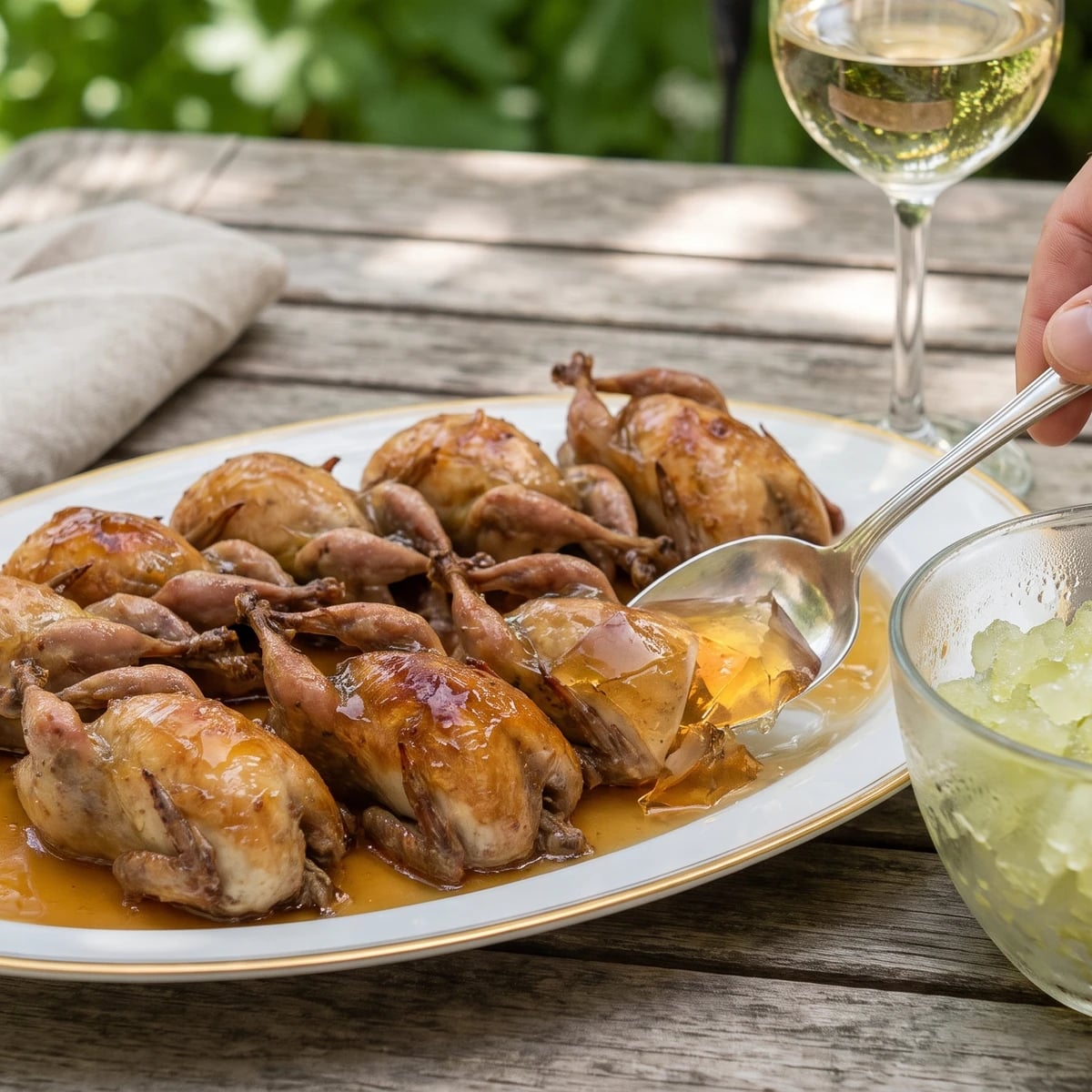
Cailles glacées au Granite

Cailles glacées au Granite

Created by Chef Juliette

Based on No. 1903, Cailles glacées au Granite, from Le Guide Culinaire (1907) by Auguste Escoffier

Cailles glacées teach precision, not severity: roast the birds gently, capture their fond in a clear trembling jelly, then serve them beside sharp green-grape granité at the last possible moment.

Main Dishes
French
Outdoor Dining
Make Ahead
Special Occasion
1 hr
Active Time
1 hr cook8 hr total
Yield4 servings

Cailles glacées au Granité (chilled glazed quails with scraped grape ice) teaches that cold food requires more seasoning, greater clarity, and stricter timing than hot food. Glacées means coated in a clear, softly set aspic, not frozen; the granité alone is ice. The one true thing before touching a pan is this: every component must be fully cold, while the jelly must tremble rather than bounce.

The grand kitchen assumed a saucier, clear poultry stock never off the fire, room for trays of birds receiving coat after coat of aspic, and a freezer watched by another pair of hands. A salamander, useful to so much of the canon, has no work in this cold dish. At home, good unsalted chicken stock gathers the quail fond, powdered gelatin supplies the body that a long-made stock would carry, and one shallow serving dish replaces the repeated glazing. Those many coats were brigade scaffolding. The roasted birds, savory jelly, tart granité, and final deep chill are the dish, and they stay.

This scale gives eight quails, two for each person, and leaves the refrigerator to do most of the work. Taste the warm liquor boldly, then test a spoonful in the cold before pouring it around the birds. If the aspic sets too firmly or too loosely, ça se rattrape, and the method tells you how. That cold set test is the step that matters most.

Cailles glacées au Granité belongs to the Parisian grand-kitchen repertory of cold summer entrées and buffet dishes, rather than to the larder of any single French region. Its pairing of savory aspic with a sweet-sharp scraped fruit ice reflects formal service devised for hot weather and hotter countries, where the contrast of jelly and granité was prized as much for temperature as taste. Glacées is often misunderstood here: it names the quails' glossy aspic coating, while granité names the frozen element.

The technique, the tradition, and the story behind every dish.

Discover Culinary Explorer

Ingredients

seedless green grapes

Quantity

4 cups (960 ml / 600 g)

washed and stemmed

water for the granité

Quantity

½ cup (120 ml / 120 g)

granulated sugar

Quantity

⅓ cup (80 ml / 65 g)

fresh lemon juice for the granité

Quantity

2 tablespoons (30 ml / 30 g)

whole oven-ready quails

Quantity

8 (about 3 pounds / 1.35 kg total)

fine sea salt

Quantity

2½ teaspoons (12.5 ml / 15 g)

divided

finely ground white pepper

Quantity

½ teaspoon (2.5 ml / 1 g)

divided

unsalted butter

Quantity

3 tablespoons (45 ml / 42 g)

medium shallots

Quantity

2 (about ¾ cup / 120 g)

thinly sliced

medium carrot

Quantity

1 (about ½ cup / 75 g)

finely diced

large celery stalk

Quantity

1 (about ½ cup / 60 g)

finely diced

dry white wine

Quantity

1 cup (240 ml / 240 g)

clear unsalted chicken stock

Quantity

4 cups (960 ml / 960 g)

fresh thyme

Quantity

4 sprigs

bay leaf

Quantity

1

powdered gelatin

Quantity

5 teaspoons (25 ml / 15 g)

cold water for blooming the gelatin

Quantity

⅓ cup (80 ml / 80 g)

fresh lemon juice for the aspic

Quantity

1 tablespoon (15 ml / 15 g)

powdered gelatin for correcting a soft set (optional)

Quantity

1 teaspoon (5 ml / 3 g)

cold water for the optional gelatin correction (optional)

Quantity

1 tablespoon (15 ml / 15 g)

Equipment Needed

  • 12-inch (30 cm) heavy skillet
  • 13 by 18-inch (33 by 46 cm) rimmed sheet pan with wire rack
  • 9 by 13-inch (23 by 33 cm) shallow metal freezer tray
  • Blender and fine-mesh sieve
  • 2½-quart (2.4-liter) shallow oval serving dish
  • Instant-read thermometer
  • Pastry brush

Instructions

  1. 1

    Freeze the granité

    Blend the grapes until completely liquid, then pass them through a fine-mesh sieve, pressing enough to extract the juice without forcing skins through. Heat the ½ cup water with the sugar just until the grains disappear, then cool it and combine it with the grape juice and 2 tablespoons lemon juice. The mixture should taste bright and slightly sweeter than you want at the table, because freezing mutes both sweetness and aroma. Pour it into a shallow metal tray, no deeper than ¾ inch (2 cm), and freeze. After 30 minutes, rake the icy edges into the liquid with a fork; repeat every 30 minutes while you prepare the quails, until loose crystals fill the tray.

  2. 2

    Brown and roast

    Heat the oven to 425°F (220°C). Dry the quails thoroughly, including their cavities, then season them with 1½ teaspoons of the salt and half the white pepper. Melt the butter in a wide skillet over medium-high heat and brown the birds in batches, turning until the breasts and legs are richly bronze. Transfer them breast-side up to a rimmed sheet pan and roast for 10 to 14 minutes, until the deepest part of each thigh reaches 165°F (74°C). Reserve the skillet and every resting juice. Cool the birds on a rack for 20 minutes, then refrigerate them uncovered until fully cold; cover them once chilled. A warm bird melts aspic on contact, so patience here is part of the dish.

  3. 3

    Build the quail liquor

    Reserve ½ cup (120 ml) of the chicken stock for adjusting the aspic. Lower the heat beneath the quail skillet, add the shallots, carrot, and celery to the butter and browned fond, and cook for 6 to 8 minutes until tender without scorching the pan floor. Pour in the wine and scrape up every bronze speck, then reduce until about one-third remains. Add the remaining stock, thyme, bay leaf, reserved quail juices, remaining salt, and remaining white pepper. Hold at a bare simmer for 25 minutes. Strain through a damp fine-mesh sieve, skim away every bead of fat, and measure the liquor. Reduce it to 3 cups (720 ml) if you have more; if you have less, add enough reserved stock to reach that mark. This measured reduction keeps the flavor and gelatin ratio honest.

  4. 4

    Set the aspic

    Sprinkle the 5 teaspoons gelatin evenly over the ⅓ cup cold water and leave it for 10 minutes to bloom. Warm the measured quail liquor until hot but not boiling, remove it from the heat, and stir in the bloomed gelatin and 1 tablespoon lemon juice until completely dissolved. Spoon a tablespoon onto a cold saucer and refrigerate it for 8 minutes. It should set clearly and tremble when nudged. If it is rubbery, rewarm the liquor gently and add reserved stock a tablespoon at a time. If it flows like broth, bloom the optional teaspoon of gelatin in its tablespoon of cold water, dissolve it into the warm liquor, and test again. Ça se rattrape. Set the bowl over ice and stir occasionally until the aspic is cool and faintly syrupy, but still pourable.

  5. 5

    Glaze and chill

    Pour enough aspic into a chilled 2½-quart (2.4-liter) shallow serving dish to make a ¼-inch (6 mm) layer. Refrigerate for about 15 minutes, until set but slightly tacky. Blot any moisture from the cold quails and arrange them breast-side up in two neat rows. Brush each bird once with aspic, chill for 5 minutes, then pour the remaining aspic gently around them so it rises about one-third of the way up their sides; spoon a final little gloss over each breast. If the aspic sets in its bowl before you finish, place the bowl in warm water and stir just until it loosens. Chill the dish uncovered until firm, then cover without touching the surface and refrigerate for at least 4 hours.

  6. 6

    Rake the granité

    Just before serving, rake the granité firmly from edge to edge with a fork, breaking it into dry, separate crystals. If it has frozen into a hard slab, leave it for 5 minutes, then scrape again; don't pour in liquid or turn it into slush. Granité is scraped ice, and the word carries the technique. Heap it loosely into a chilled bowl and nest that bowl over ice. Keep it separate from the aspic, where its clean crystals remain themselves.

  7. 7

    Serve deeply cold

    Bring out the cailles glacées only when everyone is seated. Use a broad serving spoon to cut through the trembling jelly and lift two quails onto each plate, passing the granité separately so each person can take a sharp, icy spoonful between bites. For outdoor dining, set the quail dish over a larger tray of ice and return any remainder to the refrigerator within 2 hours, sooner in fierce heat. Cold is not decoration here. It is the final seasoning. À table!

Chef Tips

  • The source note supplies the defining pairing, glazed quail with a sugary frozen preparation, but gives no fruit, working quantities, or reference formula. Green grape is the narrowest classical choice because grapes already belong beside quail; lemon keeps the granité sharp enough to accompany meat rather than behave like dessert.
  • Choose the clearest unsalted chicken stock you can find. The quail fond and wine give it character, while a cloudy, heavily seasoned stock leaves no room to judge the reduction or the final salt.
  • Gelatin strengths vary. Trust the cold saucer, not the packet: the aspic should quiver and surrender easily to a spoon. A jelly that bounces has too much gelatin, and a jelly that runs needs a little more.
  • Serve a dry sparkling wine or a mineral white with firm acidity. A tannic red turns hard beside cold jelly and tart granité, while a sweet wine makes the grape ice feel like pudding.
  • For an outdoor table, carry the quails and granité in separate insulated containers with plenty of ice packs. Assemble the serving station in the shade and bring out only what people are ready to eat.

Advance Preparation

  • The quails can be roasted and the liquor reduced one day ahead. Keep them separately covered and cold, then warm the liquor only enough to dissolve the gelatin before assembling.
  • The completed aspic dish is best assembled the day before serving and kept covered once set. Do not freeze it, because freezing damages the jelly and draws moisture from the birds.
  • The granité keeps for up to 3 days in a tightly covered freezer container. Rake it before covering, then scrape it again shortly before serving to restore its loose crystals.

Frequently Asked Questions

Nutrition Information

1 serving (about 580g)

Calories
640 calories
Total Fat
30 g
Saturated Fat
11 g
Trans Fat
0 g
Unsaturated Fat
16 g
Cholesterol
180 mg
Sodium
1660 mg
Total Carbohydrates
48 g
Dietary Fiber
1 g
Sugars
41 g
Protein
47 g

Note: Chef personas and recipes are created with AI assistance. Cook with care: follow safe food-handling practices, check doneness with a thermometer when needed, and adapt for allergies and your kitchen.

Where cooking meets culture.

Culinary guides, cultural storytelling, and the editorial depth that makes cooking meaningful.

Discover Culinary Explorer

More from Poultry (Volaille) - Partridge (Perdrix et Perdreaux)

Browse the full collection