
Chef Juliette
John Dory (St. Pierre)
John Dory has the delicacy of sole and the firmness of turbot. A light flouring, a quick butter sauté, and nut-brown beurre noisette show exactly why looks never mattered.
A cooking platform built around craft, culture, and the stories behind what we eat.
Created by Chef Juliette
Based on No. 1900, Timbale de Cailles Alexandra, from Le Guide Culinaire (1907) by Auguste Escoffier
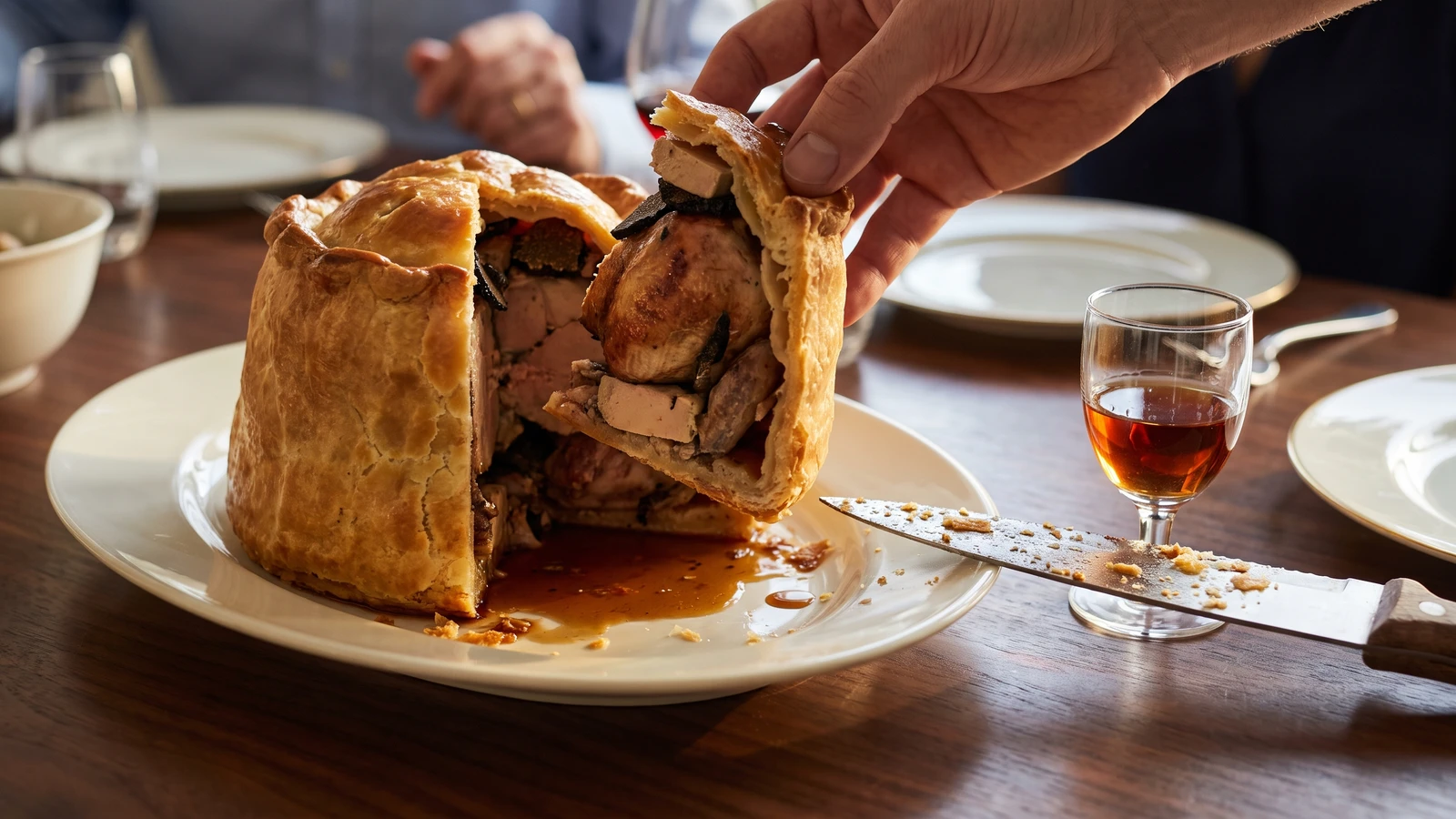
Foie gras-filled quails stand around a heart of black truffles, sealed behind bacon in a pastry mould and baked with Madeira stock, a magnificent lesson in structure, moisture, and restraint.
Timbale de Cailles Alexandra (quails baked with foie gras and truffles inside a pastry mould) teaches that structure and supper are not always the same thing. The paste is a mould, not a meal. Its bacon lining must be complete, because that thin wall of fat keeps the quails' liquor from soaking the paste and bringing the whole architecture down. Know that before you touch a pan.
The original recipe assumed a deep metal timbale mould, a saucier who could reach for excellent stock enriched with Madeira, and enough birds to build successive tiers. At home, a 1.25-litre straight-sided pudding basin replaces the timbale mould; concentrated unsalted poultry stock and Madeira replace the stockpot never off the fire; four quails make one generous ring for four people. The liquor is scaled exactly from the book's quarter pint for six birds to 95 ml for four. Successive tiers are brigade scaffolding and can go. The foie gras inside each bird, the truffle-filled centre, the bacon barrier, and the full hour and a quarter in the oven are the dish, so they stay.
One cook, one stove, one evening. When the timbale is turned out, its plain golden shell opens onto bronzed bacon, tender quail, black truffles, and Madeira-rich juices. Patch every crack you find, but give your greatest attention to the overlapping bacon: no pinholes and no hopeful gaps. That lining decides the dish.
Timbale de Cailles Alexandra belongs to the formal Parisian repertoire of named luxury dishes, where quail, foie gras, truffle, and Madeira-rich stock were assembled for the celebration table. Though it resembles a raised game pie, the paste was never intended as food: it is a disposable mould, while the bacon forms the waterproof layer protecting it from the cooking liquor. The construction passed readily into bourgeois special-occasion cooking because a smaller timbale mould accommodates fewer birds without changing the method or proportions.
Quantity
3 cups (720 ml / 375 g)
Quantity
6 tablespoons (90 ml / 85 g)
diced
Quantity
1 teaspoon (5 ml / 6 g)
Quantity
½ cup plus 1 tablespoon (135 ml / 135 g), plus up to 1 tablespoon (15 ml / 15 g) if needed
Quantity
3 tablespoons (45 ml / 42 g)
softened and divided
Quantity
10 to 12 slices (about 250 g)
Quantity
4 (about 500 g total)
Quantity
⅓ cup (80 ml / 80 g)
cut into 4 equal pieces
Quantity
1 cup (240 ml / 160 g)
fresh or whole preserved and drained
Quantity
½ cup (120 ml / 120 g), for reducing to ⅓ cup (80 ml / 80 g)
Quantity
1 tablespoon (15 ml / 15 g)
Quantity
1
torn into 4 pieces
Quantity
½ teaspoon (2.5 ml / 3 g)
Quantity
¼ teaspoon (1.25 ml / 0.5 g)
| Ingredient | Quantity |
|---|---|
| all-purpose flour | 3 cups (720 ml / 375 g) |
| chilled unsalted butterdiced | 6 tablespoons (90 ml / 85 g) |
| fine sea salt for the paste | 1 teaspoon (5 ml / 6 g) |
| cold water | ½ cup plus 1 tablespoon (135 ml / 135 g), plus up to 1 tablespoon (15 ml / 15 g) if needed |
| unsalted buttersoftened and divided | 3 tablespoons (45 ml / 42 g) |
| thinly sliced unsmoked streaky bacon | 10 to 12 slices (about 250 g) |
| oven-ready quails | 4 (about 500 g total) |
| raw foie grascut into 4 equal pieces | ⅓ cup (80 ml / 80 g) |
| small peeled black trufflesfresh or whole preserved and drained | 1 cup (240 ml / 160 g) |
| rich unsalted brown poultry stock | ½ cup (120 ml / 120 g), for reducing to ⅓ cup (80 ml / 80 g) |
| dry Madeira | 1 tablespoon (15 ml / 15 g) |
| small bay leaftorn into 4 pieces | 1 |
| fine sea salt for the quails | ½ teaspoon (2.5 ml / 3 g) |
| freshly ground black pepper | ¼ teaspoon (1.25 ml / 0.5 g) |
Combine the flour and salt, then rub in the chilled butter until no large pieces remain. Add the cold water gradually and knead just until the dough becomes smooth, firm, and pliable. This pâte à pâté, a sturdy structural paste, must bend without crumbling; tenderness is irrelevant because it will not be eaten. If it cracks when folded, ça se rattrape: knead in cold water one teaspoon at a time. Flatten into a disc, cover, and refrigerate for 30 minutes.
Simmer the poultry stock in a small saucepan until exactly ⅓ cup (80 ml) remains. Let it cool, then stir in the Madeira to make 95 ml of cooking liquor, preserving the book's proportion for four birds. Taste it before proceeding. It should be deep and savoury but not aggressively salty. If it reduces below 80 ml, add enough water to restore the measure before adding the Madeira.
Heat the oven to 350°F (180°C). Coat the entire inside of a 1.25-litre straight-sided timbale mould or ovenproof pudding basin with 1 tablespoon of the softened butter. Roll two-thirds of the pâte à pâté between sheets of parchment to a thickness of about ⅛ inch (4 mm), then ease it into the mould with 1 inch (2.5 cm) overhanging the rim. Press scrap dough firmly over every tear. Line the base and sides with overlapping bacon, leaving no pastry exposed and allowing the upper ends to extend slightly over the rim. This barrier is the one principle that decides the timbale.
Dry the quails thoroughly, then season their cavities and exteriors with the salt and pepper. Insert one 20 g piece of raw foie gras deeply into each cavity, folding the legs inward to help contain it. Keep the remaining foie gras cold while you work. Mousse or cooked pâté will melt away and cannot replace raw foie gras here.
Melt the remaining 2 tablespoons of softened butter in a wide skillet over medium heat. Raidir au beurre, meaning stiffen the quails briefly in butter, turning them for 4 to 5 minutes until their skins have tightened and taken a light golden colour. Do not cook them through or brown them hard. Set them aside until cool enough to handle. If a piece of foie gras slips out, chill it for 5 minutes and return it to the cavity.
Stand the quails upright in a single ring against the bacon-lined wall, breasts facing outward and cavity openings uppermost. Fill the centre completely with the small peeled truffles, packing them closely without crushing them. Tuck the pieces of bay leaf among the truffles, then pour in all 95 ml of the cooled Madeira stock. Fold the bacon ends inward over the contents.
Roll the remaining pâte à pâté into a lid slightly wider than the mould. Brush the overhanging paste with cold water, set the lid over the filling, and pinch it firmly to the sides before trimming the excess. Set the mould on a rimmed baking sheet and bake for exactly 1 hour 15 minutes. If the shell begins to smell scorched, cover it loosely with foil; its colour does not matter, but burnt paste would embitter the juices. At the end, a thermometer inserted through the lid into the thickest quail should register at least 165°F (74°C).
Set a warmed oval platter over the mould and invert the timbale immediately. Lift the mould straight upward. If it clings, run a thin knife around the rim and tap the sides gently. If the shell cracks, do not rebuild it. Ça se rattrape: arrange the quails and truffles on the platter and spoon over every drop of Madeira-rich liquor, because the paste was always a mould, not the meal. Present the timbale whole, then cut away and discard the paste at the table. Serve one quail per person with bacon, truffles, and cooking juices. À table!
1 serving (about 350g)
Culinary guides, cultural storytelling, and the editorial depth that makes cooking meaningful.
Discover Culinary ExplorerChef Juliette
John Dory has the delicacy of sole and the firmness of turbot. A light flouring, a quick butter sauté, and nut-brown beurre noisette show exactly why looks never mattered.

Chef Juliette
Fresh haddock proves its delicacy in the meunière pan: a fine flour crust, moist pearly flakes, and beurre noisette sharpened with lemon and parsley, ready from one skillet in half an hour.

Chef Juliette
Éperlans à l’Anglaise turns small fish into a lesson in disciplined coating: boned smelts under a close, crisp crumb, pan-fried in clarified butter and finished with bright, half-melted maître d’hôtel butter.

Chef Juliette
Tiny smelts, shallot, mushrooms, white wine, gratin sauce, and fine bread raspings meet a fierce oven, where the fish must turn tender in the same breath the buttered crust bronzes.