Culinary Explorer

A cooking platform built around craft, culture, and the stories behind what we eat.
Discover Culinary Explorer
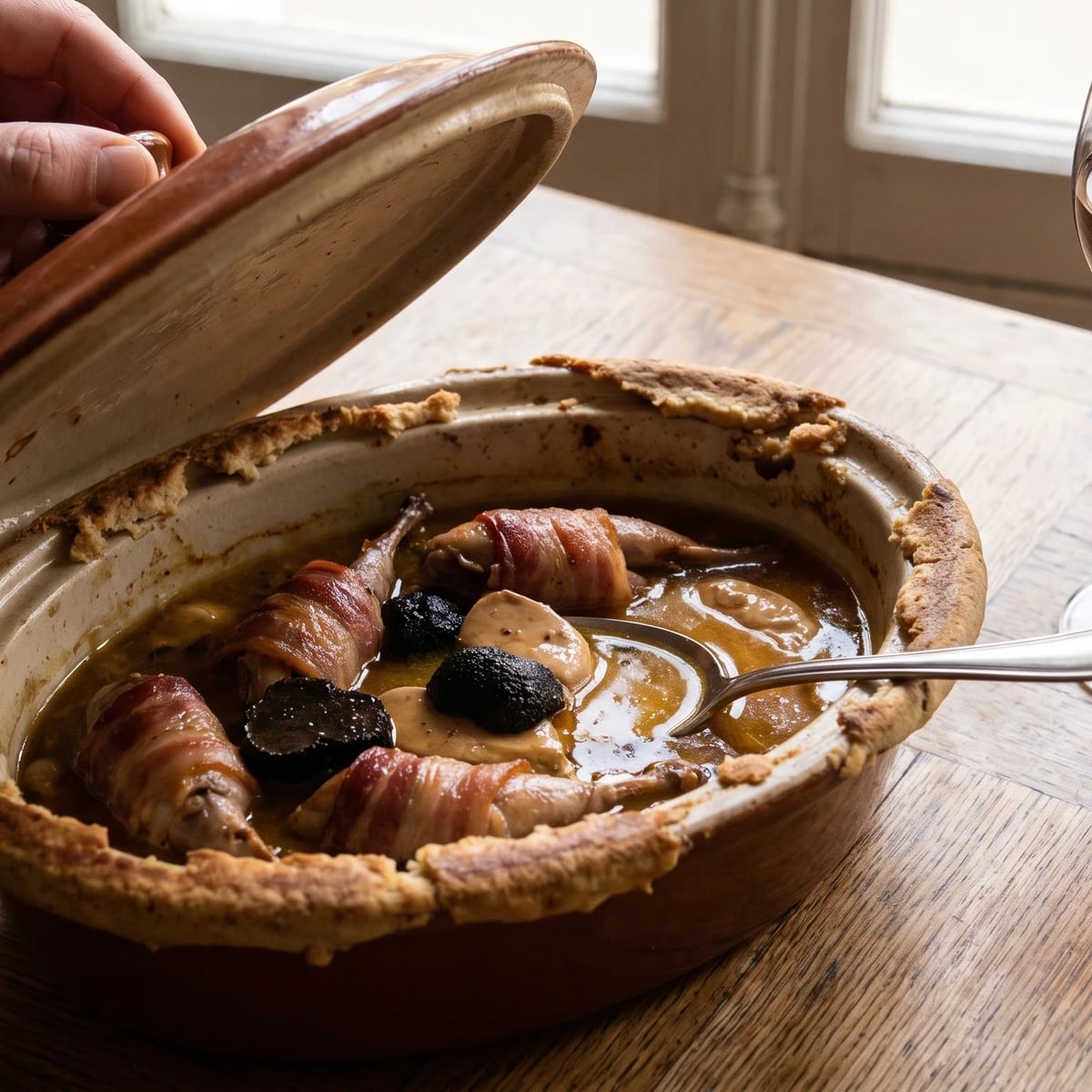
Cailles Souvaroff

Cailles Souvaroff

Created by Chef Juliette

Based on No. 1898, Cailles Souvaroff, from Le Guide Culinaire (1907) by Auguste Escoffier

Cailles Souvaroff teaches the luxury of containment: foie gras within, Madeira-dark truffles around, and eight quails finishing under a pastry seal whose first fragrant breath belongs to the table.

Main Dishes
French
Special Occasion
Celebration
Dinner Party
50 min
Active Time
35 min cook1 hr 25 min total
Yield4 servings

Cailles Souvaroff (quail with foie gras and truffles sealed in a terrine) teaches that enclosure is a seasoning. The quails are first poêlés (covered-roasted in butter and their own juices), then finish with whole black truffles, foie gras, Madeira, and game gravy under a pâte morte, a simple flour-and-water sealing dough. The first aromatic breath belongs to the table, so the lid stays shut until everyone is seated.

The source sends the cook to Faisan Souvaroff (No. 1845) and assumes a saucier on hand, light meat glaze and game gravy drawn from stock never off the fire, and a proper serving terrine. A salamander plays no part because all the heat is enclosed. In a home kitchen, finished reduced stock, a low lidded casserole, and a wired probe do the same honest work. Eight farmed quails feed four generously, while the source's equal measures of Madeira and glaze, followed by equal measures of Madeira and game gravy, remain intact. One cook, one stove, one evening.

Separate station work and grand service ware are brigade scaffolding and can go. The five-minute truffle bath, cold-diced foie within, bacon barding, two-thirds poêlé, and unbroken seal are the dish and must stay. The decisive step is the last one: make the dough gasket continuous, then trust the probe and never lift the lid to check.

Cailles Souvaroff belongs to the Parisian grand-kitchen canon rather than to a single regional larder; Souvaroff is the French rendering of Suvorov, the Russian field marshal honored through a family of richly truffled preparations. The quail entry inherits its method whole from Faisan Souvaroff (No. 1845), moving the treatment from pheasant to smaller game birds without changing the sequence of Madeira, meat glaze, foie gras, poêlé cooking, and a hermetically sealed terrine. The seal was never mere theater: it held the volatile truffle perfume until the dish reached the table.

The technique, the tradition, and the story behind every dish.

Discover Culinary Explorer

Ingredients

Faisan Souvaroff

Quantity

1 governing formula Faisan Souvaroff (No. 1845)

scaled through the method below

large oven-ready quails

Quantity

8 (about 6 to 7 ounces / 170 to 200 g each)

giblets removed

fine sea salt

Quantity

1½ teaspoons (7.5 ml / 9 g)

divided

freshly ground black pepper

Quantity

¾ teaspoon (4 ml / 1.5 g)

whole black truffles

Quantity

6 medium (about 5½ ounces / 150 g total)

scrubbed, or drained if preserved

dry Madeira

Quantity

½ cup (120 ml / 120 g)

for cooking the truffles

finished light meat glaze

Quantity

½ cup (120 ml / 130 g)

warmed

raw foie gras

Quantity

about 1 cup (240 ml / 225 g)

cut into large dice and thoroughly chilled

thinly sliced unsmoked streaky bacon

Quantity

8 broad slices (about 4½ ounces / 130 g)

unsalted butter

Quantity

2 tablespoons (30 ml / 28 g)

dry Madeira

Quantity

¼ cup (60 ml / 60 g)

for the terrine

finished game gravy or concentrated brown poultry jus

Quantity

¼ cup (60 ml / 65 g)

warmed

all-purpose flour

Quantity

1½ cups (360 ml / 180 g)

for the pâte morte

cool water

Quantity

6 tablespoons (90 ml / 90 g), plus up to 1 tablespoon (15 ml / 15 g) if needed

for the pâte morte

Equipment Needed

  • Low 4-quart (3.8-liter) ovenproof terrine or lidded cast-iron braiser
  • 12-inch (30-cm) ovenproof sauté pan with lid
  • Small heavy-bottomed saucepan
  • Oven-safe wired temperature probe
  • Kitchen twine
  • Slotted spoon

Instructions

  1. 1

    Set the sequence

    Heat the oven to 425°F (220°C) with a rack in the lower-middle position. Faisan Souvaroff (No. 1845) governs the order: truffles first, foie gras within, quails two-thirds poêlés, then Madeira, game gravy, and the sealed terrine. Pat the quails completely dry, season them inside and out with the salt and pepper, and refrigerate uncovered. Spread the foie gras dice on a cold plate and place them in the freezer for 15 minutes; they should become very firm but not freeze solid.

  2. 2

    Make the pâte morte

    Mix the flour with 6 tablespoons (90 ml) of water until a stiff dough forms, adding the remaining water only if dry flour refuses to join. Knead for a minute, cover, and rest for 15 minutes. Roll it into a rope long enough to circle the terrine's rim, about ¾ inch (2 cm) thick. This dough is a gasket, not bread, so beauty is irrelevant; flexibility and an unbroken seal are what matter.

  3. 3

    Cook the truffles

    Combine the ½ cup (120 ml) Madeira and light meat glaze in a small saucepan and bring them to a bare simmer. Add the whole truffles and cook for exactly 5 minutes, turning them once or twice so their surfaces are lacquered. Lift the truffles into the terrine with a slotted spoon. Reduce the cooking liquor gently to about ½ cup (120 ml), or until it coats the back of a spoon in a thin, glossy layer.

  4. 4

    Stiffen the foie gras

    Lower the heat until the truffle liquor barely trembles. Add the very cold foie gras and turn the dice gently for 30 to 45 seconds, just until their outer faces firm while the centers remain cold. Divide the glazed dice and their clinging liquor among the quail cavities. If the foie begins melting into a puddle, lift the pan off the heat immediately and transfer the dice to a plate set over ice; whisk the released fat back into the glaze, then continue stuffing once everything has firmed. Ça se rattrape.

  5. 5

    Stuff and bard

    Fold each quail's wings behind its back and tie the legs together so the foie remains inside. Wrap one broad bacon slice around each breast, overlapping beneath the bird and securing it under the same loop of twine. Keep the birds cold while you finish the batch. The bacon is barding, protection for a small bird under fierce heat, not a garnish meant to become crisp.

  6. 6

    Poêler the quails

    Melt the butter in a wide ovenproof sauté pan. Arrange the quails breast-side up in one uncrowded layer, spoon the butter over them, cover, and roast for 8 minutes. Uncover only long enough to baste with the buttery poêling liquor, then cover and roast for another 3 to 5 minutes. Two-thirds cooked means the bacon is pale gold, the birds feel set rather than soft, and the inner thigh reaches about 125 to 130°F (52 to 55°C). Do not chase a dark crust; the enclosed cooking is the technique.

  7. 7

    Fill and seal

    Snip away the twine without disturbing the bacon and arrange the quails snugly among the truffles in the terrine. Pour over the poêling liquor, the remaining ¼ cup (60 ml) Madeira, and the warm game gravy. If the poêling liquor looks watery rather than glossy, reduce it briefly in the sauté pan before adding it; excess water weakens both sauce and perfume. Insert an oven-safe probe into the thickest inner thigh of a central quail without touching bone or entering the cavity. Press the pâte morte rope around the terrine rim, set on the lid, and pinch the dough firmly against both vessel and lid, sealing around the probe cable. If the dough cracks, patch it with a wet scrap before the terrine enters the oven.

  8. 8

    Finish under seal

    Bake the sealed terrine without lifting its lid until the probe registers 165°F (74°C), usually 10 to 16 minutes for quails of this size. If a gap appears in the dough while baking, press a fresh scrap over it without disturbing the lid; the perfume is still yours. Remove the terrine and let it rest for 5 minutes with the seal and probe undisturbed.

  9. 9

    Break seal at table

    Carry the closed terrine to the table. Only now break away the pâte morte, withdraw the probe, and lift the lid. Discard the sealing dough, then serve two quails per person with the foie gras, glossy cooking juices, and one whole truffle; halve the remaining two truffles so every plate receives its share. Never apologize at your own table. À table!

Chef Tips

  • Two quails per person is generous but correct here. One quail is a first course; two, with foie gras and truffle-rich juices, make the celebration dinner promised by the dish.
  • Fresh black winter truffles give the fullest aroma. Outside their season, use excellent whole preserved black truffles from a sealed jar and drain them well. Truffle oil cannot replace the body, texture, or gentle exchange of flavor between the whole truffle and Madeira.
  • A home cook needn't maintain two stockpots. Start from one sound, unsalted brown chicken, quail, or veal stock: reduce one portion until syrupy for the light meat glaze and another until spoon-coating for the game gravy. Salt only after reduction.
  • Choose quails within the same weight range so they finish together. The wired probe replaces the brigade cook's practiced touch and lets you respect the seal without gambling on stuffed poultry.
  • Use a dry or medium-dry Madeira you would drink, never salted cooking wine. At the table, pour a mature red Burgundy or a restrained Bordeaux whose fruit won't shout over the truffles.

Advance Preparation

  • Prepare the light meat glaze and game gravy up to 3 days ahead, chill them promptly, and warm them gently before use. Both can also be frozen in small portions for up to 1 month.
  • The pâte morte can be mixed up to 4 hours ahead and held tightly covered at room temperature. If it stiffens, knead in a few drops of water before rolling the sealing rope.
  • Scrub the truffles and dice the foie gras earlier on the day of serving, keeping each tightly covered and cold. Stuff the quails only when you are ready to cook them.
  • Do not cook the assembled terrine ahead. Its whole pleasure is the unbroken seal arriving at the table while the quails and truffles are ready to serve.

Frequently Asked Questions

Nutrition Information

1 serving (about 440g)

Calories
1075 calories
Total Fat
69 g
Saturated Fat
23 g
Trans Fat
0 g
Unsaturated Fat
46 g
Cholesterol
430 mg
Sodium
1800 mg
Total Carbohydrates
46 g
Dietary Fiber
4 g
Sugars
3 g
Protein
67 g

Note: Chef personas and recipes are created with AI assistance. Cook with care: follow safe food-handling practices, check doneness with a thermometer when needed, and adapt for allergies and your kitchen.

Where cooking meets culture.

Culinary guides, cultural storytelling, and the editorial depth that makes cooking meaningful.

Discover Culinary Explorer

More from Poultry (Volaille) - Partridge (Perdrix et Perdreaux)

Browse the full collection