
Chef Juliette
John Dory (St. Pierre)
John Dory has the delicacy of sole and the firmness of turbot. A light flouring, a quick butter sauté, and nut-brown beurre noisette show exactly why looks never mattered.
A cooking platform built around craft, culture, and the stories behind what we eat.
Created by Chef Juliette
Based on No. 1891, Cailles Lucullus, from Le Guide Culinaire (1907) by Auguste Escoffier
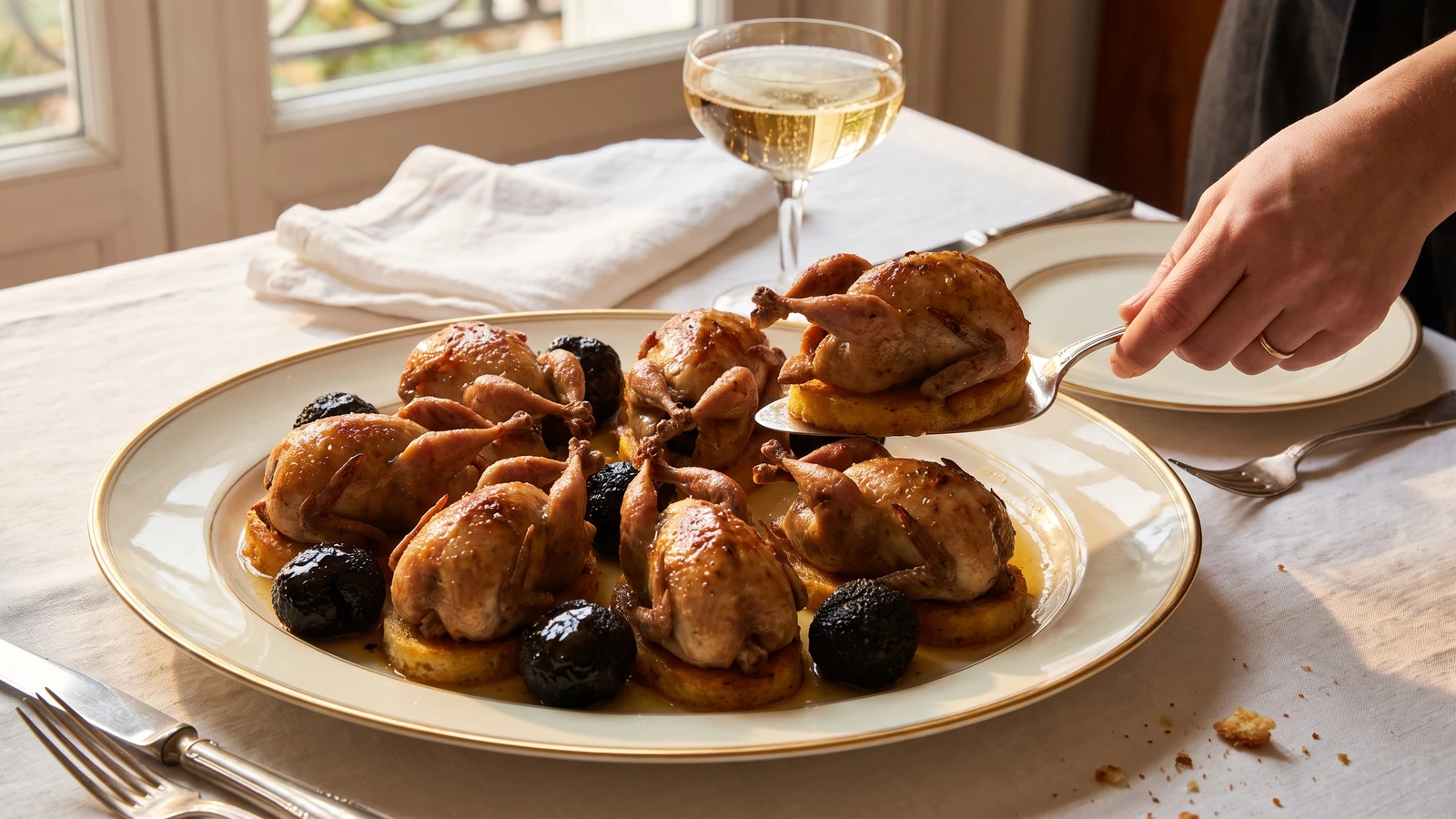
Butter-basted quails circle a warm platter on crisp croûtons, with whole black truffles gleaming between them in Champagne and chicken glaze. The bread is structural, ready to catch every precious drop.
Cailles Lucullus (butter-cooked quails with whole truffles in Champagne and chicken glaze) teaches that luxury still requires structure. The croûton, bread fried in butter, isn't decoration. It must be broad and crisp enough to support its bird, then drink the butter, glaze, and roasting juices that run from it at the table.
The original entry assumed a saucier with chicken glaze ready, a stockpot never off the fire, and enough hands to fry bread while the birds cooked. At home, reduce one pan of good stock, fry the croûtons first, let the truffles wait in their cooking liquor, and cook the quails last. There is no salamander step because nothing here is gratinéed. The brigade choreography is scaffolding and it goes; butter-cooked quail, fried croûtons, and whole truffles cooked in Champagne and chicken glaze are the dish, and they stay. Eight birds make four generous portions. One cook, one stove, one evening.
When it reaches the table, the quails should be bronze and glossy, the truffles black and lacquered, the croûtons crisp at their edges and already beginning to drink. Have every component ready and the round platter warm before the birds meet the butter. That final timing matters most, because quail waits for nobody.
Cailles Lucullus belongs to the formal Parisian table, where the title Lucullus announces deliberate luxury rather than a particular French region. The name invokes Lucullus, remembered in French culinary language for lavish banquets, so whole truffle and costly wine are the substance of the dish, not ornamental flourishes. Although Champagne and Périgord truffles carry their own precise origins, their meeting here is a composition of the grand kitchen rather than a regional farmhouse preparation.
Quantity
8 (about 4 ounces / 115 g each; 2 pounds / 920 g total)
giblets removed and birds patted dry
Quantity
8 (about 4 1/4 ounces / 120 g total)
gently cleaned
Quantity
4 cups (960 ml / 960 g)
Quantity
1 1/2 cups (360 ml / 355 g)
Quantity
8 slices (about 8 1/2 ounces / 240 g total)
cut 1/2 inch / 1.25 cm thick with crusts removed
Quantity
12 tablespoons (180 ml / 170 g)
divided
Quantity
2 teaspoons (10 ml / 12 g)
divided
Quantity
1 teaspoon (5 ml / 2 g)
| Ingredient | Quantity |
|---|---|
| oven-ready whole quailsgiblets removed and birds patted dry | 8 (about 4 ounces / 115 g each; 2 pounds / 920 g total) |
| small whole black Périgord trufflesgently cleaned | 8 (about 4 1/4 ounces / 120 g total) |
| unsalted, gelatin-rich chicken stock | 4 cups (960 ml / 960 g) |
| brut Champagne | 1 1/2 cups (360 ml / 355 g) |
| pain de miecut 1/2 inch / 1.25 cm thick with crusts removed | 8 slices (about 8 1/2 ounces / 240 g total) |
| unsalted butterdivided | 12 tablespoons (180 ml / 170 g) |
| fine sea saltdivided | 2 teaspoons (10 ml / 12 g) |
| freshly ground black pepper | 1 teaspoon (5 ml / 2 g) |
Pour the chicken stock into a wide saucepan and bring it to a boil, then lower the heat to a lively simmer. Reduce it uncovered to 1/2 cup (120 ml / 120 g), skimming any foam from the surface, until it tastes concentrated and lightly coats a cold spoon. This is glace de volaille, chicken glaze, made on a home stove instead of drawn from the brigade stockpot. Watch closely near the end, when reduction accelerates. If it drops below 1/2 cup or turns tacky, whisk in enough hot water to restore the measure; ça se rattrape.
Season each quail inside and out with 1 1/2 teaspoons (9 g) of the salt and all the pepper. Tie the legs together with kitchen string and tuck the wing tips underneath so the birds hold a neat, compact shape and cook evenly. Keep them chilled until twenty minutes before cooking. Shape each slice of pain de mie into an oval or rectangle slightly larger than the footprint of one quail. These will become the Croûtons, and their size is structural rather than decorative.
Melt 6 tablespoons (90 ml / 85 g) of the butter in the skillet over medium heat. Fry the Croûtons in two batches, turning once, until both faces are evenly golden and crisp, about two minutes per side. Add the second half of the butter as needed rather than crowding the skillet. Transfer them to a wire rack, not paper, which traps moisture and softens the underside. If a Croûton tastes bitter rather than nutty, replace it. Burnt bread has no useful rescue, and the rest of this dish is too good to set upon it.
Combine the Champagne and the chicken glaze in the cleaned saucepan. Bring them to a bare simmer, set the whole truffles in one layer, and cover with a lid set slightly ajar. Cook fresh truffles at the gentlest tremble for eight to ten minutes, turning them once; preserved whole truffles need only three to four minutes. Lift the truffles out and cover them loosely. Reduce their cooking liquor until it leaves a translucent amber coat on a spoon, about eight minutes. It should flow, not pull into threads. If it tightens too far, whisk in Champagne or hot water one tablespoon at a time. Ça se rattrape.
Heat the oven to 425°F / 220°C. Melt 3 tablespoons (45 ml / 42 g) of the remaining butter in the ovenproof skillet over medium-high heat. When the foam subsides, set in four quails and brown them breast-side down for two minutes, then give each side about one minute. Move them to the sheet pan and repeat with the remaining quails and butter. Keep the heat lively but controlled. If the milk solids turn black or smell acrid, lift the birds out immediately, wipe the skillet, and continue in fresh butter; the birds are unharmed if moved promptly, but scorched butter must go.
Arrange all eight browned quails breast-side up on the sheet pan and spoon the clean butter from the skillet over them. Roast for six to ten minutes, basting once, until the skin is burnished and an instant-read thermometer reaches 165°F / 74°C in the thickest part of the thigh without touching bone. Smaller birds will finish first, so remove them as they are ready. Rest the quails for five minutes while you warm the platter and finish the glaze. Quail is lean and fast; another five careless minutes turns it from succulent to string.
Pour the quails' resting juices into the Champagne and chicken glaze, then warm it gently and taste. Add the remaining 1/2 teaspoon (3 g) salt only if the glaze needs it. Return the whole truffles for one minute, rolling them through the liquid until their surfaces shine. Don't boil them now; hard heat drives away the perfume you paid for.
Arrange the eight warm Croûtons in a circle on the round platter and set one quail breast-side up on each. Between every two quails, set one whole truffle, using all eight so the circle alternates bird and truffle. Spoon the Champagne and chicken glaze over the truffles and around the bases of the birds, leaving the outer edges of the Croûtons crisp. Bring the platter straight to the table. The bread will catch what runs out, exactly as it should. À table!
1 serving (about 350g)
Culinary guides, cultural storytelling, and the editorial depth that makes cooking meaningful.
Discover Culinary ExplorerChef Juliette
John Dory has the delicacy of sole and the firmness of turbot. A light flouring, a quick butter sauté, and nut-brown beurre noisette show exactly why looks never mattered.

Chef Juliette
Fresh haddock proves its delicacy in the meunière pan: a fine flour crust, moist pearly flakes, and beurre noisette sharpened with lemon and parsley, ready from one skillet in half an hour.

Chef Juliette
Éperlans à l’Anglaise turns small fish into a lesson in disciplined coating: boned smelts under a close, crisp crumb, pan-fried in clarified butter and finished with bright, half-melted maître d’hôtel butter.

Chef Juliette
Tiny smelts, shallot, mushrooms, white wine, gratin sauce, and fine bread raspings meet a fierce oven, where the fish must turn tender in the same breath the buttered crust bronzes.