
Chef Juliette
John Dory (St. Pierre)
John Dory has the delicacy of sole and the firmness of turbot. A light flouring, a quick butter sauté, and nut-brown beurre noisette show exactly why looks never mattered.
A cooking platform built around craft, culture, and the stories behind what we eat.
Created by Chef Juliette
Based on No. 1887, Cailles Figaro, from Le Guide Culinaire (1907) by Auguste Escoffier
Four truffle-scented quails poached inside tightly tied casings with pale veal glaze, a precise lesson in containment, gentle heat, and why good stock is the cook's first rescue.
Cailles Figaro (quail sealed with truffle and pale veal glaze) teaches one exact principle: the envelope is part of the cooking, not packaging. Each bird must be held close with its nugget of glaze and tied at both ends. If that casing opens in the pot, the glaze runs away and the quail goes flat.
The original entry assumed a saucier on staff, a stock never off the fire, and clean lengths of gut waiting in the larder. It needed no salamander, and neither do you; broiler colour would contradict a dish meant to be poached pale. For one cook, one stove, one evening, I have scaled the service to four birds, specified food-safe large casing in place of an unmeasured piece of gut, and measured one pigeon-egg-sized portion of chilled glace de veau blonde for each. The truffle, the glaze, and the veal-stock poach stay exactly where they were.
The brigade's ready stock and glaze are scaffolding, so you may prepare or buy them ahead. The casing, the double tie, and stock in place of salted water are the dish, so none can go. Keep the poach at a bare tremble and tie each parcel closely without stretching it drum-tight; that is the step that decides everything before the bird meets the pot.
Cailles Figaro belongs to the Parisian grand-kitchen repertory of named quail preparations, where truffle and concentrated veal juices gave a small bird the weight of a formal main course. Its name points to no provincial larder; the classical formula defines Figaro by a gut envelope, pale veal glaze, and a stock poach rather than by a separate sauce. The use of veal stock instead of salted water is not extravagance but insurance: if the casing splits, the quail is not washed of its flavour.
Quantity
4, each 6 to 7 ounces (170 to 200 g)
necks and giblets removed and birds patted dry
Quantity
1 small (3/4 ounce / 20 g)
brushed clean and cut into 4 equal pieces
Quantity
1/4 cup (60 ml / 65 g)
divided into 4 equal portions
Quantity
8 1/2 cups (2 L / 2 kg)
Quantity
5 lengths, each 8 inches (20 cm)
4 for wrapping and 1 spare
| Ingredient | Quantity |
|---|---|
| oven-ready quailsnecks and giblets removed and birds patted dry | 4, each 6 to 7 ounces (170 to 200 g) |
| black truffle, fresh or whole preserved in its own juicebrushed clean and cut into 4 equal pieces | 1 small (3/4 ounce / 20 g) |
| chilled glace de veau blonde (pale veal glaze)divided into 4 equal portions | 1/4 cup (60 ml / 65 g) |
| good unsalted fond de veau (veal stock) | 8 1/2 cups (2 L / 2 kg) |
| food-safe natural beef bung casing, 100 to 120 mm wide4 for wrapping and 1 spare | 5 lengths, each 8 inches (20 cm) |
Soak the casing lengths in plenty of cool water for 30 minutes, then rinse the outsides and run fresh water through each tube. Keep four flawless lengths and the fifth close as insurance. A nick becomes a split under heat; if you find one now, replace that section with the spare rather than trusting a weak envelope.
Keep the quails cold while you work. Insert one piece of truffle deep into the body cavity of each bird so it cannot slip out during wrapping. Divide the firm glace de veau blonde into four pieces of about 1 tablespoon (15 ml / 16 g) each, roughly the size of a small pigeon's egg, and return them to the cold until the casings are ready.
Drain one casing and open it carefully with wet fingers. Slip in a quail, then place one cold portion of glace de veau blonde against its breast inside the casing. Smooth out large air pockets without stretching the wrapper tight, and tie the casing firmly at two points, about 1 inch (2.5 cm) in from the bird's neck and leg extremities. Repeat with the remaining birds. The parcel should fit closely but retain enough ease for the glaze to melt and move; drum-tight casing contracts and bursts.
Heat the fond de veau in a snug, deep pot to 180 to 185°F (82 to 85°C), where the surface barely trembles. Lower in the wrapped quails with a wide spoon and keep them fully submerged without crowding or pressing them against the pot. Hold this gentle heat and never allow a boil, which knocks the parcels about and tightens the casing. If one bursts, lower the heat, lift it immediately, transfer the bird and as much escaped glaze as you can into the spare casing, retie it, and return it to the stock. Ça se rattrape. The fond de veau is exactly why the bird has not washed out while you repair it.
Poach for 20 to 25 minutes, maintaining the same bare tremble. At 20 minutes, lift the largest parcel and slide an instant-read thermometer through the tied leg end, following the opening rather than puncturing the broad side of the casing. The thickest part of the inner thigh must reach 165°F (74°C). If it has not, retie the end and return all four parcels for another 3 to 5 minutes.
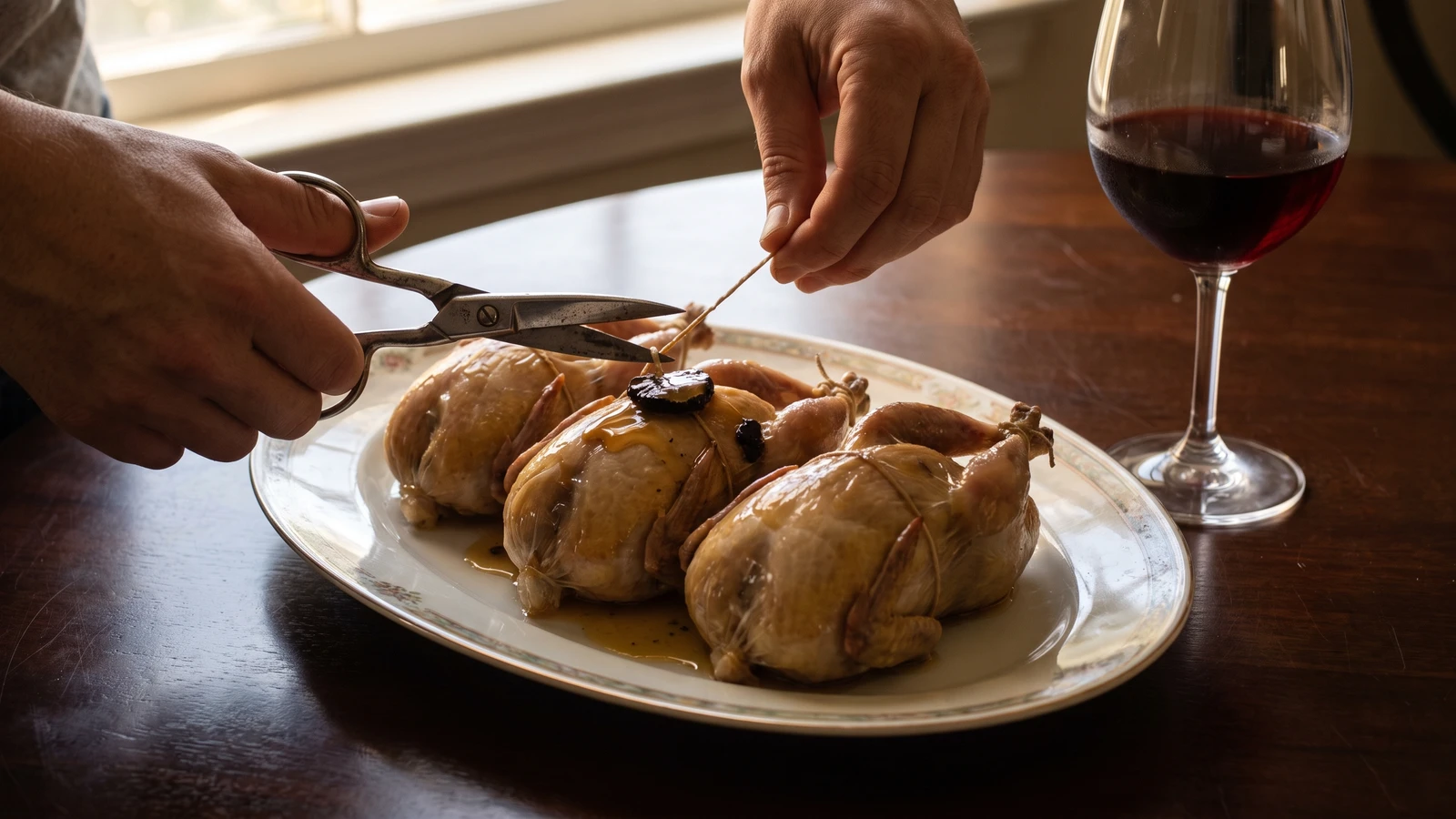
Warm an oval platter, then lift the quails directly from the fond de veau and let each drain for only a few seconds. Arrange them on the platter in their tied envelopes, exactly as they leave the cooking liquor. At the table, snip one end of each casing, peel it away, and spoon every drop of melted glace de veau blonde back over its bird. Do not brown them under a broiler, reduce the poaching stock into another sauce, or add a garnish the formula never asked for. À table!
1 serving (about 130g)
Culinary guides, cultural storytelling, and the editorial depth that makes cooking meaningful.
Discover Culinary ExplorerChef Juliette
John Dory has the delicacy of sole and the firmness of turbot. A light flouring, a quick butter sauté, and nut-brown beurre noisette show exactly why looks never mattered.

Chef Juliette
Fresh haddock proves its delicacy in the meunière pan: a fine flour crust, moist pearly flakes, and beurre noisette sharpened with lemon and parsley, ready from one skillet in half an hour.

Chef Juliette
Éperlans à l’Anglaise turns small fish into a lesson in disciplined coating: boned smelts under a close, crisp crumb, pan-fried in clarified butter and finished with bright, half-melted maître d’hôtel butter.

Chef Juliette
Tiny smelts, shallot, mushrooms, white wine, gratin sauce, and fine bread raspings meet a fierce oven, where the fish must turn tender in the same breath the buttered crust bronzes.