
Chef Juliette
John Dory (St. Pierre)
John Dory has the delicacy of sole and the firmness of turbot. A light flouring, a quick butter sauté, and nut-brown beurre noisette show exactly why looks never mattered.
A cooking platform built around craft, culture, and the stories behind what we eat.
Created by Chef Juliette
Based on No. 1885, Cailles aux Cerises, from Le Guide Culinaire (1907) by Auguste Escoffier
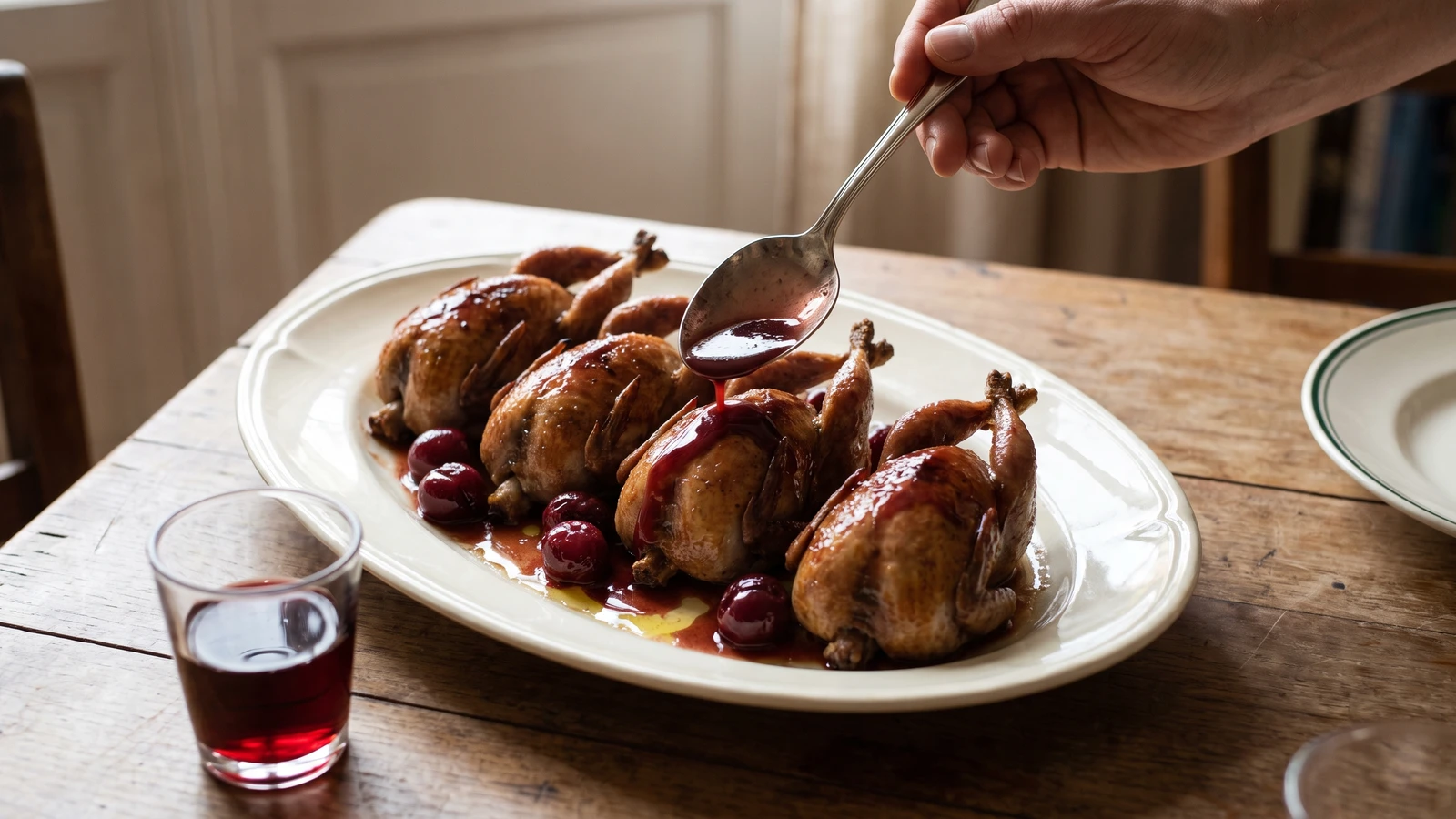
Cailles aux Cerises teaches the balance of fruit and fond: butter-browned quail, Port scented with orange, and cherries poached separately, then gathered in a glossy sauce sharpened with lemon.
Cailles aux Cerises (quail with cherries) teaches the balance governing every fruit sauce in the classical canon: sweetness must rest on fond, reduction, and enough acidity to keep the plate savory. The one true thing to know before touching a pan is this: the cherries cook and cool apart. Their perfume belongs in the finished sauce, but their poaching syrup does not.
The original formula already gives four quails, so the bird count stays intact. What it assumed was a saucier tending two pans, a veal stockpot never off the fire, and a Saccharometer to test the syrup. At home, a small saucepan handles the fruit, one part sugar to two parts water by weight reproduces the light 18-degree syrup, and a few spoonfuls of concentrated, gelatin-rich veal stock supply the body. The Saccharometer and formal entrée trussing are brigade scaffolding and can go. The separate poach, butter browning, brandy and Port deglaze, and red-currant finish are the dish, so they stay. One cook, one stove, one evening.
When it lands correctly, each quail is bronze beneath a garnet glaze, the cherries remain whole, and the sauce tastes savory first, fruit-bright second. If it turns cloying, don't dilute it; a few drops of lemon pull it straight back. Drain the cherries until no syrup falls from the spoon before they enter the sauce. That single pause decides the dish.
Cailles aux Cerises belongs to the classical Parisian table, where small game birds were dressed as an entrée, a savory course served before the roast, and fruit sauces supplied contrast without turning the plate into dessert. Port, orange rind, red-currant jelly, and veal stock reveal a grand kitchen's cosmopolitan pantry rather than the larder of one French province; calling the dish specifically Burgundian or Provençal would misplace it. Its telling discipline is the separate cherry poach, a pastry-kitchen treatment brought into the saucier's pan so the fruit stays whole and the final sauce remains controlled.
Quantity
4 (6 to 7 oz / 170 to 200 g each)
giblets removed
Quantity
1 teaspoon (5 ml / 6 g)
Quantity
1/2 teaspoon (2.5 ml / 1 g)
Quantity
3 tablespoons (45 ml / 42 g)
divided
Quantity
2 tablespoons (30 ml / 28 g)
Quantity
1/3 cup (80 ml / 78 g)
Quantity
1 strip (about 2 by 1 inches / 5 by 2.5 cm)
cut without white pith
Quantity
3 tablespoons (45 ml / 45 g)
Quantity
3 tablespoons (45 ml / 60 g)
Quantity
40 (about 2 1/2 cups / 600 ml / 350 g)
pitted
Quantity
1 1/2 cups (360 ml / 360 g)
Quantity
3/4 cup plus 2 tablespoons (210 ml / 180 g)
Quantity
1/2 teaspoon (2.5 ml / 2.5 g)
used a few drops at a time
| Ingredient | Quantity |
|---|---|
| oven-ready whole quailsgiblets removed | 4 (6 to 7 oz / 170 to 200 g each) |
| fine sea salt | 1 teaspoon (5 ml / 6 g) |
| freshly ground black pepper | 1/2 teaspoon (2.5 ml / 1 g) |
| unsalted butterdivided | 3 tablespoons (45 ml / 42 g) |
| brandy | 2 tablespoons (30 ml / 28 g) |
| ruby Port | 1/3 cup (80 ml / 78 g) |
| orange rindcut without white pith | 1 strip (about 2 by 1 inches / 5 by 2.5 cm) |
| rich unsalted veal stock | 3 tablespoons (45 ml / 45 g) |
| red-currant jelly | 3 tablespoons (45 ml / 60 g) |
| medium ripe red or black cherriespitted | 40 (about 2 1/2 cups / 600 ml / 350 g) |
| water | 1 1/2 cups (360 ml / 360 g) |
| granulated sugar | 3/4 cup plus 2 tablespoons (210 ml / 180 g) |
| fresh lemon juiceused a few drops at a time | 1/2 teaspoon (2.5 ml / 2.5 g) |
Put the orange rind into the Port and leave it at room temperature for 30 minutes while you prepare the cherries and quails. Cut away every trace of white pith before soaking; pith contributes bitterness, while the colored rind gives the clean orange perfume the sauce needs. Remove and discard the rind before the Port reaches the pan.
Combine the water and sugar in a small saucepan and bring them to a boil, stirring only until the sugar dissolves. This one-part-sugar to two-parts-water ratio by weight is the home equivalent of the source's light 18-degree syrup. Add the cherries, return the syrup just to a simmer, and poach gently for 2 to 3 minutes, until the fruit looks glossy but remains firm. Remove the pan from the heat and cool the cherries completely in their syrup, about 30 minutes. If their skins begin splitting, pull the pan off the heat immediately; ça se rattrape, and the syrup's residual warmth will finish them without making compote.
Pat the quails thoroughly dry inside and out. Tuck each wing tip behind the back, bring the legs together, and secure them with one loop of kitchen twine. This simple tie replaces the formal entrée truss: it keeps the birds compact enough to cook evenly without asking you to perform poultry embroidery. Season every surface and the cavities with the salt and pepper.
Melt 2 tablespoons of the butter in a wide lidded sauté pan over medium-high heat. When the foam subsides, lay in the quails breast-side down and brown them without crowding, turning until the breasts, backs, and sides are a deep, even bronze, 7 to 9 minutes in all. Lower the heat, add the remaining butter, cover, and cook for another 5 to 7 minutes, turning once, until the thickest part of a thigh reaches 165°F / 74°C. Transfer the quails to a warm plate and rest them while you make the sauce. If the butter turns black or smells acrid during browning, lift out the birds and wipe away the burnt fat with folded paper held in tongs, then continue with fresh butter. Burnt fat is bitter, but the quails are not lost.
Pour off any loose fat beyond a thin coating, keeping the clean brown fond in the pan. Take the pan off the heat before adding the brandy, then return it to medium heat and scrape the pan floor until the brandy has nearly evaporated. There is no need to set it alight. Pour in the orange-infused Port and boil steadily until reduced by about half, scraping until every savory brown speck has joined the liquid.
Add the veal stock and red-currant jelly, whisking until the jelly melts. Tip in any juices collected beneath the resting quails, then simmer for 3 to 5 minutes, until the sauce reaches a light nappant consistency, coating the back of a spoon in a glossy film. Don't reduce it to jam; the jelly will tighten further as the sauce settles.
Drain the cooled cherries thoroughly without pressing them, and let the last syrup drip away before they enter the pan. Return the quails to the sauce breast-side up, add the cherries around them, and baste over low heat for 2 to 3 minutes, just until everything is glazed and warmed through. If the sauce is thin, lift out the birds and cherries and reduce it in 30-second bursts. If it tightens too far, loosen it with a teaspoon of veal stock or water. If it tastes cloying or flat, add lemon juice three drops at a time, tasting after each addition. Ça se rattrape.
Cut away the twine and arrange the quails breast-side up on a warm platter, one bird for each person. Nestle the cherries around them and spoon over every drop of the glossy Port sauce. Bring the platter straight to the table while the glaze still catches the light. À table!
1 serving (about 235g)
Culinary guides, cultural storytelling, and the editorial depth that makes cooking meaningful.
Discover Culinary ExplorerChef Juliette
John Dory has the delicacy of sole and the firmness of turbot. A light flouring, a quick butter sauté, and nut-brown beurre noisette show exactly why looks never mattered.

Chef Juliette
Fresh haddock proves its delicacy in the meunière pan: a fine flour crust, moist pearly flakes, and beurre noisette sharpened with lemon and parsley, ready from one skillet in half an hour.

Chef Juliette
Éperlans à l’Anglaise turns small fish into a lesson in disciplined coating: boned smelts under a close, crisp crumb, pan-fried in clarified butter and finished with bright, half-melted maître d’hôtel butter.

Chef Juliette
Tiny smelts, shallot, mushrooms, white wine, gratin sauce, and fine bread raspings meet a fierce oven, where the fish must turn tender in the same breath the buttered crust bronzes.