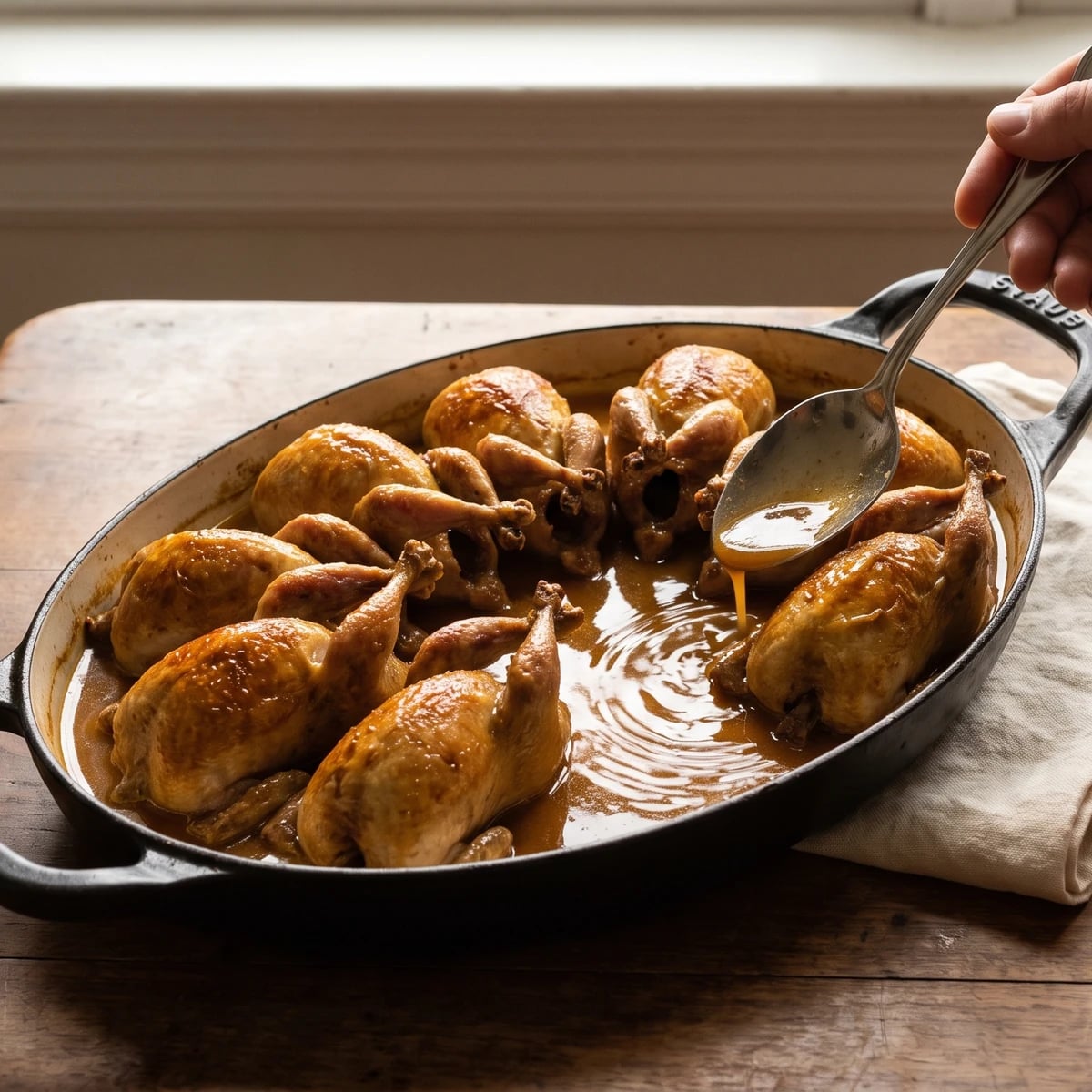
Eight bronzed quail, butter, a restrained splash of brandy, and game fumet under a tight lid. The casserole builds the sauce and carries it straight to the table.
Main Dishes
French
Quick Meal
Dinner Party
One Pot
20 min
Active Time
25 min cook•45 min total
Yield4 servings
Cailles en casserole, quail cooked and served in the same pot, teaches the discipline of stopping. Quail has no patience: once its skin is bronzed in butter, a short covered finish is enough. Push beyond that and the breast dries before the sauce has anything more to gain.
The original entry assumed a saucier on staff and game fumet, a concentrated game essence, always ready at the stove. A home kitchen needs one broad lidded casserole and ½ cup of prepared fumet, kept whole as the referenced component rather than rebuilt inside this recipe. This version scales the brigade pan to eight quail for four and translates a few drops of brandy into a measured two teaspoons. The separate sauce station is scaffolding and can go; butter, brandy, fumet, the lid, and service from the cooking vessel are the dish and must stay.
The birds reach the table deep butter-gold, with a light, glossy jus, the natural cooking juices, pooled around them and the clean perfume of brandy behind the game. Watch the covered cooking, not the clock alone: begin checking at eight minutes and stop as soon as the thickest thigh reaches 74°C / 165°F.
Cailles en casserole belongs to the French cuisine bourgeoise and the classical service of small game birds, rather than to one regional larder. En casserole describes both method and service: the birds cook with their short jus under a lid and come to the table in that same vessel, preserving their heat and every drop of flavour. The spare formula exposes the professional kitchen beneath its simplicity, because generations of cooks could call for a little game fumet only when a concentrated game essence was already at hand.
The technique, the tradition, and the story behind every dish.
•28 cm (11-inch) heavy lidded casserole or shallow braiser
•Kitchen twine
•Tongs
•Instant-read thermometer
Instructions
1
Prepare the quail
Take the quail from the cold twenty minutes before cooking. Remove any pinfeathers, pat every surface and cavity thoroughly dry, then season evenly with the salt. Fold the wing tips behind the shoulders and tie the legs together with short lengths of kitchen twine. This small trussing is practical, not ceremony: it keeps the extremities against the bird so they brown rather than scorch.
Quail skin must be dry before it meets the butter. Surface moisture traps the birds in their own liquid, giving you pale skin and a weak fond.
2
Brown in butter
Set a broad, heavy casserole over medium heat and add half the butter. When it foams and the foam begins to subside, brown four quail without crowding them, about two minutes on the breasts and one minute on each remaining side. Lift them out, add another tablespoon of butter, and brown the second batch. Aim for an even butter-gold surface, not dark mahogany, because the birds still have to cook under the lid. If the milk solids turn black, stop before the bitterness reaches the meat. Lift out the birds, wipe away the black specks, add the reserved butter, and continue over gentler heat. Ça se rattrape.
3
Swill with brandy
Return all eight quail to the casserole in one snug layer, breast side up. Pull the casserole off the heat, pour the brandy around the birds, and tilt and roll the vessel so the brandy washes across the fond and the base of the pan. That is the old instruction to swill. Return it to medium heat for twenty seconds, just until the sharp alcohol scent softens. Do not ignite it; the source asks for perfume, not flame.
4
Add fumet and cover
Pour in the prepared game fumet and scrape the base once with a wooden spoon to release the butter-browned fond. Bring the liquid just to a bare simmer, cover tightly, and lower the heat. Cook for eight minutes before checking. The liquid should murmur beneath the lid, never boil hard, because violent heat tightens the breast before the legs are ready.
5
Test and finish
Check the thickest part of a thigh without touching bone. Remove each quail as it reaches 74°C / 165°F, usually after eight to twelve minutes under the lid, and hold it on a warm plate while any slower birds finish. The jus should be glossy and lightly coat a spoon, not stand like gravy. If it remains watery when the birds are done, lift them all out and boil the jus uncovered for one or two minutes. Ça se rattrape. If it becomes too concentrated, loosen it with a tablespoon of hot water.
6
Serve from casserole
Return the quail to the casserole, breast side up, and spoon the glossy jus over them. Cover for thirty seconds, no longer, then carry the same vessel directly to the table and serve two birds per person while everything is very hot. Nothing else belongs in the pot. À table!
Chef Tips
•Choose plump quail of roughly equal size, about 6 oz (170 g) each, so they finish together. Frozen birds are perfectly honest here if they are thawed completely and dried with care.
•The game fumet is the foundation, not an incidental splash. It should taste concentrated and rounded before it enters the casserole; thin broth leaves this deliberately spare dish with nowhere to hide.
•Keep the brandy restrained and do not flambé it. Two teaspoons are enough to scent the fond without turning the jus into a brandy sauce.
•A supple red Burgundy or a mature Beaujolais suits the buttered game without overwhelming it. Give the jus something plain to land on at the table, such as pommes purée or good bread.
Advance Preparation
•Up to eight hours ahead, inspect, dry, and truss the quail, then refrigerate them uncovered. Bring them out twenty minutes before cooking and season them only then.
•The prepared game fumet can be measured and gently warmed thirty minutes ahead. Brown and cover-cook the quail only when the table is nearly ready, because reheating steals the tenderness this dish depends upon.
Frequently Asked Questions
Nutrition Information
1 serving (about 320g)
Calories
515 calories
Total Fat
37 g
Saturated Fat
14 g
Trans Fat
1 g
Unsaturated Fat
21 g
Cholesterol
195 mg
Sodium
1070 mg
Total Carbohydrates
1 g
Dietary Fiber
0 g
Sugars
0 g
Protein
44 g
Where cooking meets culture.
Culinary guides, cultural storytelling, and the editorial depth that makes cooking meaningful.