
Chef Juliette
John Dory (St. Pierre)
John Dory has the delicacy of sole and the firmness of turbot. A light flouring, a quick butter sauté, and nut-brown beurre noisette show exactly why looks never mattered.
A cooking platform built around craft, culture, and the stories behind what we eat.
Created by Chef Juliette
Based on No. 1878, Bécasse Souvaroff, from Le Guide Culinaire (1907) by Auguste Escoffier
Bécasse Souvaroff is woodcock at its most perfumed: Madeira-soaked truffles, foie gras held inside the birds, and a sealed terrine opened only when every guest is ready to breathe it in.
Bécasse Souvaroff (woodcock with truffles and foie gras sealed in a terrine) teaches one thing: perfume must be trapped before it can be shared. Truffles cook in Madeira and light meat glaze, foie gras sits inside each bird, and the final quarter hour happens under a tight lid. Open it early and you've thrown away the part no sauce can put back.
The entry takes its procedure from Faisan Souvaroff (No. 1845), then asks the cook to make due allowance for the smaller bird. The original assumed a saucier holding light meat glaze and game gravy, a stockpot never off the fire, and a terrine that could be pasted shut. Your equivalents are prepared, unsalted glaze and gravy, four individual birds, and a double foil gasket under a close-fitting lid. The separate stockpots were brigade scaffolding and may go. The truffles, stiffened foie gras, bacon wrapping, two-thirds poêler (to roast covered in butter and its own juices), and sealed finish are the dish, so every one stays. One cook, one stove, one evening.
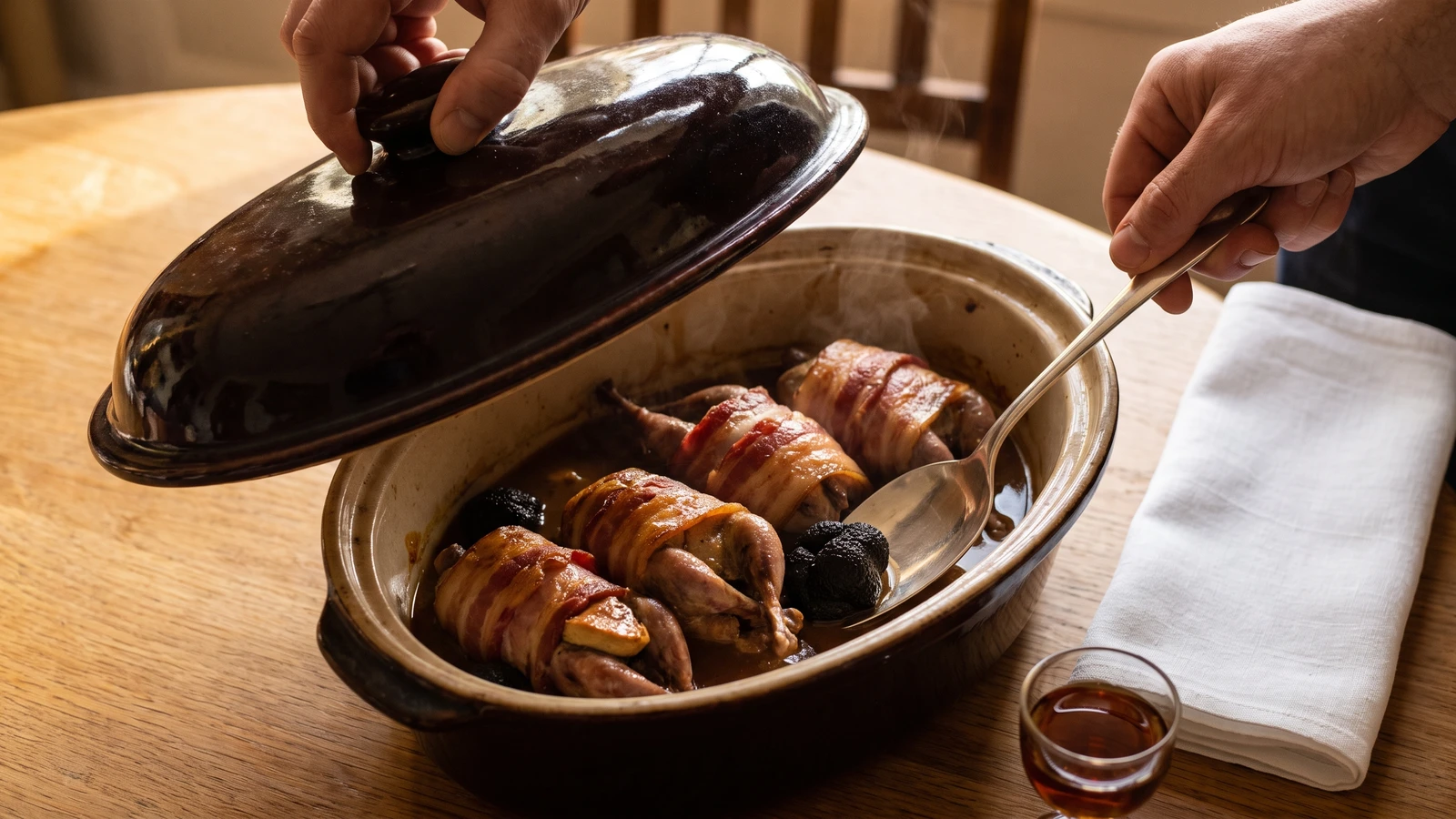
Bring the terrine to the table whole. Under the lid are four bacon-gilded birds, black truffles, and a Madeira-rich liquor whose gloss catches every bit of light. The step that matters most is the seal: press it tight, keep it closed for the full quarter hour, and open it only when everyone is at the table.
Bécasse Souvaroff belongs to Parisian grand cuisine rather than a Russian regional table; the Souvaroff name reflects the French custom of giving lavish truffle and foie gras preparations Russian honorifics. The formula travels through the canon by cross-reference, scaling the sealed-terrine method for pheasant to woodcock, whose smaller body takes the Madeira perfume more quickly. Unlike simpler French woodcock roasts that prize the bird's innards, this preparation draws the bird so foie gras can occupy the cavity, with whole truffles served beside it.
Quantity
4 birds, about 9 to 11 oz (255 to 310 g) each, proportions scaled from Faisan Souvaroff (No. 1845)
Quantity
4 medium truffles (about 3 oz / 85 g total)
brushed clean
Quantity
½ cup (120 ml / 120 g)
for cooking the truffles
Quantity
½ cup (120 ml / 135 g)
warmed
Quantity
4 oz (115 g)
cut into large ¾-inch (2 cm) dice
Quantity
12 thin slices (about 6 oz / 170 g)
Quantity
2 tablespoons (30 ml / 28 g)
Quantity
¼ cup (60 ml / 60 g)
for finishing
Quantity
¼ cup (60 ml / 65 g)
warmed
Quantity
½ teaspoon (2.5 ml / 3 g), plus only if needed
Quantity
½ teaspoon (2.5 ml / 1 g)
| Ingredient | Quantity |
|---|---|
| oven-ready woodcock | 4 birds, about 9 to 11 oz (255 to 310 g) each, proportions scaled from Faisan Souvaroff (No. 1845) |
| fresh black trufflesbrushed clean | 4 medium truffles (about 3 oz / 85 g total) |
| dry Madeirafor cooking the truffles | ½ cup (120 ml / 120 g) |
| light meat glazewarmed | ½ cup (120 ml / 135 g) |
| raw foie grascut into large ¾-inch (2 cm) dice | 4 oz (115 g) |
| unsmoked streaky bacon | 12 thin slices (about 6 oz / 170 g) |
| unsalted butter | 2 tablespoons (30 ml / 28 g) |
| dry Madeirafor finishing | ¼ cup (60 ml / 60 g) |
| rich unsalted game gravywarmed | ¼ cup (60 ml / 65 g) |
| fine sea salt | ½ teaspoon (2.5 ml / 3 g), plus only if needed |
| freshly ground black pepper | ½ teaspoon (2.5 ml / 1 g) |
Heat the oven to 400°F (200°C). Choose a lidded terrine or casserole that holds the four birds snugly in one layer. The source directs the cook through Faisan Souvaroff (No. 1845), with the proportions reduced for woodcock; four small birds replace the single pheasant while the sequence remains intact. Check each cavity for stray feathers or shot, pat the birds thoroughly dry, and season inside and out with the salt and pepper. Season lightly because the bacon, glaze, and gravy will all speak later.
Combine the ½ cup Madeira and light meat glaze in the smallest saucepan that will hold the truffles closely. Bring the liquid to a bare simmer, add the whole truffles, and cook for exactly 5 minutes, turning them once so every surface is lacquered. Lift the truffles into the terrine. The liquid should coat a spoon without becoming sticky; if it catches at the edge, pour it immediately into a clean pan without scraping the scorched spot and loosen it with a tablespoon of water. Ça se rattrape.
Lower the truffle liquor to the gentlest tremble and add the cold foie gras dice. Turn them carefully for 30 to 45 seconds, only until their surfaces firm and turn glossy; they must not cook through. Lift them out at once. If a cube begins to slump or shed a pool of fat, take the pan off the heat, remove every piece, and chill the remaining foie for 10 minutes before continuing in liquid brought back only to a tremble. The centre belongs inside the bird, not melted into the saucepan.
Divide the foie gras dice among the four cavities, handling them gently so they remain in large pieces. Truss each bird compactly with kitchen twine, then wrap each with three bacon slices, covering the breasts and thighs and securing the ends beneath the twine. The bacon is barding, a protective coat of fat for a bird that dries quickly; keep it close to the flesh rather than arranging it decoratively.
Melt the butter in a large ovenproof sauté pan over medium heat. Add the wrapped birds and turn them gently for 2 minutes, just until the bacon begins to gild. Set them breast-side up, cover the pan, and poêler in the oven for 8 to 10 minutes, basting once with the butter and bacon juices. Stop while the birds are only about two-thirds cooked. They will still feel yielding at the breast, which is correct; the sealed terrine must finish them without drying them.
Set the birds among the truffles in the terrine. Pour over every spoonful of the poêling liquor. Add the remaining ¼ cup Madeira and the game gravy to the hot sauté pan, scraping up the browned fond, then pour this over the birds along with the truffle cooking liquor. Cover the terrine opening with a double layer of heavy foil, pressing it firmly around the rim, and clamp on the lid. If the foil tears, replace it completely. A loose patch leaks the perfume, and the perfume is the dish.
Return the sealed terrine to the oven for 15 minutes. Do not lift the lid during that quarter hour. At the end, remove only the lid in the kitchen and pierce the foil over the largest bird with an instant-read thermometer; the centre of the foie-filled cavity must reach 165°F (74°C). If it falls short, press a small fresh foil patch over the puncture, replace the lid, and cook for another 3 to 5 minutes. Ça se rattrape, and dry woodcock does not.
Rest the terrine for 5 minutes with its seal intact, then carry it to the table as it stands. Lift the lid and peel back the foil only when everyone is seated. Give each guest one bird and one truffle, spooning the glossy Madeira and game liquor over both. No scattered herbs, no ornamental plate work. The late opening and the first rush of truffle, foie gras, and game are the finish. À table!
1 serving (about 280g)
Culinary guides, cultural storytelling, and the editorial depth that makes cooking meaningful.
Discover Culinary ExplorerChef Juliette
John Dory has the delicacy of sole and the firmness of turbot. A light flouring, a quick butter sauté, and nut-brown beurre noisette show exactly why looks never mattered.

Chef Juliette
Fresh haddock proves its delicacy in the meunière pan: a fine flour crust, moist pearly flakes, and beurre noisette sharpened with lemon and parsley, ready from one skillet in half an hour.

Chef Juliette
Éperlans à l’Anglaise turns small fish into a lesson in disciplined coating: boned smelts under a close, crisp crumb, pan-fried in clarified butter and finished with bright, half-melted maître d’hôtel butter.

Chef Juliette
Tiny smelts, shallot, mushrooms, white wine, gratin sauce, and fine bread raspings meet a fierce oven, where the fish must turn tender in the same breath the buttered crust bronzes.