
Chef Juliette
John Dory (St. Pierre)
John Dory has the delicacy of sole and the firmness of turbot. A light flouring, a quick butter sauté, and nut-brown beurre noisette show exactly why looks never mattered.
A cooking platform built around craft, culture, and the stories behind what we eat.
Created by Chef Juliette
Based on No. 1873, Perdreaux Froids, from Le Guide Culinaire (1907) by Auguste Escoffier
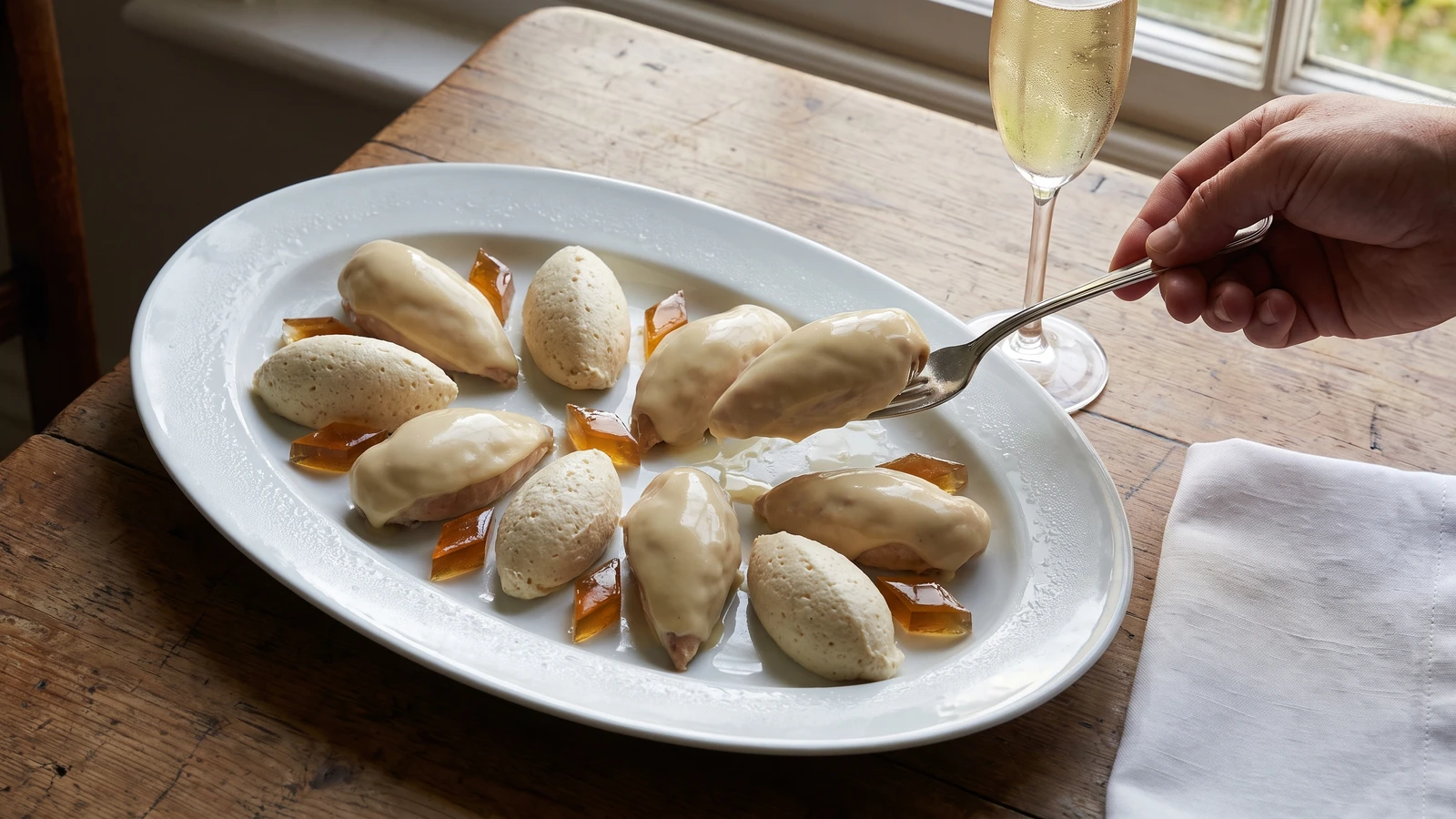
Partridge poached at a tremble, cooled in its liquor, masked with satin sauce chaud-froid, then glazed with aspic and served beside a light mousse: cold cookery built one patient layer at a time.
Perdreaux froids (cold partridges) teach the discipline of cold cookery: every layer must be properly cold before the next one touches it. The birds are poached at a tremble and cooled in their own liquor, the sauce chaud-froid is laid on only when it has the body of thick cream, and the aspic follows after that coat is firm. Rush those temperatures and the beautiful ivory mantle slides straight onto the tray.
The original entry sent the cook back to the cold pheasant formulas and assumed their whole brigade behind the words: a stock never off the fire, a saucier for the chaud-froid, and a garde-manger to clarify aspic and shape mousse. Here one poaching liquor supplies both sauce and jelly, powdered gelatin gives a dependable set, and the refrigerator does the waiting. Four birds become eight neat suprêmes plus enough leg meat for four small mousses. Egg-white clarification and elaborate decoration are brigade scaffolding, so they go; gentle poaching, cooling in the liquor, chaud-froid, aspic, and mousse are the dish, so they stay. The active work fits one cook, one stove, one evening.
Before you touch the pan, remember the one true thing: temperature decides everything. Keep the poaching liquor below a boil, dry the chilled suprêmes thoroughly, cool the chaud-froid until it coats rather than runs, and let each layer set firm before adding the next.
Perdreaux froids belong to the Parisian repertoire of pièces froides, where game was gently cooked, masked with sauce chaud-froid, and sealed under aspic for buffets and formal suppers. Partridge came from hunting tables across France, but the composed coating, molded mousse, and cut aspic traveled from grand kitchens into bourgeois dining rooms as a make-ahead showpiece. The name chaud-froid describes the method, prepared hot and served cold, not a sauce that should reach the table half warm.
Quantity
4, each about 12 to 14 ounces (340 to 400 g)
Quantity
6 cups (1.42 L / 1.42 kg)
Quantity
1 cup (240 ml / 240 g)
Quantity
1 (about 100 g)
sliced
Quantity
1 (about 120 g)
quartered
Quantity
1 (about 50 g)
sliced
Quantity
1
Quantity
1 teaspoon (5 ml / 3 g)
Quantity
2 teaspoons (10 ml / 12 g), plus more as needed
Quantity
2 tablespoons plus 1 teaspoon (35 ml / 21 g)
divided
Quantity
3 tablespoons (45 ml / 42 g)
Quantity
1/3 cup (80 ml / 42 g)
Quantity
1 1/2 cups (360 ml / 360 g)
well chilled and divided
Quantity
1 tablespoon (15 ml / 15 g)
divided
Quantity
1/2 teaspoon (2.5 ml / 1 g)
divided
| Ingredient | Quantity |
|---|---|
| oven-ready partridges | 4, each about 12 to 14 ounces (340 to 400 g) |
| unsalted light chicken stock | 6 cups (1.42 L / 1.42 kg) |
| dry white wine | 1 cup (240 ml / 240 g) |
| medium carrotsliced | 1 (about 100 g) |
| small yellow onionquartered | 1 (about 120 g) |
| celery stalksliced | 1 (about 50 g) |
| bouquet garni of parsley stems, thyme, and bay leaf | 1 |
| black peppercorns | 1 teaspoon (5 ml / 3 g) |
| fine sea salt | 2 teaspoons (10 ml / 12 g), plus more as needed |
| unflavored powdered gelatindivided | 2 tablespoons plus 1 teaspoon (35 ml / 21 g) |
| unsalted butter | 3 tablespoons (45 ml / 42 g) |
| all-purpose flour | 1/3 cup (80 ml / 42 g) |
| heavy creamwell chilled and divided | 1 1/2 cups (360 ml / 360 g) |
| fresh lemon juicedivided | 1 tablespoon (15 ml / 15 g) |
| ground white pepperdivided | 1/2 teaspoon (2.5 ml / 1 g) |
Combine the stock, wine, carrot, onion, celery, bouquet garni, peppercorns, and half the salt in a wide heavy pot. Bring the liquor to a bare simmer and hold it there for 15 minutes so the aromatics give up their flavor. Taste before adding the birds; it should be lightly seasoned because reduction will strengthen it later.
Lower the partridges breast-side down into the liquor and cover them with a cartouche (a round of baking paper) so the exposed surfaces stay moist. Hold the liquid between 180 and 190°F (82 and 88°C), with only an occasional tremble at the edge. Turn the birds after 12 minutes and begin checking at 25 minutes; they are ready when the thickest breast and thigh register 165°F (74°C), usually after 25 to 35 minutes. If the liquor breaks into a boil, pull the pot off the heat immediately, uncover it, and lower the flame before returning it. Caught quickly, ça se rattrape.
Lift the cooked birds into a shallow metal pan. Strain enough hot liquor over them to come halfway up their sides, then strain the remaining liquor into a second shallow pan. Set both pans in ice-water baths, turn the birds every few minutes, and stir the separate liquor until everything falls below 70°F (21°C) within one hour. Cover and refrigerate at 40°F (4°C) or colder until thoroughly chilled, at least 2 hours. This keeps the promise of cooling the birds in their own liquor without leaving a deep hot stockpot to cool slowly.
Lift the cold birds from the liquor and blot them dry. Remove the skin, then cut away the eight breasts as clean suprêmes (boneless breast pieces); cover and keep them cold. Strip all meat from the legs and wings for the mousse, aiming for about 1 1/2 cups (200 g), and discard the bones. Combine the cold liquors, remove every trace of set fat, then boil gently until reduced to 4 2/3 cups (1.1 L). Strain through a damp fine cloth. Taste a spoonful cooled over ice and correct the salt now, because cold dulls seasoning.
Measure 2 1/2 cups (600 ml) of the reduced liquor. Cool 1/2 cup (120 ml) over ice and sprinkle 2 tablespoons (30 ml / 14 g) of the gelatin evenly across it; leave it for 5 minutes to bloom. Heat the remaining 2 cups (480 ml) without boiling, whisk in the bloomed gelatin, and add 1 teaspoon (5 ml / 5 g) of the lemon juice. Pour 1 3/4 cups (420 ml) into a shallow tray. Spoon 1 tablespoon (15 ml) into each of four small ramekins and turn them to coat the interiors. Pour the remaining aspic into a small bowl for glazing, then chill all three preparations until firm, about 2 hours.
Measure the remaining 2 1/8 cups (500 ml) reduced liquor and cool 1/4 cup (60 ml) over ice. Sprinkle the remaining 2 1/4 teaspoons (11 ml / 7 g) gelatin over that cold portion and leave it to bloom. Melt the butter in a saucepan, stir in the flour, and cook this roux blanc (white roux) for 2 minutes without letting it color. Whisk in the remaining 1 7/8 cups (440 ml) liquor by degrees, then simmer gently for 10 minutes until smooth. Add 1 cup (240 ml / 240 g) cream and simmer until the sauce coats the back of a spoon. Remove it from the heat and whisk in the bloomed gelatin, the remaining lemon juice, and half the white pepper. Reserve 1/2 cup (120 ml) for the mousse, then stir the rest over ice until it has the consistency of thick cream. If it sets too firmly, warm the bowl over barely warm water; if it remains runny, return it to the ice. Do not pour it out. It can be brought back.
Process the reserved leg and wing meat with the 1/2 cup (120 ml) reserved sauce chaud-froid until very smooth, scraping the bowl often. Taste and adjust with salt and the remaining white pepper. Whip the remaining 1/2 cup (120 ml / 120 g) cream to soft peaks, then fold it into the game mixture in three additions. If the mousse puddles rather than mounds, set the bowl over ice for 5 minutes and fold once more. Divide it among the aspic-lined ramekins, smooth the tops, and chill until firm, at least 2 hours.
Set the thoroughly cold, dry suprêmes on a wire rack over a tray. Spoon a thin, even layer of sauce chaud-froid over each one, letting the excess fall away, then chill for 10 minutes. Apply a second layer and chill until firm. This coating is the step that decides the presentation. If it slides off, either the bird is damp or the sauce is too warm; scrape the drips back into the bowl, dry and rechill the suprêmes, thicken the sauce briefly over ice, and begin again.
Warm the reserved bowl of aspic over lukewarm water only until it becomes liquid, then cool it until faintly syrupy. Brush one thin coat over the firm sauce chaud-froid and chill the suprêmes again for 15 minutes. If the aspic begins to soften the ivory coating, stop at once and chill both components before continuing. Turn the mousses onto a chilled oval platter, loosening each ramekin with a towel dipped in warm water. Arrange two suprêmes around each mousse. Cut the tray of aspic into rough diamonds and nestle them between the portions.
Cover the platter without letting the covering touch the glazed surfaces and chill for at least 30 minutes, or hold it until the following day. Take it from the refrigerator 15 minutes before serving so the mousse softens slightly while the aspic remains firm. Serve each guest two suprêmes, one mousse, and a generous spoonful of cut aspic. À table!
1 serving (about 370g)
Culinary guides, cultural storytelling, and the editorial depth that makes cooking meaningful.
Discover Culinary ExplorerChef Juliette
John Dory has the delicacy of sole and the firmness of turbot. A light flouring, a quick butter sauté, and nut-brown beurre noisette show exactly why looks never mattered.

Chef Juliette
Fresh haddock proves its delicacy in the meunière pan: a fine flour crust, moist pearly flakes, and beurre noisette sharpened with lemon and parsley, ready from one skillet in half an hour.

Chef Juliette
Éperlans à l’Anglaise turns small fish into a lesson in disciplined coating: boned smelts under a close, crisp crumb, pan-fried in clarified butter and finished with bright, half-melted maître d’hôtel butter.

Chef Juliette
Tiny smelts, shallot, mushrooms, white wine, gratin sauce, and fine bread raspings meet a fierce oven, where the fish must turn tender in the same breath the buttered crust bronzes.